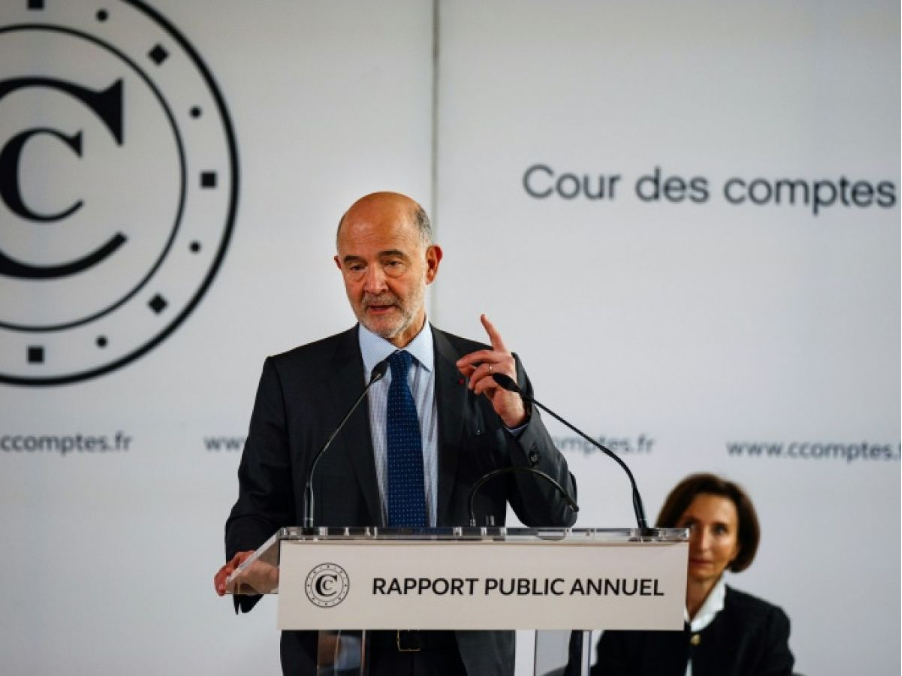
"Would the austere Court of Auditors be developing a taste for green?" Libération pretends to wonder this week. Indeed, the magistrates of the Rue Cambon are multiplying incursions into an area where they were not at the forefront and are doing so with force. After tackling the issue of mountains and ski resorts last month, the Court's annual report published a few days ago gives pride of place to France's adaptation to climate change. Some 700 pages covering railways, forests, coastal areas, housing, and cities, with solid, documented data. As Breaking (RE)NEWS knows your time is precious, here is the link to the summary – 100 pages still. Conclusion of the report: "Not adapting [to climate change], or adapting poorly, could ultimately prove much more costly" [than doing it].
So there is still a way to go. Especially since the report points to the difficulty, but also the necessity, of moving forward together, "simultaneously," towards mitigating warming and adapting to it, which we know is inevitable. In remarkable and noted timing, Christophe Béchu wrote an opinion piece in the same Libération presenting the outlines of what the national climate adaptation plan will be, which is based on an additional 4 degrees by the end of the century…
The magistrates are hard-hitting, especially when they highlight the many risks of "maladaptation." Typically, creating air conditioning to combat heat is understandable but is a bad idea, risking the creation of heat islands and consuming ever more energy. While awaiting more virtuous air conditioning systems (and there are leads on this subject), conversely, urban cooling networks, building insulation, or the use of reflective materials find favor with the Rue Cambon. Other symbols of maladaptation: pouring artificial snow (highly water-consuming) on black slopes (for example) of ski resorts, or adding sand (otherwise in short supply) to the beaches of our seaside resorts, are very bad ideas. Concerning housing, " no prospective study has been conducted on the overall cost of adapting housing to climate change, nor on the distribution of associated costs between the State, local authorities, businesses, and households ", regrets the Court. The overall costing of residential adaptation is currently neither possible, due to a lack of technical data, nor relevant, due to a lack of defined objectives." For the magistrates, "the issue of housing adaptation must be ranked among public priorities and bring about a comprehensive policy".
The report dwells in particular on forests (too many deer eating young shoots, we learn in a paragraph), electricity, rail transport (SNCF has a few commendations), state real estate (a "blind spot," no less, of adaptation policy), coastal areas (emergency solutions unfortunately favored over long-term visions, say the magistrates), housing…
To decide on priority spending, data is needed. Yet " the assessment of adaptation costs is patchy, even non-existent ", asserts the President of the Court of Auditors, Pierre Moscovici. This is why we do not propose a magic number, because we do not have the means to do so and the data is too scattered. […] Definitely harsh, Moscovici states that "adaptation must not necessarily involve new public spending." No doubt a reference to the recent budget cuts, particularly targeted at the environment, announced by Bruno Le Maire. And perhaps in anticipation of reactions to the other bombshell unveiled by the Court of Auditors in the same move, which points to the sharp drift in French public finances for over a five-year term.
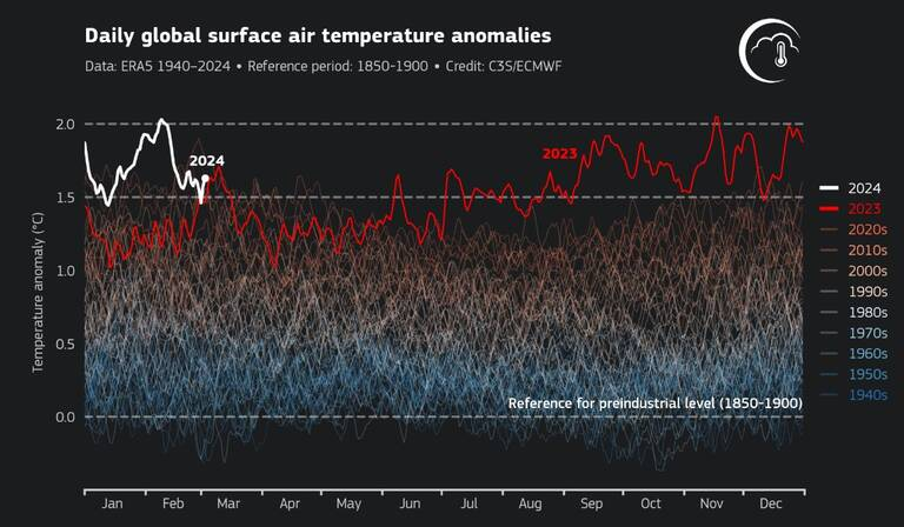
To begin our weekly sections, a classic, the number of the week : 9. This seems routine to us and is not good news. February 2024 was the warmest February ever recorded globally, according to the European Observatory Copernicus. Above all: it's the ninth consecutive month that the monthly record has been broken, France Bleureminds us. And month after month, we never tire of reusing these Copernicus graphs meticulously published by Libération, as they are so telling:
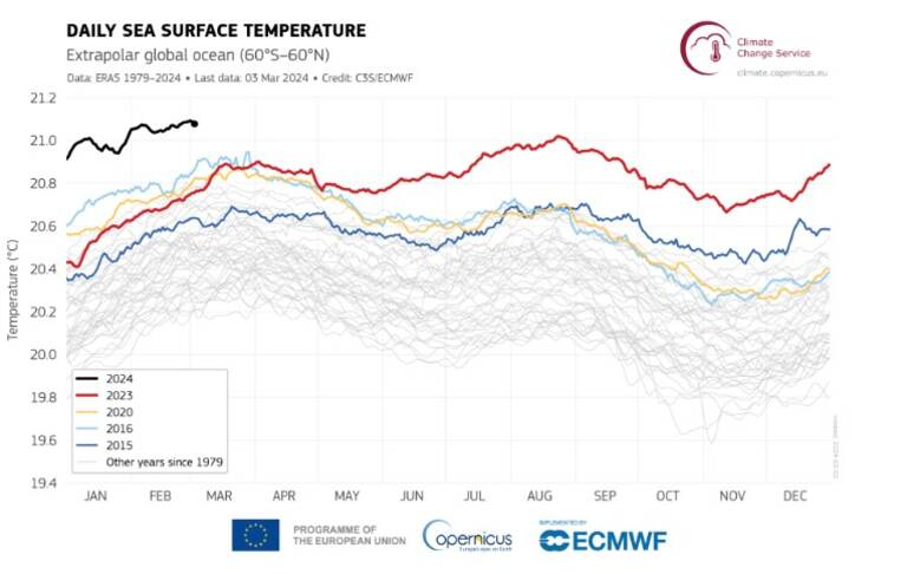
Perhaps even more impressive, the temperature of our oceans is also rising endlessly:
And for those – and there are many – who secretly think that the climate crisis will affect us less than others, due to Europe's geographical position, the European Environment Agency has just published a report in the form of a warning: "Europe is the fastest warming continent" and must act much more quickly to avoid situations described as "catastrophic." The study lists thirty-six major climate risks for Europe. Twenty-one of them, according to the Agency, require more immediate action.
Which leads us to look at the second number of the week (!), concerning global methane emissions in 2023: according to the International Energy Agency, they remained at a record level last year, perfectly incompatible with the objectives of fighting the climate crisis. Worse: 40% of methane emissions from the fossil industry could have been avoided in 2023, according to the IEA, quoted by La Tribune, because solutions exist and are affordable, foremost among which is simply repairing leaks. And given the value of the gas thus recovered, the net cost of these repairs would be… zero. " Methane is responsible for about 30% of the global temperature increase since the industrial revolution, and the energy sector is the second largest source of emissions from human activities", recalls Christophe McGlade, head of the IEA's energy supply unit, quoted by Le Monde.
Regarding climate, the "IPCC of the week" is a misnomer, as it concerns chemical pollution this time, but it's for better understanding. Facing the triple planetary crisis of climate change, biodiversity loss, and pollution, the latter is the forgotten one. While intergovernmental platforms exist for climate (IPCC, therefore) and for biodiversity (IPBES), the UN has been working since 2022 to create a similar expert panel on chemical pollution and waste. According to Novethic, this should see the light of day by the end of the year, but many problems persist, notably around conflicts of interest with the chemical industry…
And yet, the concept of the week is alas gradually imposing itself in public discourse, in our pre-electoral context: "greenblaming" is on the rise. It has become good form, as we have already mentioned in Breaking (RE)NEWS and will mention again, to disparage ecology and its concrete translation, the transition, which has become a scapegoat for all evils, or almost, often despite the evidence, especially scientific. A report takes stock of the subject. The experts' conclusion: more educational efforts are needed, and to ensure they are understood, the necessary efforts must be distributed as fairly as possible. Otherwise, at the risk of contributing to the " construction of an ecological scarecrow ". So don't hesitate any longer, suggest that your relatives subscribe to this press review; it's free.
Regarding the fair distribution of efforts, we are not necessarily on the right path if we look at the " dividends of the week ": those distributed in 2023 by CAC 40 companies, which once again broke their historical records. The main French groups made 153.6 billion euros in profits last year. Dividends, 67.8 billion euros, as well as share buybacks, 30.1 billion, reached unprecedented amounts, as can be read in Le Monde which takes the opportunity to quote a dangerous left-wing activist, denouncing " the cynicism of these groups that make such exceptional revenues that they end up using this money to buy back their own shares ". The sentence was from a year ago and was signed by Emmanuel Macron. For its part, Novethic quotes Oxfam, which once again notes that companies favor their shareholders over their employees. In ten years, between 2011 and 2021, wages only increased by 22%, while payments to shareholders increased by 57%. Worse, the NGO worries that French companies pay out too large a share of their earnings, dividends having represented 71% of their profits over this period. For some, dividends were paid even when they were in deficit, the study notably pointing to Engie. Yet the ecological transition should require them to increase their investments to decarbonize their business models, before "rewarding" their shareholders…
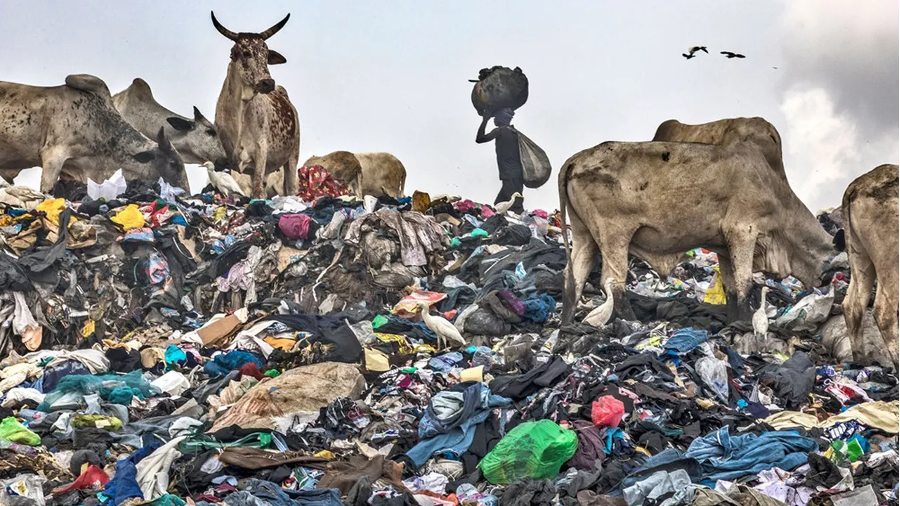
The bill of the week was overwhelmingly supported, which is not so frequent, in the National Assembly. Its name is explicit: "Moderate fast fashion with a bonus-malus system." It therefore tackles "fast fashion," and Antoine Vermorel-Marques, the (Republican) promoter of the text, wants to go further than the anti-waste law for a circular economy, passed in 2020. "A 20% penalty does nothing for a T-shirt bought for 4 euros", estimates the deputy. He wants to establish a penalty of 5 euros on all products stamped fast fashion. The goal is "to encourage producers to adopt more environmentally friendly practices, by reducing the renewal frequency of their collections or by adopting more sustainable production and distribution practices", he writes. He won the approval of his colleagues, as the deputies present unanimously adopted the text presented! The bill provides for mandatory environmental labeling, a bonus-malus system, and a ban on advertising for the brands concerned. But it leaves the heavy task of precisely defining, via decree, what fast fashion is to the government. According to Les Echos, the content of this decree will ultimately be decisive for the final impact of the text.
The dossier of the week is offered to us by L'Usine Nouvelle, which opportunely investigated the difficult transformation of French industry towards the circular economy, noting that there are now more "good intentions" than concrete achievements. Even if it is to note that the road is still long, the articles highlight the projects and progress made. Also notable: the quotes from the founders of (RE)SET, Géraldine Poivert ("the green transition has a soul, it's a real reindustrialization opportunity (…), if we don't start now, it will be too late!") and Frank Gana ("We must not forget to have durable textiles (…) durability also means the mechanical qualities of textiles!"). (RE)SET, at the heart of reindustrialization through the green transition.
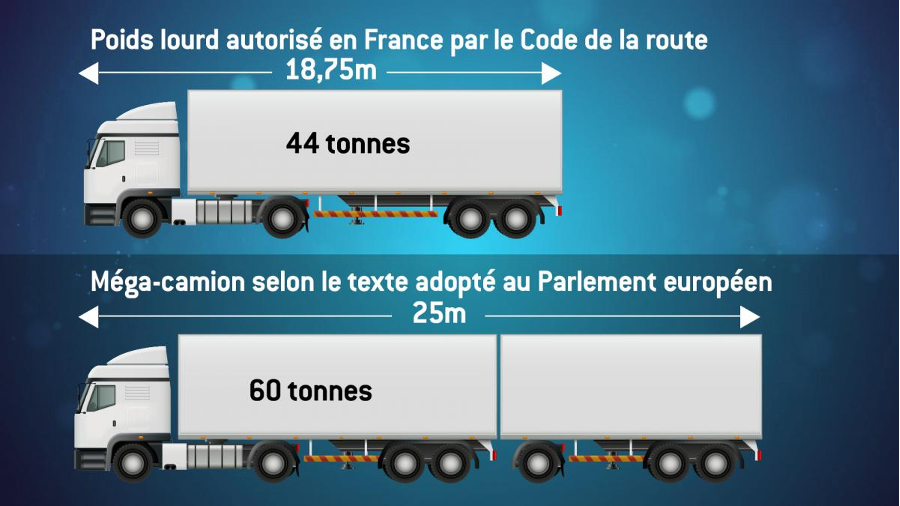
The truck of the week is coquettishly called "mega-truck." Much less popular than the fast fashion text, especially in France, the European directive on these famous mega-trucks was nevertheless approved by European deputies. As Le Monderecounts, MEPs voted on Tuesday, March 12, in favor of facilitating the circulation of "mega-trucks" measuring up to 25 meters in length within the European Union (EU), despite concerns about the environment and safety. Too bad for rail freight, the designated victim of this vote! This legislation will now have to be negotiated among member states, whose approval is essential for its application. These extended trucks, carrying a container plus a trailer, are banned in France, but are already authorized in some countries like Sweden and Finland and being tested in others like Germany. The text provides for the automatic authorization between consenting neighboring states, which already accept them on their territory, of the circulation of these giants measuring up to 25 meters and weighing up to 60 tonnes according to European standards. An "insane, anachronistic, and anti-ecological project," according to the editorialist of Libération, who stigmatizes these " monsters authorized to roam the highways of France and Navarre like 700-horsepower Mad Max vehicles crossing the Australian bush " and believes it is the kind of text " that risks making us hate Europe ". He may not be wrong.
The forum of the week was held in France on March 7 and 8 and was dedicated to how to build buildings – we dare not say "mega-buildings"! For this World Building and Climate Forum, 70 states, thirty ministers, industrialists, financial institutions, 1,800 participants in total, made the trip, Le Monderecounts. Among the states present were China and the United States, the largest emitters, Japan, Germany, but also Brazil, Egypt, Turkey, Côte d'Ivoire, Cameroon, and South Africa, directly concerned by urban spiraling. The thirty ministers (of construction, ecological transition, housing, depending on the title) committed to a common text, which reiterates the imperative to act, the need to adapt cities, and that all – the urban world, the building world, the financial world – move in the same direction and at the same pace: at a forced march. Christophe Béchu rejoices on LinkedIn: « The Chaillot Declaration, adopted today at the end of negotiations, is a victory and a major step forward for the building sector. It has been endorsed by 70 countries. It will allow the creation of an Intergovernmental Council for Building and Climate, whose mission will be to monitor everyone's commitments; we are also equipping ourselves with a monitoring and accountability mechanism. »
The opinion piece of the week attacks fertilizers from a new angle: that of sovereignty, in this case food sovereignty. Entitled "Food sovereignty, really?", the analysis is as clinical as it is convincing. The author, an economics professor at AgroParisTech, attacks the "FNSEA model," which emerged rather strengthened from the crisis of recent weeks, and which "ratifies geostrategic fragility." Indeed, he explains in Les Echos, our plant production today, with our intensive agriculture model, is only possible thanks to three fertilizers for which we are exclusively dependent on imports: Morocco and Algeria for phosphorus; Canada and Russia for potash; Russia and the United States for nitrogen and the gas it requires. No sovereignty is possible, therefore, when we are so dependent on imports alone. The author recalls that our food trade surpluses are actually shrinking like a wet paper bag if we include in the calculations the amount of our imports of fertilizers or the materials to produce them.
The report of the week is offered to us by the World Economic Forum with its annual survey on the perception of risks by companies, the "Global Risks Report," 2023/2024 edition. One illustration summarizes its content :
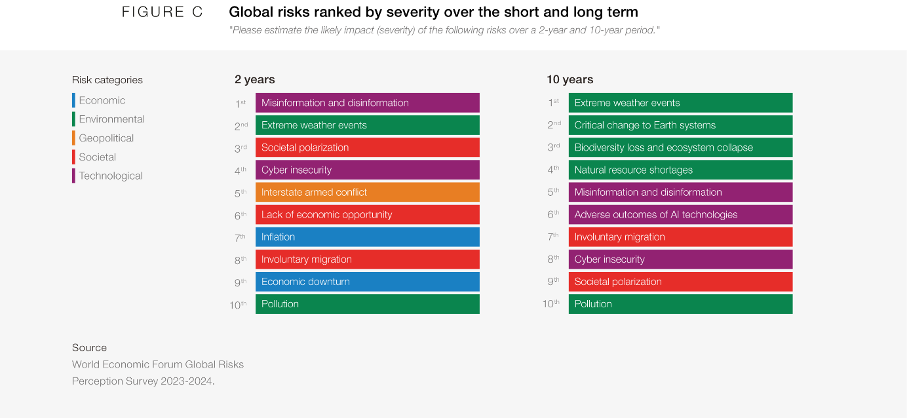
At least in their 10-year outlook, it seems that companies have now well understood what their real vulnerability points are. Given the lead times for adaptation, (RE)SET would undoubtedly explain that it's therefore time to roll up their sleeves right away.
The guide of the week was written by ADEME and is also aimed at companies. Following the announcements by Bruno Le Maire and Christophe Béchu regarding the main projects for corporate adaptation to climate change, ADEME, in partnership with the EpE association and the Ministry of Ecological Transition, has designed a small practical guide entitled "In business, how to engage in a climate change adaptation journey?" which is based on the testimonials of 30 French companies already engaged in this process. The guide presents the different steps to follow, from diagnosis to evaluation, illustrated by the actions and strategies of these 30 companies. Its ambition is to draw inspiration from what has already been done elsewhere, in companies of different sizes, sectors, and levels of maturity. A guide to put in all hands.
Still on ADEME, the poll of the week shows us what the French are ready, or much less ready, to do to accelerate the environmental transition. At least according to them. Cars and meat still have some beautiful days ahead of them.
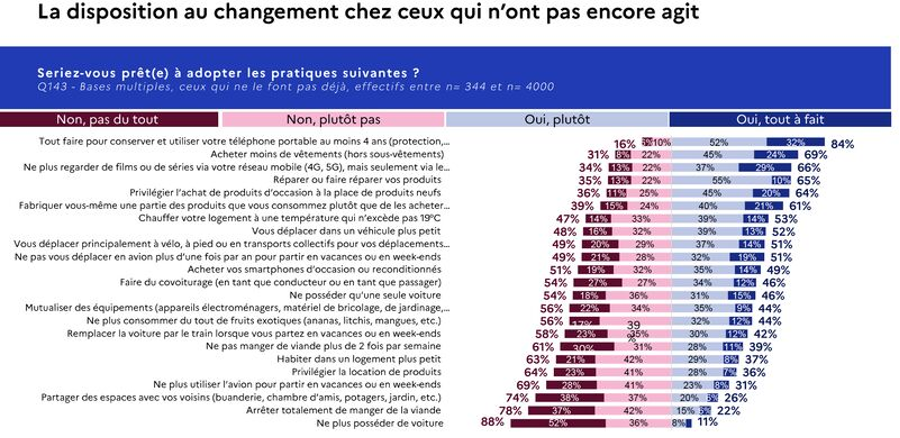
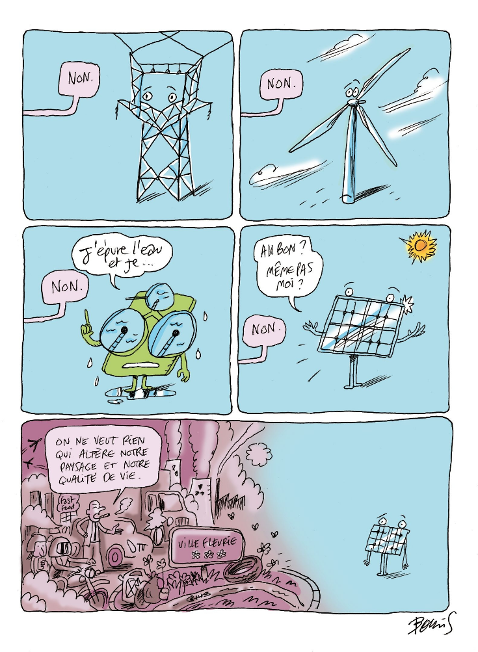
These fine resolutions could nevertheless be contradicted by the acronym of the week : "nimby"! Which, in proper French, means "not in my backyard". In other words: "yes, I am very much in favor of mining lithium in France to ensure the transition, as long as it's not next to the petunias in my backyard" (a very creative translation of "nimby"). The geographer Sébastien Bourdin, who observes the intensification of the phenomenon, explains it all in his interview with Libération.
The judicial development of the week is shaping up to be crucial for the future of the "duty of vigilance": the first hearings of the special chamber dedicated to corporate social responsibility and the duty of vigilance took place on Tuesday, March 5, 2024 at the Paris Court of Appeal. TotalEnergies, EDF, and Suez were sued by associations and local authorities for non-compliance with their obligations regarding human rights and environmental vigilance. About fifteen French companies are already targeted by procedures related to the duty of vigilance: Total, EDF, and Suez, but also BNP Paribas, McDonald's, Yves Rocher, and Casino are concerned. Seven years after its entry into force, the duty of vigilance could thus finally have a functional jurisprudence and open the way to the legal liability of multinationals. Answer on June 18, when the special chamber will render its decisions! June 18, a date that sometimes makes history.
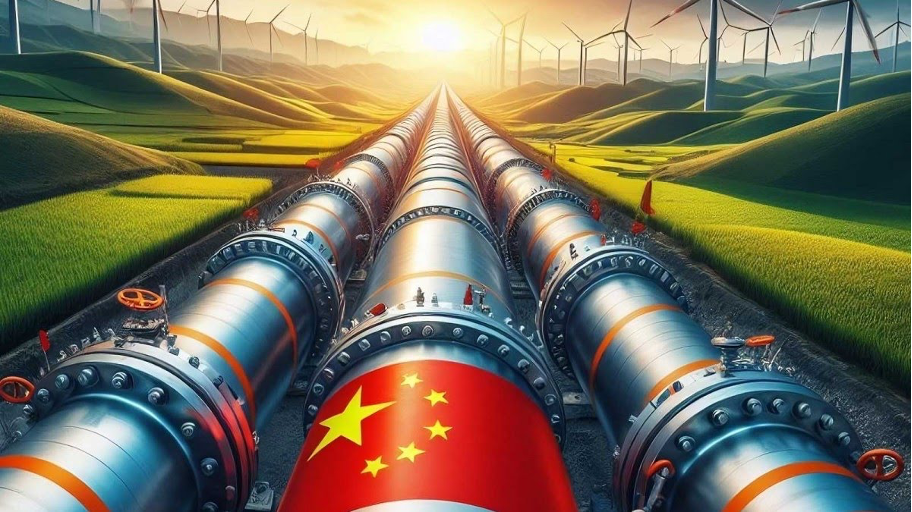
The hydrogen pipeline of the week is the longest on the planet: China will begin construction this year of the longest hydrogen pipeline (yes, that's what it's called) to date. Costing the pretty sum of 6.1 billion yuan ($845 million), this gigantic pipeline will facilitate the transport of hydrogen across the country. Named " Zhangjiakou Kangbao-Caofeidian", it will be 737 km long and will carry hydrogen produced at a plant in Zhangjiakou to the port of Caofeidian, about 250 km southeast of Beijing. It will pass through the municipalities of Chengde and Tangshan, located in Hebei.
The video of the week has a distant connection to our subjects, but after all, why not, it's the weekend. A new species of giant green anaconda has been discovered: Eunectes Akiyama. It is even now officially recognized as the largest snake in the world: 6.30 meters and 250 kilos! You wonder how it could have gone unnoticed until now. You can swim with it, as seen in this video. Or contemplate it from afar (that's the personal preference of the author of these lines), as in this photo:

Perhaps cuter and definitely more hexagonal, the little critter of the week is this charming amphibian. Unfortunately for it, it is on the " red list " of threatened species in France, according to the latest report drawn up on World Wildlife Day. After 16 years of assessments and analyses on fauna and flora, the established panorama makes it possible to measure the scale of the issues, the progress made, and the challenges to be met. Thanks to this Red List, we have a scientific basis for identifying priorities and taking action to protect them. Since its launch in 2008, the French Committee of the IUCN and the PatriNat unit (OFB-MNHN-CNRS-IRD) have identified: 17 367 species assessed in metropolitan France and overseas; 2 903 species are currently threatened; 189 species have disappeared from France, some of which are also globally extinct.

The riddle from last week took us up in height, distance, and age… What was it? The clue was that it was absolutely not an image taken from the second part of the film Dune. Indeed, this artist's view represents the brightest known object in the universe, recently discovered: the quasar J059-4351, the core of a "distant galaxy," as they say in Star Wars, powered by a supermassive black hole. "We have discovered the fastest-growing black hole known to date. It has a mass of 17 billion suns and 'eats' just over one sun per day", explained Christian Wolf, an astronomer at the Australian National University (ANU) and lead author of the study, in a press release from the European Southern Observatory (ESO). One sun per day… Enjoy your meal! (And congratulations to those who answered this not-easy riddle correctly).

The week's riddle has no more connection to the film Dune, despite appearances: what is it? Neither a giant worm nor spice if you dig.

[As a reminder, (RE)SET, founded in 2019, is the first independent consulting firm dedicated to economic and environmental transition and built for action. "(RE)SET: resources to win environmental and economic battles!" Inevitably partial, sometimes biased, always committed, this media review with its often spirited, even impertinent tone, in no way commits (RE)SET in its consulting activities, but it paints a picture we find interesting of the state of the transition as it appears in the press and research. A snapshot of the debate, of the forces at play, the oppositions, the convergences, which we hope is useful for your decisions and for building your transition strategies.]