
Reading time: 7 min
Last updated : 05/12/2025
When heatwaves become the norm...
2024, a record year: the hottest ever observed, +1.5°C compared to pre-industrial levels. And at this rate, +3°C by 2100 is no longer science fiction, but the global climate business plan1.
Heatwaves, droughts, wildfires, floods: the list is increasingly resembling the week's weather forecast. These phenomena are no longer anomalies, but the new routine. And for companies, the real question is no longer *if* they will be affected, but *when*, and with what intensity.
The costs, meanwhile, are no joke: 738 billion euros in climate-related damages in Europe since 19802. On a global scale, rising temperatures and nature loss could lead to an 18-23% decrease in global GDP by 20503. In short, climate change is crashing the P&L statements, uninvited.
This is where adaptationcomes in. Not a plan B, nor a CSR report exercise, but a strategic lever to ensure continuity, resilience, and competitiveness.
Targeted investments in climate and environmental resilience could generate at least four times more benefits than costs4. It's not a gamble, it's an equation: and it tilts in favor of action.
1 WMO, TRACC, 2025 / 2 EEA, 2024 / 3 NGFS 2025
4Grantham Research Institute preliminary analysis of 75 studies – The Macroeconomic Case for Adaptation Investment, 2025
UNDERSTANDING ADAPTATION: KEY CONCEPTS
The Climate change leads to a global rise in average temperatures, which results in more intense climate hazards such as droughts, heatwaves, storms, or floods5. These hazards directly impact economic activities (disruptions to supply chains, infrastructure damage, agricultural losses, rising insurance costs… etc). And because a hazard typically affects a multitude of actors and triggers ripple effects throughout the entire chain, the financial consequences can be devastating for entire sectors or regions.
The historic 2021 drought in Taiwan, for example, threatened the supply of microprocessors, a sector highly dependent on water, to the point that TSMC estimates such extreme events can reduce its revenue by 0.7 to 1.1%.6
The term "climate risks" was therefore defined by IPCC Working Group II as referring to the negative impacts of certain climate hazards on human activities and ecosystems. According to the IPCC AR5report, these risks are a combination of three factors: a "climate hazard" factor, an "exposure" factor, and a "vulnerability" factor to that hazard.
5IPCC, 2023 / 6Taipei Times, « TSMC touts water saving efforts and emission goals » (2021)
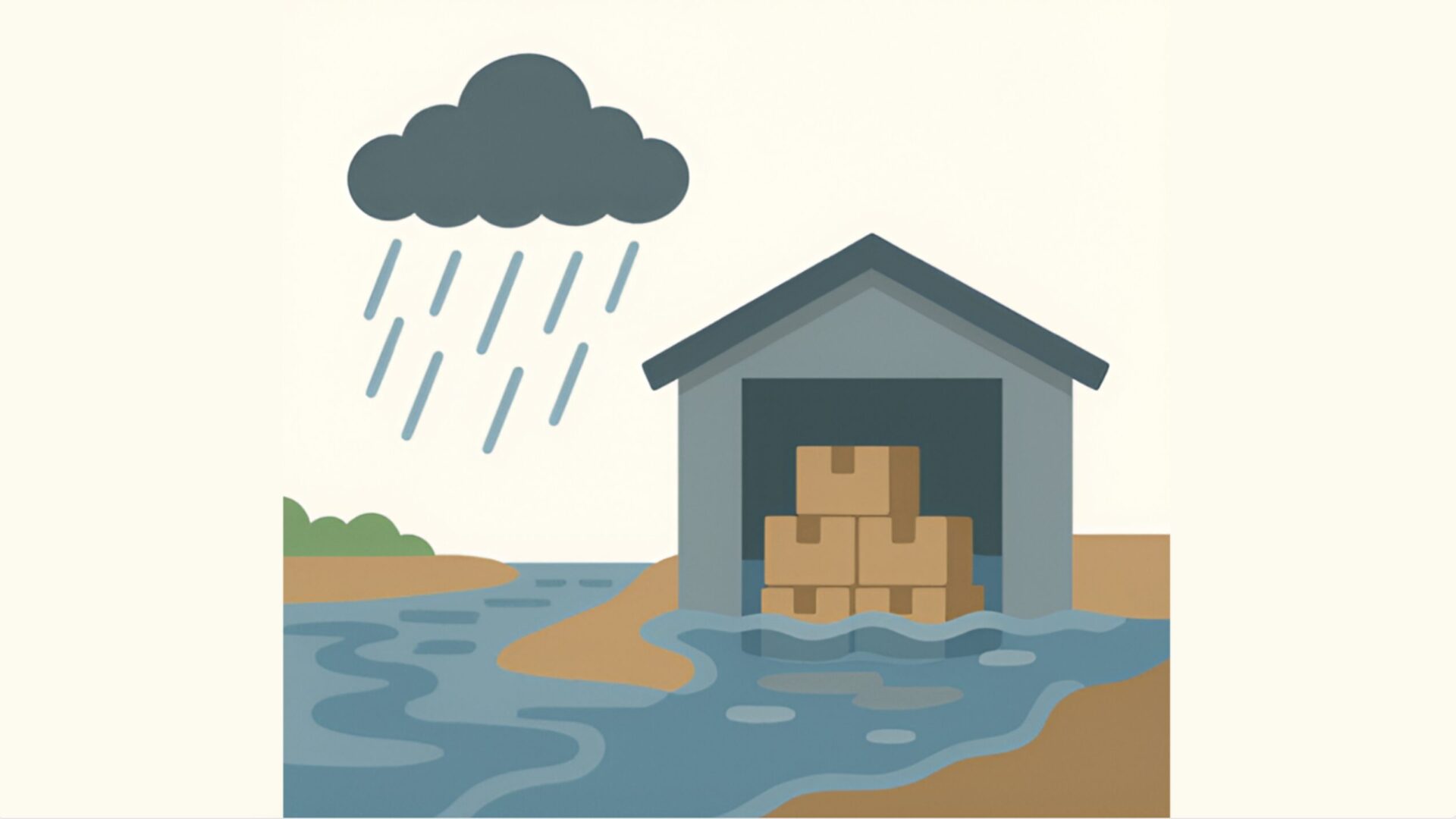
Ex: heavy rains causing significant flooding of a river
Ex: high-value goods from a company stored in a warehouse located along the river
Ex: the goods are stored in cardboard boxes directly on the floor (sensitive to river flooding) and cannot be quickly raised or moved to a safe site (inability for short-term adaptation)
Climate risk, a function of three key concepts
In this context,climate change adaptation, as defined by the IPCC (2022), is "the process of adjustment to actual or expected climate and its effects. In human systems, adaptation seeks to moderate or avoid harm or exploit beneficial opportunities. In natural systems, human intervention may facilitate adjustment to expected climate and its effects." In other words, it's about transforming our organizations so they continue to function and thrive despite climate disruptions.
Simultaneously, mitigation efforts – that is, the reduction of greenhouse gas emissions (through carbon footprint assessments and setting emission reduction pathways) – already undertaken by many economic actors are essential to limit the temperature rise and thus the frequency and intensity of climate hazards. However, they do not protect companies from impacts already underway, which are irreversible.
Adaptation and mitigation therefore form the two complementary pillars of the climate response: one aiming to prepare and protect, the other to limit the worsening of risks.
CLIMATE ADAPTATION IN BUSINESS: AN ITERATIVE PROCESS THAT EVOLVES OVER TIME
Adapting to climate change is not a checkbox for reporting. It is a continuous movement, much like an innovation or digital transformation initiative: it requires testing, learning, correcting, and moving forward. Climate conditions evolve, science advances, customer and investor expectations change: therefore, your adaptation strategy must remain alive and evolving.
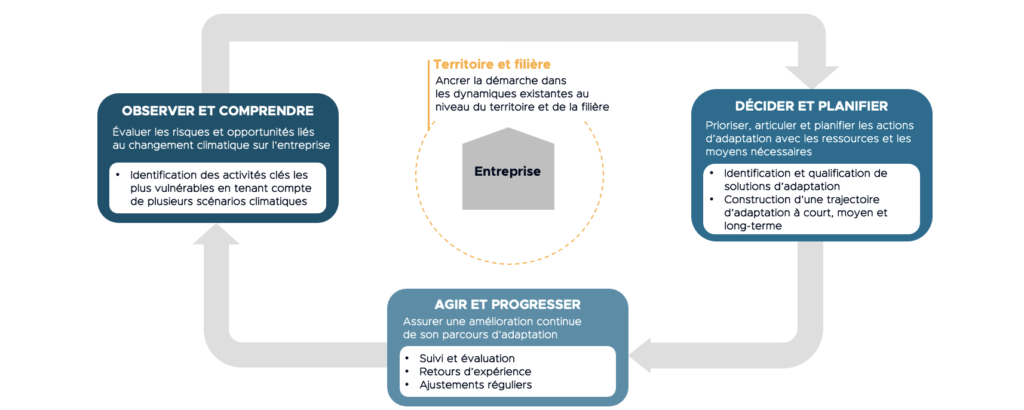
Concretely, climate adaptation in business revolves around three complementary dynamics:
Observe and Understand: this begins with a climate vulnerability assessment. What are your most critical assets, sites, and activities for your company? Which are most vulnerable to climate hazards? What do climate scenarios predict for your geographic locations? This step transforms uncertainty into knowledge.
Decide and Plan: based on this diagnosis, the company defines its adaptation strategy. This is the time to identify priorities, develop an action plan and chart a realistic adaptation pathway : from securing infrastructure to diversifying supply sources, including adapting working hours. Companies then have several adaptation options, both technical and organizational. The challenge lies in evaluating their effectiveness and identifying potential negative externalities, to avoid the trap of maladaptation, which involves implementing measures that could prove counterproductive or insufficient for the challenges at hand.
Act and Progress : adaptation is never static. The actions implemented must be monitored, evaluated, and adjusted regularly. Every experience gained enriches collective resilience and helps strengthen the framework over time.
And because the effects of climate change are interdependent and systemic, it is crucial toaddress these risks collectively, by mobilizing sectors and networks of actors, in order to anticipate indirect repercussions and strengthen the resilience of the entire economic system.
Adaptation as a continuous improvement process7
7Illustration inspired by the adaptation pathway defined by ADEME in the report «In business, how to engage in a climate change adaptation journey» (2024)
To turn awareness into action, Climate Change Adaptation Workshops (ADACC) are an essential starting point. They help structure the adaptation approach by bringing teams together around a common language, a clear method, and concrete examples. In short, a collective framework for moving from theory to practice; effectively and without waiting for the next temperature record.
THE (RE)SET VISION: RELEVANT AND COLLECTIVE ADAPTATION
At (RE)SET, we know that climate change adaptation is neither simple nor instant. But it is now essential to preserve the competitiveness and sustainability of companies. Adapting means strengthening the resilience of organizations against climate shocks, securing their value chains, and maintaining their performance in an economically pressured context.
Our approach is based on three pillars:
Breaking Down Internal Silos: Climate change adaptation requires cross-functional mobilization. It cannot be confined to CSR or environmental departments. Every function: strategy, finance, operations, procurement, HR, innovation, ... holds part of the solution. Breaking down silos means establishing shared governance, aligning goals, and integrating climate considerations into daily decisions.
Working Across Entire Value Chains : the collective approach! Acting at the scale of your value chains (companies, partners, territories, sectors) to anticipate systemic risks, strengthen collective resilience, and secure business continuity. Shared adaptation strategies allow for cost-sharing, increased efficiency, and maximized impact.
Leverage Recognized Methodologies: OCARA (Carbone 4) and ACT Adaptation (Ademe), while aligning with key reporting frameworks: TCFD, CDP, CSRD… to structure the initiatives, ensure their coherence, and strengthen the credibility of the results achieved.
CONCLUSION: ADAPTING TO TRANSFORM BETTER
To adapt is not to resign oneself. It is to acknowledge that the world is changing and that inaction now costs more than action.
Climate change adaptation is not merely a defense mechanism: it is an opportunity to rethink priorities, invest in resilience, and strengthen cooperation among economic actors. In other words, an opportunity for strategic transformation.
The climate, however, will not wait for us. So the real question is: which adaptation pathway will you choose?
At (RE)SET, we help companies move from awareness to action; concretely, collectively, and without waiting for the next temperature record.