
The R3PACK consortium, composed of more than 25 partners from all areas of the agri-food value chain and coordinated by (RE)SET (a consulting firm dedicated to the environmental and economic transition), is taking on the challenge of reusable packaging. Together, they launched "Return for Reuse" to promote the reuse of food packaging and make deposit a truly daily eco-gesture. A first experiment was launched on June 7 in three Cooperative U stores in the north of France.
This experiment is part of the national single-use plastic reduction plan. With the implementation of the anti-waste law for a circular economy (AGEC), France is the first country in the European Union to equip itself with a target of phasing out single-use packaging by 2040.
"RETURN FOR REUSE" KEY FIGURES AND INFORMATION
A Horizon Europe project, supported by the European Commission and Citeo
+ 25 partners to date, including 2 major retailers
3 pilot stores in phase 1 (June 2024), 30 in phase 2 (starting September 2024)
15 product families involved
Standardized packaging for certain product categories
AN INITIATIVE TO DEVELOP REUSE IN MASS RETAIL WITH A SIMPLE APPROACH FOR CONSUMERS
Around Cooperative U and Carrefour for distribution, manufacturers Altho-Brets, Biscuits Bouvard, ECLOR Boissons, Eurial, Europe Snacks, Florette, Laiteries H. Triballat Rians, Lesieur, Les Crudettes, LSDH, Monin, Schreiber, Sodebo are joining forces to address a major societal issue: reducing the environmental impact of food product packaging. Aware of the environmental urgency and consumer expectations, they are encouraging the use of reusable packaging that will withstand multiple usage cycles.
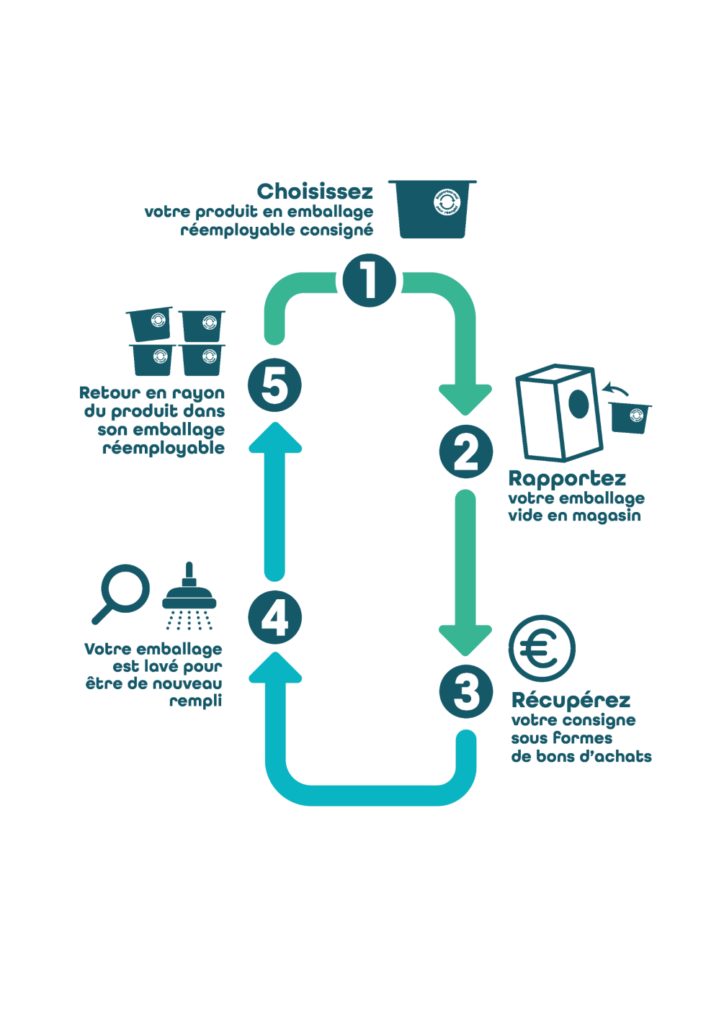
The objective is to offer consumers a wide range of everyday food products in packaging that they can easily return, to any store affiliated with the project, for reuse. Containers deposited in the collection points will be collected and then washed. Once all quality and food safety tests have been validated, the containers will be refilled by the manufacturers and then returned to the shelves.
CONCRETELY, HOW DOES IT WORK?
To find the list of stores and products concerned:
"RETURN FOR REUSE": LAUNCHES IN THE NORTH
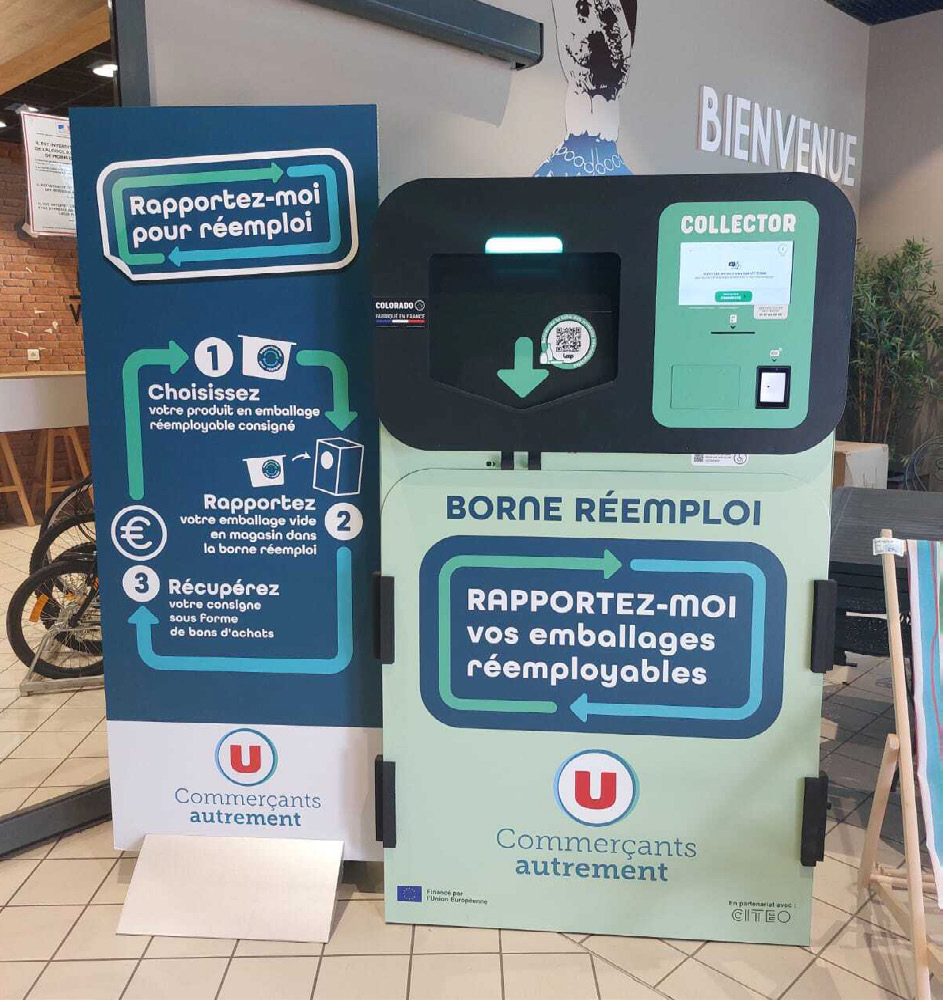
This ambitious project, supported by the European Commission and Citeo, started on June 7 with an experiment in three Cooperative U stores in northern France (Lille-La Madeleine, Merville, Grand-Fort-Philippe). The goal is to offer customers a wide assortment of everyday food products whose packaging meets reuse conditions. Collection points, already successfully tested by Carrefour in its Montesson hypermarket, have been installed, allowing customers to return the packaging after consumption. Very easy to use, they issue a store credit for the amount of the deposit or a bank card refund to anyone who comes to drop off their packaging.
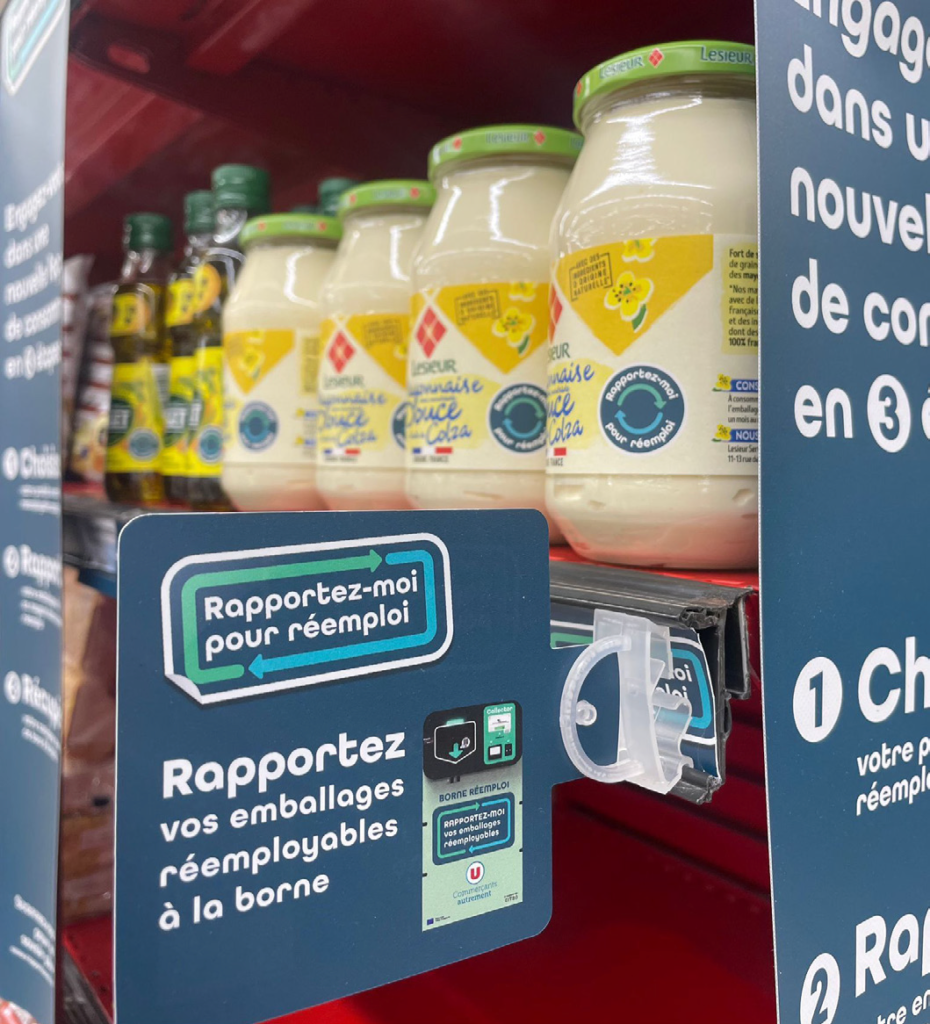
At launch, 8 products are available.
From September 2024, for the second phase of deployment, 12 additional Cooperative U stores and 15 Carrefour stores will offer this service, with an expanded range of products in reusable packaging from numerous sections: fresh food, dairy, sweet and savory groceries, beverages.
The packaging will be glass or plastic, a major innovation within the reuse ecosystem. The objective of this experiment is to expand learning on the attractiveness of reuse for a wide range of products and to measure key performance indicators of reuse (return rate, washing efficiency, packaging rotation, logistics, …).
A COLLECTIVE COMMITTED TO A CIRCULAR ECONOMY APPROACH
The circular economy is a major challenge for the agri-food industry, from production to distribution. Actors must rethink their methods, their operations, but also support changes in consumer behavior. This collective commitment allows the integration of more products, the development of common packaging, and the provision of drop-off for many different packaging types in varied, interoperable locations. Packaging standardization and pooling of flows will allow the rapid scaling up of processed volumes and the achievement of economies of scale.

"The environmental and economic transition is not an option because our resources are limited, our energy is too carbon-intensive, and our pollution is exponential. Less than 7% of our economy is circular, and within a few decades we will have consumed more rare earths than since the dawn of humanity. However, while the observation is unequivocal, transforming is a complex challenge that requires coopetition among players in the same value chain, refounding industrial production models, and rethinking customer experiences and marketing while reconciling the end of the world with the end of the month! Changing packaging is anything but simple! Hats off to the 20 actors doing it live, with energy, and for real! We hope that many consumers will support these new containers by continuing to help us improve the system! The difference between saying and doing is doing!" declares Géraldine Poivert, President and Co-founder of (RE)SET.