
No, we will not talk to you this week about the 28th UN Climate Change Conference of the Parties (COP 28), except to remind you that it will take place from November 30 to December 12 in Dubai and is causing a lot of ink to flow, without necessarily teaching us much! The opportunity to mention, however, that October 2023 was the hottest ever recorded in the world. But life is not only about energy and decarbonization; there are also, and even above all, resources, and particularly one of them that has been much discussed this week in France: water.
In a fascinating investigation, Le Monde discusses France's water resources, described as a "pandemonium." For eighteen months, the search for pollutants previously ignored by monitoring plans – particularly pesticide degradation products (or "metabolites") and per- and polyfluoroalkyl substances (PFAS) – has rendered the water supplied to millions of French people non-compliant with quality criteria. According to the most up-to-date figures from the Ministry of Health and Prevention, more than 11.5 million people received water that was occasionally or regularly non-compliant in 2021. This estimate is expected to be revised upward for 2022 and 2023, with the inclusion of new substances in monitoring plans. On September 22, the directors of the Regional Health Agencies (ARS) were invited to a seminar on the subject at the Ministry of Health, Le Monde reports. Nothing leaked from it, except an email sent the following day by Didier Jaffre, the director of ARS Occitanie, to his managers, in which a certain feverishness is evident. "Quite clearly, we will have to change our approach and our discourse; PFAS and [pesticide] metabolites are everywhere," he wrote in this message revealed on October 18 by Le Canard Enchaîné. "And the more we look for them, the more we will find." Mr. Jaffre went further, casting doubt on the sanitary safety of the water supplied to users…
Within two years, the European Union will require member states to systematically search for these substances in drinking water. "The search for PFAS becomes mandatory as part of the sanitary control of the ARS from January 2026, in connection with the analytical capacities of the laboratories performing sanitary control analyses," indicates the Directorate General of Health. An evolution that promises to make the situation even more delicate. Indeed, it will be necessary "to change our approach and our discourse," concludes Le Monde.
Especially sincea new study published on Thursday revealed that about 12% of the active substances in synthetic pesticides authorized in the European Union (EU) – or 37 molecules out of 306 – belong to the PFAS family. A report from the association Générations Futures and the Pesticide Action Network Europe (PAN Europe) uses official figures to assert that the quantities of these "PFAS pesticides" sold in France have seen a "spectacular" increase over the past decade. They rose from some 700 tonnes in 2008 to more than 2,300 tonnes in 2021. As a character drawn by Aurel, also in Le Monde, says: "we're going local!" (with irony).

Enough to fuel debates on the possible future EPR on wastewater, which we at (RE)SET did not fail to do, with a webinar you may have attended, dedicated to the challenge of pollutants in urban wastewater:
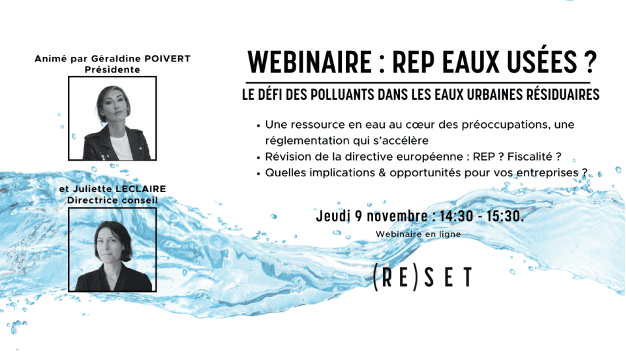
We take this opportunity to remind you that to continue the discussions and kick off a collective dynamic, (RE)SET invites you to one-hour sectoral meetings (remote): Thursday, November 30 at 10 a.m. for the cosmetics sector; Thursday, November 30 at 2 p.m. for the hygiene sector; Friday, December 1 at 10 a.m. for the pharmaceutical sector. To register, it's here! (Editor's note: there, end of the "corporate advertising" sequence 😊).
To proceed gently towards our weekly sections, and staying in (cold) water, theCall of the week is called "Paris" and resonates with the Agreements of the same name. Emmanuel Macron launched a "Paris Call for Poles and Glaciers" on Friday, at the conclusion of a summit on the issue organized in the French capital. The head of state notably announced the construction of a French ship, the "Michel Rocard," as part of a polar research effort in which France will invest one billion euros "by 2030." A reminder for the younger ones: Michel Rocard, former Prime Minister under François Mitterrand, was France's first ambassador for the poles. In his introduction, the head of state described the degradation of glaciers as " a very present and accelerating threat a threat already very present and accelerating": "When we talk about the issue of our cryosphere, we are talking about a transformation that is underway, which already threatens millions and will threaten billions of inhabitants on the planet." By 2100, "more than half of the world's 200,000 glaciers will have disappeared, with an impact on at least one billion inhabitants deprived of water resources," he recalled.

The Summit of the week, which begins today, is taking place in Nairobi and is dedicated to the continuation of negotiations on the development of a future international treaty against plastic pollution. The Minister of Ecology, Christophe Béchu, recently detailed France's priorities, which has developed a "zero draft": "Our line is reduction and overall that's the roadmap we will follow. Introducing recycling too early is a potential brake on the reduction target, especially for virgin plastic," said Mr. Béchu. The road to the treaty is still long, as many countries, including Saudi Arabia and several Gulf countries, as well as Russia, China, India, and Brazil, remain vehemently opposed to any binding target…
Theoffensive of the week against pro-climate initiatives comes from the United States, rather in the South and rather from the side of Republicans who admire Donald Trump. Decidedly, it's not simple anywhere to carry out the economic and environmental transition! The House Judiciary Committee issued subpoenas to two important organizations: the Glasgow Financial Alliance for Net Zero (GFANZ) and As You Sow. The reason invoked, Les Echos recall, is that the two organizations are suspected by US Congress members of "potentially violating" antitrust law by encouraging corporate collusion to achieve carbon neutrality… To use the words of Géraldine Poivert, President of (RE)SET, France could be exemplary in this area, despite the numerous remaining reluctances to collective action for fear of the judge, of legal breach… At (RE)SET, a promoter of collective solutions with its consortia skillfully run for four years, we enjoy making competitors work together, for example in the cosmetics, textile, and other sectors. It is our pride and above all the only way to move forward. But it requires legal work and an implementation that leaves no room for approximations!
The pollution of the week is invisible and, frankly, not well understood. It concerns our microbiota. Our what? Our microbiota, yes, that is, our "microbial ecosystem with which we have a close symbiotic relationship." Not yet truly analyzed in humans, it is already known that pollutants disrupt the microbiota of many living organisms, particularly aquatic ones. We are only at the beginning of our discoveries.
The unexpected co-product valorization of the week should make the Gallic rooster proud. Because yes, it's about chicken feathers! Scientists from the Swiss Federal Institute of Technology Zurich and Nanyang Technological University in Singapore have made a fuel cell membrane from chicken feathers. This offers a second life to this waste from the poultry industry, which, when incinerated, releases harmful gases, to produce green electricity. Especially since, lacking chicken feathers, it is mostly PFAS (forever chemicals) that are currently used to produce fuel cell membranes. One co-product, three benefits! When we were telling you about the necessary valorization of co-products…

The little-talked-about resource of the week should make us think, as it concerns phosphorus. Let's phosphorize a bit, with Socialter, on this element essential to all life but capable of causing disastrous consequences for ecosystems. It contributed to the rise of post-war industrial agriculture by being massively used in synthetic fertilizers. While global demand for phosphate rock has never been stronger, concerns about the more or less sustainable nature of this resource lead us to reconsider our uses of it. From animals to the smallest DNA molecule, including enzymes and cell bacteria walls, phosphorus is everywhere in nature, but only in an oxidized form (phosphate). Farmers enrich their soil with phosphorus using fertilizers that may also contain nitrogen (N) and potassium (K), other essential nutrients. Too much, in fact, because phosphorus can pollute groundwater and cause green algae blooms. Today, becoming less dependent on the extraction of phosphate rock is crucial for regions without mines, such as France and other European Union (EU) members. In 2014, the EU thus placed phosphate rock as a critical raw material for its supply. The priority is to reduce the amount of phosphorus consumed. The other challenge is a more virtuous phosphorus cycle, making several loops rather than a single straight line ending at the bottom of the oceans. The main lever to achieve this is increased recycling of animal or human excretions. This valorization of our "manure gold" would be an echo of Victor Hugo, who already wrote in Les Misérables: "You are masters at losing this wealth, and at finding me ridiculous into the bargain. This will be the masterpiece of your ignorance."

The judicial decision of the week brings us back to PFAS, eternal pollutant and eternal object of lawsuits, as it is still another episode in the legal battles that began in 1999 against the chemist DuPont. GenX, a per- and polyfluoroalkyl substance (PFAS) marketed by Chemours (a company spun off from DuPont) and used in the manufacture of many non-stick products, will remain on the blacklist of "Substances of Very High Concern" (SVHC) established by the European Chemicals Agency (ECHA). In a judgment delivered on Thursday, November 9, the Court of Justice of the European Union (CJEU) rejected the request for annulment filed by Chemours's Dutch subsidiary, the importer and supplier of GenX in the European Union. This decision, as eagerly awaited as it was dreaded by all PFAS manufacturers, would enable a future ban! As a reminder, GenX was developed by DuPont in 2009 to replace PFOA, which served as a processing aid in the manufacture of Teflon (non-stick coating found notably on cookware) for decades. Banned in the EU since April 2020, PFOA is at the heart of the film Dark Waters. Targeted in the US by thousands of lawsuits, which have already cost it more than a billion dollars, DuPont spun off its PFAS-related industrial activities in 2015 to concentrate them within the firm Chemours… In short, if you still haven't done so despite Breaking (RE)NEWS's numerous recommendations, watch the film Dark Waters – that's an order 😉!

The unexpected act of generosity of the week comes from TotalEnergies and concerns only its own employees: our national fossil fuel champion commits to paying a gross envelope of 2,000 euros to each of its 35,000 French employees to allow reimbursement of personal expenses related to ecological mobility. Among the eligible mobility expenses are electric and hybrid cars, electric bicycles, cars with a Crit'Air 1 sticker, the installation of charging points for electric and hybrid cars, or the purchase of a conversion kit for a biofuel. "With this agreement, which is one of the first of this scale in France, we wish to contribute positively to the country's decarbonization goals," seriously justified Patrick Pouyanné, CEO of TotalEnergies.
The label of the week is ISR, for Socially Responsible Investment (SRI). Highly criticized for years, it has just been revamped by the Ministry of Economy and Finance. Created in 2016, the SRI label was the first state label allowing the general public to choose savings vehicles that integrate environmental, social, and governance principles into their management. With the Pacte law, SRI-labeled funds are systematically referenced in life insurance unit-linked accounts and retirement savings plans. Thus, today, 1,174 funds are SRI-labeled, for a total assets under management of €773 billion. The criteria had not been revised since 2016. Bruno Le Maire has just announced in this press release a new, more ambitious version of the SRI label, making climate impact a key principle of the label. Thus, fund eligibility will exclude companies that exploit coal or unconventional hydrocarbons, as well as those launching new hydrocarbon (oil or gas) exploration, exploitation, or refining projects. In addition, a transition plan aligned with the Paris Agreement will be required. This reform surprised observers who had rather anticipated a government retreat on this sensitive subject which was the object of intense lobbying, notably by oil companies.
After the label, here is the standard of the week : Euro 7, its sweet name. Here, lobbying, in this case by car manufacturers, especially German ones, seems to have been effective. In its proposal made in November 2022, the European Commission intended to significantly reduce emissions of nitrogen oxides (NOx) and fine particles from vehicles, but the text adopted by Parliament provides for keeping emission limits almost unchanged compared to the previous standard. It does however confirm a lowering of emission thresholds for heavy goods vehicles, as well as the introduction for the first time in Europe of limits on particle emissions caused by brake and tire wear. It remains "an ultralight version" of the standard and "a huge waste," according to French MEP Karima Delli (The Ecologists), quoted in Libération.
The (soon-to-be) European law of the week is particularly welcome and dedicated to biodiversity: the European Union is indeed going to provide itself with a Nature Restoration Law. The result of long and difficult months of negotiations that had raised fears of the worst. Finally, at the cost of sometimes painful compromises, the text was voted on last Thursday! The agreement reintroduced agriculture, alongside marine ecosystems and forests. It nevertheless provides for an emergency brake that would allow the suspension of the law for a temporary period and under conditions yet to be specified, if "food security" were to be threatened. Furthermore, the compromise expands the scope of the agreement beyond just Natura 2000 sites: it specifies that the Twenty-Seven must prioritize these sites, but its scope is not limited to them. This was welcomed by the NGO WWF in a press release. Pascal Canfin "regrets" that the text only provides for obligations of means – not of ends – for member states, but considers it nevertheless represents "progress." That said, on November 29, the European Parliament's environment committee will have to vote again on the compromise before it is submitted to all MEPs. So a matter still to be followed.
The scary-but-very-beneficial critter of the week is a vampire. Or almost: the so-called "Nosferatu" spider is now the subject of a national inventory, by the National Inventory of Natural Heritage. This is an opportunity for specialists to collect valuable data but also to raise public awareness of these often misunderstood arthropods, despite their crucial role in regulating insects, including mosquitoes and cockroaches. Contrary to appearances, it is in no way harmful to humans 😊. If spiders or other not necessarily beautiful small animals can replace, here or there, PFAS-based pesticides, thus a biocontrol logic, it's always better!

The riddle from last week was about a number: 38 tons in four hours. The clue was that to find the answer, you would need to run for a long time. What was it about? The long-distance runners among you will have found the correct answer: the New York Marathon, held on November 5, generated 38 tons of discarded clothing during the race period (two hours for the world champions, much more for you and the author of these lines). Running is very sustainable development; throwing your trash and waste everywhere is less so. "The dark side of the race," as Le Monde headlines 😊.

The week's riddle is a galaxy, or rather, since we spare no expense, a galaxy cluster. A very simple question: how many galaxies does this so-called "Perseus" cluster, only 240 million light-years from Earth, contain? This is just to put our little planet in its proper place. Besides, if it disappeared, who would notice, besides us? 😉

For pleasure, and to finish, a little quote from Madonna during her concert last night in Paris: "I discovered Malawi, a country even more abandoned than others, because there are no rare earths for phones. But what can I do? I too am dependent on my phone!" The audience (Editor's note: including a fan named Géraldine Poivert!) answered her by quoting her: "NEVER GIVE UP"!