
Green smoke in Dubai! An agreement has therefore been found, approved by acclamation and therefore unanimously by the 195 participating countries. But what does the outcome of a COP come down to? Two words: forget "phasing out," remember "transitioning away"! In French and for the layperson, this translates to "forget the phase-out of fossil fuels," "remember the gradual transition to alternative energies". Historic agreement, important step, victory for climate diplomacy: states loudly congratulated themselves on this semantic breakthrough bringing ultimate deliverance.
Enthusiasm half-shared by scientists, some of whom recognize the "quasi-historical" and "ambitious" dimension of the agreement (François Gemenne, co-author of the latest IPCC report), while others deem it "necessary but insufficient" (Valérie Masson-Delmotte, former colleague of the previous), and still others fear " a paper agreement " (Jean Jouzel, former colleague of both previous, who also presents the agreement as "a Spanish inn," where everyone can come and take what they want, or not). "Proof," if one dares to write: even TotalEnergies judged, in a press release, that "the Dubai agreement reinforces its strategy " …
In short, a fine diplomatic exercise about which no one can say whether it will really be followed by effects. Indeed, "how to separate the true from the fossil," to paraphrase the headline of Libération?
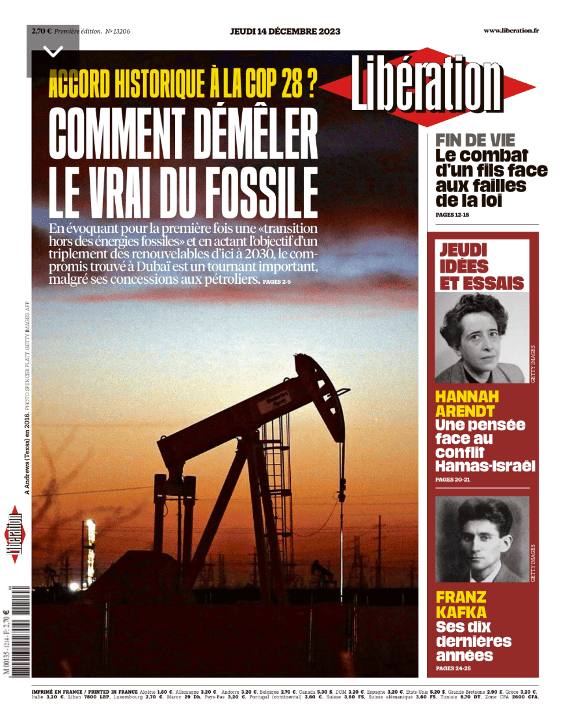
In reality, "the question of whether this is a turning point that truly marks the beginning of the end of the fossil fuel era depends on future actions and the mobilization of necessary funds to carry them out," analyzes former US Vice President Al Gore. Because to fulfill the noble ambitions of the COP, hands will need to be put to work. Yet "we saw a glaring lack of funding in all areas of climate action, whether energy transition, adaptation, or loss and damage," regrets Fanny Petitbon of the humanitarian NGO Care. Valérie Masson-Delmotte says nothing else, pointing out that success, or failure, will depend essentially on the funding provided or not. Laurence Tubiana, President of the European Climate Foundation and architect of the Paris Agreement, is well placed to know that these agreements are not legally binding and that their translation into reality will ultimately depend on the goodwill of states. For the COP 28 agreement not to remain an empty shell, "new financial sources, new ambitious climate plans, and progress on adaptation must still be discussed before COP29," she asserts.
About COP 29 and to finish with COP 28, we have noted that it will be held next year in another petro-gas dictatorship : Azerbaijan. A snub to NGOs, certainly, but after all, the Dubai agreement was also off to a bad start, yet the result "is not nothing," as children say. Moreover, one of Baku's tourist curiosities is none other than the crude oil bath. The crude oil cure is supposed to be good for treating rheumatoid arthritis. Tempted? 😉.

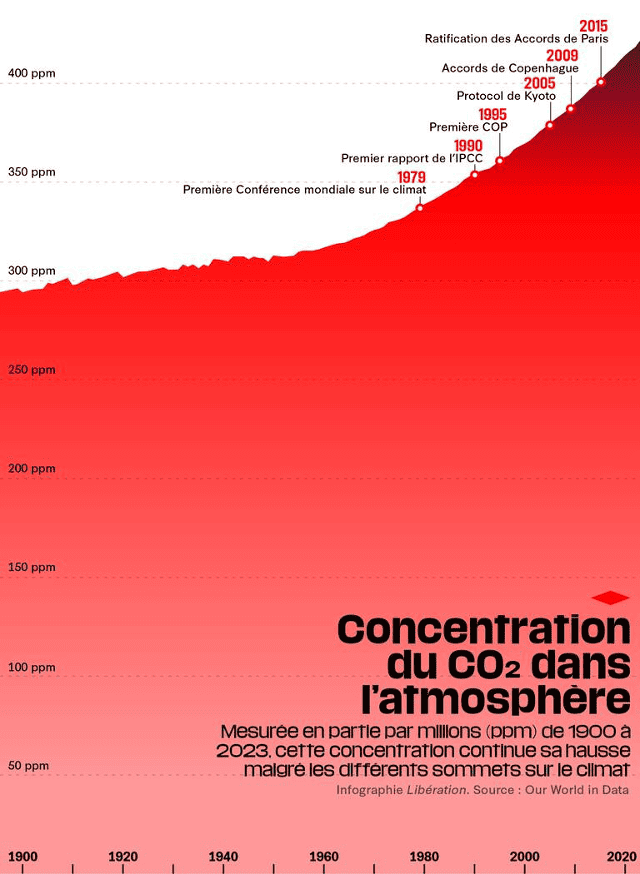
To conclude, until Baku, the subject, two illustrations should make us think. First this one, which reminds us of the extraordinary inertia of the phenomena at play and that a good part of the damage has already been done and will take time, decades and more, to be corrected. Since 1978 and the first World Climate Conference, the concentration of CO2 in the atmosphere has continued to increase. Worse: faster and faster.
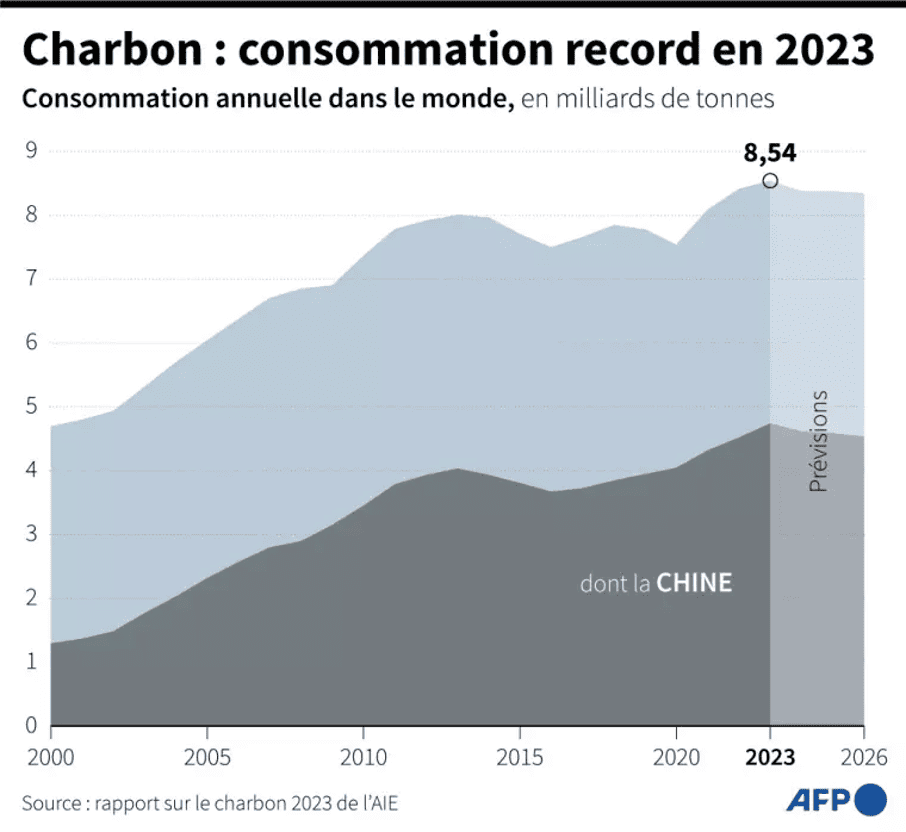
And this cannot be a surprise because, as the second illustration shows, the production and consumption of the main culprit of greenhouse gas emissions continues to grow, reaching its historical record in 2023. We are talking about "King Coal." Global demand reached 8.53 billion tonnes this year – unprecedented – the International Energy Agency (IEA) announced today. Coal remains, today as in the 18th century, the world's leading energy source, yet it alone is responsible for more than 40% of annual greenhouse gas emissions, compared to 32% for oil and a little over 20% for gas. The burning of coal to produce energy therefore releases into the atmosphere a large part of the CO₂ responsible for global warming. As a reminder, on December 6, the European Copernicus observatory officially announced that 2023 would also be the hottest year measured in the history of records.
The transition is easy to start our weekly sections with the report of the week, which comes to us from the FAO (Food and Agriculture Organization). It confirms what we have also known for a long time, without the situation changing: livestock is responsible for 12% of human greenhouse gas emissions and unsurprisingly, meat production is the main source of these emissions. Emissions directly related to livestock, from bovine belching to manure fermentation, represent 60% of the total. In indirect emissions, the FAO counted the manufacture of fertilizers and pesticides for forage production, animal transport and processing, but also the conversion of forests into pastures or soybean fields for fodder. According to the report, cattle farming is the main source of emissions (62%), followed by pigs (14%), chickens (9%), buffalo (8%), and sheep and goats (7%). On the production side, meat is the biggest source (67%), ahead of milk (30%) and eggs (3%). In short, as Jacques Chirac said in 1995, "Eat apples" 😉.

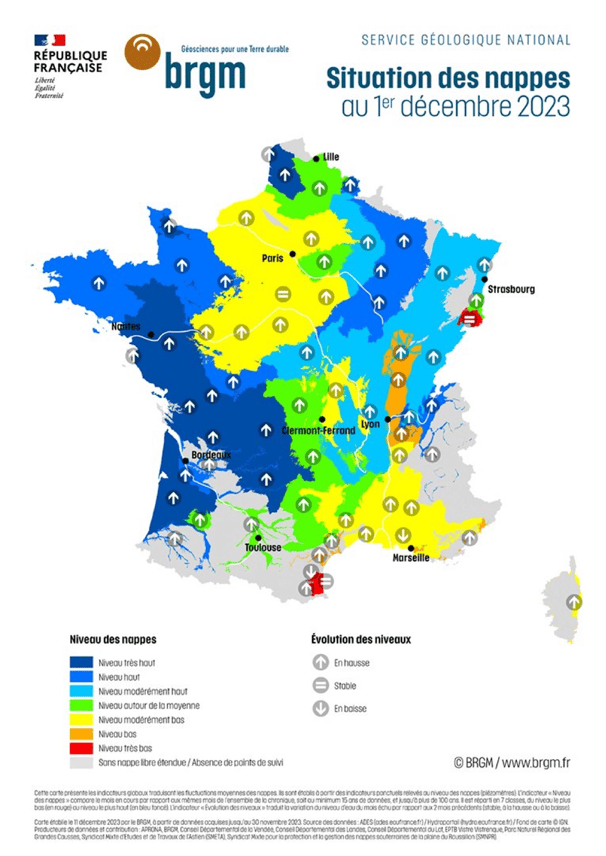
Regarding agriculture, the good news of the week concerns water. For the first time in three years, groundwater levels in France have returned to an almost normal level, thanks to the heavy rains of the last two months. "Levels are very favorable in the reactive aquifers of the northern two-thirds," where levels are even "very high," and in the southwest, "but remain below normal for aquifers in Corsica, the Mediterranean rim, the Limagne plain, the Rhône-Saône corridor, southern Alsace, and the Paris Basin," notes the BRGM (French Geological Survey) in its latest study.
It's not only in water that we find harmful chemical molecules; the European report of the week, made public by the European Chemicals Agency (ECHA), informs us that one in five consumer goods currently sold in our regions should be banned. This is due to the excessive presence of hazardous chemicals (lead, cadmium, phthalates, …). Toys, headphones, yoga mats, bicycle gloves, shoes, jewelry: of around 2,400 articles checked in 2022 in twenty-six EU countries, including France, by fraud prevention services or customs, more than 400 (20%) were in breach of European legislation. Electrical devices (electric toys, chargers, cables, headphones) are the most affected: more than half of this category of items (52%) was deemed non-compliant, mainly due to the presence of lead in solders, phthalates in soft plastic parts, or cadmium in printed circuits. Of the 2,400 articles checked, the majority are imported products, either of origin "outside the European Economic Area" (1,289) or "unknown" (523). The ECHA specifies that most come from China. These have the highest non-compliance rates: 22% compared to 8% for articles manufactured in Europe.
About China, the vigilant report of the week comes from the European Parliament, which tells us that about forty iconic brands in the textile sector, including Hugo Boss and Zara, still use certain products made by forced Uyghur workers. This makes urgent, according to European deputies, the upcoming adoption of the CSDDD. You liked CSRD? You'll love CSDDD! If CSRD concerns corporate reporting, CSDDD (Corporate Sustainability Due Diligence Directive) deals more directly with the actual implementation of "comprehensive processes to mitigate negative impacts on human rights and the environment in their value chains." It specifies its objectives: "integrating sustainability into their governance and corporate management systems, and making business decisions based on impacts on human rights, climate, and the environment, as well as on the company's long-term resilience." The text goes further than the current French law on the duty of vigilance, with heavy financial sanctions at stake and a wide possibility of legal recourse.

Nothing to scare, at least we hope, the activist bosses who sign the opinion piece of the week, published by Le Monde. Distancing themselves from MEDEF, business leaders Pascal Demurger (MAIF) and Philippe Zaouati consider, in an op-ed in Le Monde, that the transparency constraint brought by CSRD on environmental impacts constitutes more of a stimulus than a brake for making good decisions. At (RE)SET, we share the vision of the CSRD as a relevant "dashboard" for companies!
The new priorities of the week, and even of the year, for France 2030, were unveiled by Emmanuel Macron. Rather than accelerating funding, the President wants to set new priorities: small nuclear reactors, nuclear fusion, superconducting magnets, lithium refining capacity on French territory, mapping of mineral resources, white hydrogen, carbon capture. Above all, to attract industrial projects to France, the head of state promises "hyper-simplification" of procedures in all areas, particularly for site establishment, from early 2024, in the spirit of the Green Industry law. And there, we applaud, especially regarding heavy industry: there is still room for improvement, to put it politely, as we regularly observe at (RE)SET…
Another government announcement of the week, we now know the criteria needed to have a chance of soon driving an electric car for 100 euros per month. We'll tell you right away, it's unlikely you'll be concerned. The income criteria, distance to work, and number of kilometers driven per year will reduce the number of concerned people to about 20,000. That is, according to a rough calculation, 0.03% of the French population. Not sure that will be enough to bridge the social inequalities inherent in the transition in France…

The riddle from last week took us to such heights that it's hard to go higher (that was the clue 😉). Who said: "(…) fill the earth and subdue it (…) be masters of the fish of the sea, the birds of the sky, and all the animals that move on the earth"? Several found the correct answer: the Creator himself. That is at least what we read in Genesis 😊. We don't hold it against the authors of this holy text, COP 15 and SNB 3 had not yet taken place at the time! This week's riddle will not necessarily please Instagram enthusiasts (clue 😉). Who is today's top predator of animal biodiversity (outside of humans, of course, the out-of-category champion)?