The event of the week is, of course, the formation of the full Attal government. Sorry, that was a bad joke. As Le Mondeputs it, "such a long wait for a non-event"! Regarding the transition, we will simply note that there is… nothing to note at the end of this reshuffle, or almost, as we will see a little later. To talk about more serious matters, the distancing from the agricultural crisis allowed observers to take stock, in hindsight. And it appears, which will not surprise readers of this Breaking (RE)NEWS, that in the end " la protection de la biodiversité est la grande perdante de la crise agricole ". Judge for yourselves.
Among the major setbacks, the executive has thus announced the "halt" of the Ecophyto plan, aimed at reducing pesticide use by 50% by 2030. This decision comes as the State was convicted, in June 2023, for failing to meet its commitments to reduce the use of these plant protection products, and ordered to repair the associated ecological damage by June 2024. But that's not all in the concessions made to FNSEA. There is also the placement of the French Biodiversity Office (OFB) under the authority of prefects. Following this announcement, incidents targeting the OFB have multiplied. As a reminder, the OFB has 3,000 agents, including 1,800 environmental inspectors, and performs many missions: it notably carries out administrative police actions to verify that regulations on irrigation, spreading, or the maintenance of rural roads are being respected. The establishment also carries out judicial police missions, under the authority of the public prosecutor. Each year, 3,000 inspections concerning the agricultural profession are carried out, while France has 400,000 farms. A minority of these result in legal proceedings. Another damaging setback concerns fallow land: the government obtained from the European Commission the proposal to only partially apply, in 2024, the provision provided for in the Common Agricultural Policy (CAP). Farmers will thus be able to receive aid if they devote 7% of their farms to intermediate crops (planted for a few months between two main crops) or nitrogen-fixing crops, and will not need to set aside part of their farms (3%) for hedges, copses, ponds, or fallow land. Hedges, these great preserver of biodiversity, hated by large grain farms, will therefore be subject to "regulatory simplification". You can share an article by clicking on the sharing icons at the top right of it. Furthermore, the wetland mapping project – more than 50% of which have disappeared since 1960 – has been put on "pause," a word that has become very fashionable in the environmental transition. It has also been announced that the country will derogate for one year from the obligation to replant grasslands in departments where too large a share of these ecosystems, crucial for biodiversity protection and carbon storage, exist.
Beyond these announcements, environmental preservation was presented by the government as one of the causes of the sector's difficulties, a victim of climate change. It was not recalled, however, that intensive agriculture is also one of the most greenhouse gas-emitting sectors and one of the main causes of the collapse of biodiversity. Nor that another model, based on agroecology, is being promoted by experts and the High Council for Climate, in a report with perfect timing that Breaking (RE)NEWS had echoed.
Following these developments, little was heard from Sarah el Hairy, the short-lived Secretary of State for Biodiversity. To be fair, she was lost in the "no man's land" of the reshuffle. She is now accelerating her move to her new post – Minister Delegate for Children, Youth, and Families, as we learned yesterday. And it is Hervé Berville, Secretary of State for the Sea, whose responsibilities have been expanded to include biodiversity. He is now attached to the Minister of Ecological Transition and Territorial Cohesion, Christophe Béchu. The Sea and Biodiversity, two areas that interest us at (RE)SET.

In the meantime, to paraphrase Le Monde columnist Stéphane Foucart, if there is an "agricultural rearmament," it is mainly a "chemical rearmament" of agriculture that is being discussed. At a time when infertility and chronic diseases are soaring in the general population, when about a third of French households receive non-compliant tap water due to pesticide metabolites, when undoubtedly more than 80% of flying insect biomass and 60% of farmland birds have disappeared in forty years, one can imagine the nervous laughter of hypothetical historians who would seek, in the coming decades, to describe and above all understand the logic of what is happening these days.
Don't jump to the conclusion that Breaking (RE)NEWS is not sensitive to the challenges the agricultural world faces; quite the contrary! Agricultural production must be reformed for the good of farmers, for our good, and for the environment. Reform. Not sweep things under the rug…
It is in this context – note the skillful transition to our weekly sections – that the opinion piece of the week fits in. Since Lio and the 80s, we know that "brunettes aren't just for kicks." French scientists also don't want to be taken for fools and are reacting strongly in their text, co-signed by hundreds of them, eloquently titled: "We, researchers, denounce the shelving of scientific knowledge." The cause: the announcements following this famous agricultural crisis, particularly the "pause" of the Ecophyto 3 plan. INSERM, INRAE, IFREMER, CNRS, the cream of the crop of scientists from these institutions are fed up, as they say in farming…

Still on biodiversity and pollution, the contamination of the week takes us to the Cévennes, to Salindres, where unprecedented analyses reveal spectacular levels of trifluoroacetic acid (TFA) in watercourses around a PFAS production plant belonging to the Solvay group, as well as in drinking water. According to the Le Mondeinvestigation, the town of 3,500 inhabitants is victim of what could be the most significant pollution ever detected of one of the per- and polyfluoroalkyl substances (PFAS). Linked to several cancers, cardiovascular and thyroid disorders, and alterations to the immune system, PFAS can persist in the environment for centuries. Fluorides, aluminum, arsenic, heavy metals, chlorides, hydrocarbons, etc.: a document listed in 2012 no less than 62 substances emitted into the environment by the local platform's activities. Until 2008, Rhodia even discharged mustard gas (phosgene) directly through its chimney. PFAS pollution has lasted for four decades, and TFA, an ultra-short carbon-fluorine chain PFAS, is therefore ultramobile.
While some praise the virtues of "the pause," the European Commission is rather stepping on the accelerator, at least in its stated objectives. The roadmap of the week is therefore that of the European administration. As L’Usine Nouvellereminds us, until now, two objectives were known in Europe: reduce net greenhouse gas emissions by 55% by 2030 (compared to 1990 levels), and achieve carbon neutrality by 2050. On Tuesday, February 6, the Commission unveiled an additional milestone by advocating for a 90% reduction in emissions by 2040. According to the "climate law," which was agreed at European level in 2021, the Commission must review climate targets within six months of each global stocktake. Since the COP 28 in Dubai was at the end of last year, the European executive could have unveiled its plans by mid-2024. But with the June European elections looming, the exercise would have been even more perilous later in the year. "I am delighted because the targets need to be clarified," explains MEP Pascal Canfin (Renew Europe), who hopes these announcements can "feed the democratic debate" ahead of the ballot. In reality, few observers are betting on the implementation of this new milestone as just presented. Indeed, the current Commission will no longer be in place, and the new one, which will partly reflect the results of the upcoming European Parliament elections, is unlikely to adopt such a level of ambition.
The vote of the week was, of course, that of Parisians regarding the pricing of parking for SUVs in the city of light. Good news: citizens were directly consulted on a subject related to the environmental and economic transition. Bad news: very few felt concerned… As Le Parisienconfirms, "turnout was very low," with only 5.7% of registered voters, i.e., 78,121 out of 1,374,532, going to the polls in one of the 222 polling stations set up for the occasion. So it was 42,415 people (54.55% of votes) who decided on a future tripling of the parking price for SUVs, or rather, to use the official expression used during the vote, "heavy, polluting, and bulky" vehicles. A word to SUV owners among you: the tripling should be effective from September 1st , according to Paris Mayor Anne Hidalgo.

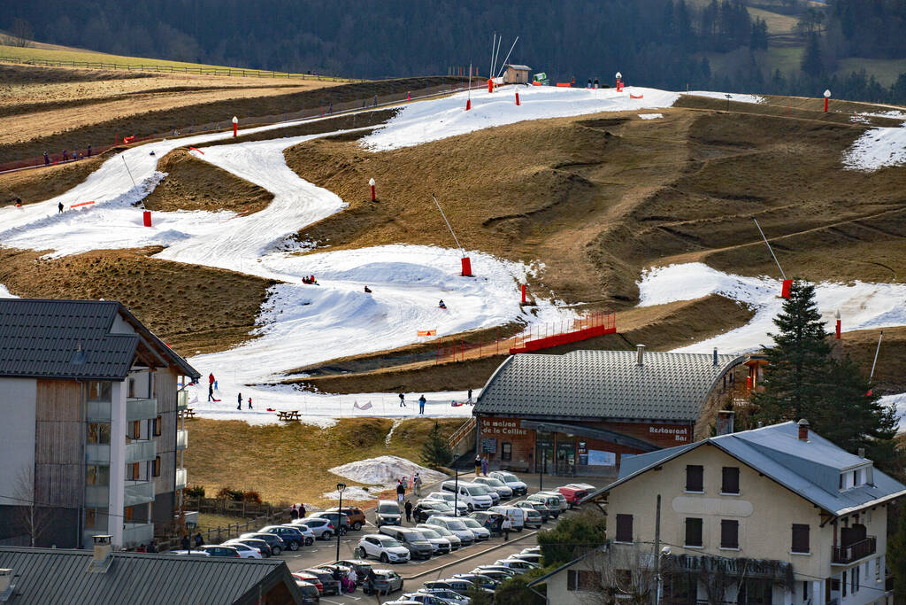
The interview of the week is with Jean-Michel Soubeyroux, a climatologist at Météo-France, in the newspaper Libération, about the lack of snow in our mountains: "Winter 2024 illustrates tomorrow's problems, which are already today's." The photo illustrating the article (below) speaks for itself. It is certain that winter sports resorts must now urgently consider their transition. However, this is not the case, according to the latest Court of Auditors report on the subject, published last week and analyzed by Le Monde. For the Court, ski resorts have not sufficiently grasped the scale of climate change, estimating that only a few sites in France can hope to continue operating beyond 2050 and that this evolution is underestimated by mayors and local authorities.
Regarding climate, the profits of the week are, of course, those of TotalEnergies: $21.4 billion in 2023, which is even a historic record. Thanks to "growth in hydrocarbons, particularly liquefied natural gas (LNG) and electricity," the multinational improved its net profit by 4% compared to 2022, a year in which it had already achieved a record €19.5 billion in profits. Dividends paid to shareholders will increase by 7.1%, the group also announced. Economist Maxime Combes recalls, in Reporterre, that in 2023 TotalEnergies invested three times more money in fossil fuels than in low-carbon energies. The latter received only 4.9 billion (€4.5 billion) over the past year (out of total investments of $16.8 billion, or €15.6 billion). The remuneration of shareholders, meanwhile, amounted to €16.6 billion (€15.4 billion). That is three times the amount invested in low-carbon energies. That has the merit of being clear.
The big beast of the week is precious for biodiversity protection, to stay on theme! It is the sea otter, great protector of salt marshes. In a recent issue of the journal Nature, an American team published a study demonstrating how the return of this mustelid to a California salt marsh helped halt ecosystem degradation, despite ongoing human pressures. The journal even devoted its cover to it. The smallest marine mammal on the planet, the sea otter once populated all American coastal areas, until the fur industry decimated it from the 18th century onwards. In California, only a small group persisted on the Big Sur coast. In the mid-1980s, taking advantage of protective measures, a few individuals returned to the Elkhorn Slough estuary. By the late 2000s, there were over a hundred, and they have been multiplying since, with a very clear result: where they concentrate, sea otters prevent biodiversity erosion! A team of scientists has just published its findings: the rate of bank erosion in Elkhorn Slough decreased as the otter population increased, but not just anywhere. Environmental resistance (soil and biomass) was concentrated where the mammals were most numerous, with a reduction in erosion of up to 90% in the most populated areas. The main reason: the sea otter's diet, which loves the small crabs that are themselves responsible for erosion!

The new word of the week is "trashlocene" (poubellocène)! You knew theAnthropocene, you'll love the trashlocene. A fascinating investigation by Le Monde looks back at "the crazy story of the age of waste." Whereas they did not exist until the end of the 19th century, waste has colonized the living world. Beyond the technical challenges they raise, waste has become a field of investigation for the humanities, which seek to shed light on the systems and myths at the source of their production. They have also become a fascinating subject for (RE)SET consultants, but that's another story.
The blunder of the week is to be found on the side of Pascal Praud, a star journalist for the "Bolloré Media" group. He managed to accumulate a maximum of commonplaces, all wrong, about the environment and the transition in a minimum of sentences, gathered in his column in the Journal du Dimanche last week, elegantly titled "Ecologism, expiration date 2024". You will find the details in this post , half ironic, half angry, by Loup Espargilière, editor-in-chief of "Vert, le média qui annonce la couleur". His conclusion: "Poor Pascal Praud, it must be hard to never understand anything at all."
The riddle from last week was a recent and very well-turned quote, whose author needed to be identified. Who wrote: " The poles are overheating. The ocean is angry in this era of widespread boiling, sick from plastic, stuffed with CO2 and heat accumulated in the atmosphere by the greenhouse effect, gnawed like its corals by acidification. The great eruptive wave is only waiting for a sign to break. And we continue, like capricious children, to hop happily on the thin layer of ice that will soon give way under the weight of our culpable carelessness! " The clue was that this person can write, and indeed, it is a writer: Olivier Poivre d'Arvor is a writer and diplomat. He is also France's ambassador for polar and maritime issues.
The week's riddle is a list: what are the ten biggest plastic polluters of 2023? The list of winners has just been revealed in the latest report from the BreakFreeFromPlastic collective. A clue: most are probably the ones you're thinking of.