
To start the "transition" media review this week, a quote: "A priori, no one is against climate commitment, however there are a thousand and one ways to sweep things under the rug, for example by betting heavily on carbon storage solutions that have yet to be invented or improved." Lola Vallejo, director of the climate program at the Institute for Sustainable Development and International Relations (IDDRI), got straight to the point on Wednesday at the opening of the "Climate Ambition Summit" launched at the UN as an appetizer to its annual General Assembly. Carbon storage solutions are certainly not the global answer we are still seeking, but we still know that they will be part of the solution… The transition is always complicated! Notable absentees from this summit (not invited by UN Secretary-General António Guterres, according to Le Monde): the world's main carbon-emitting countries, including China and the United States, but not the European Union, which spoke.
An opportunity to return, with Novethic, to the thorny question: which countries contribute most to climate change? It all depends on the indicators used, as often, but it seems that the United States is at the forefront, as this very clear illustration shows, even though the "mass effect" naturally works against China, which is moreover opening the equivalent of two large coal-fired power plants per week since the beginning of 2022…
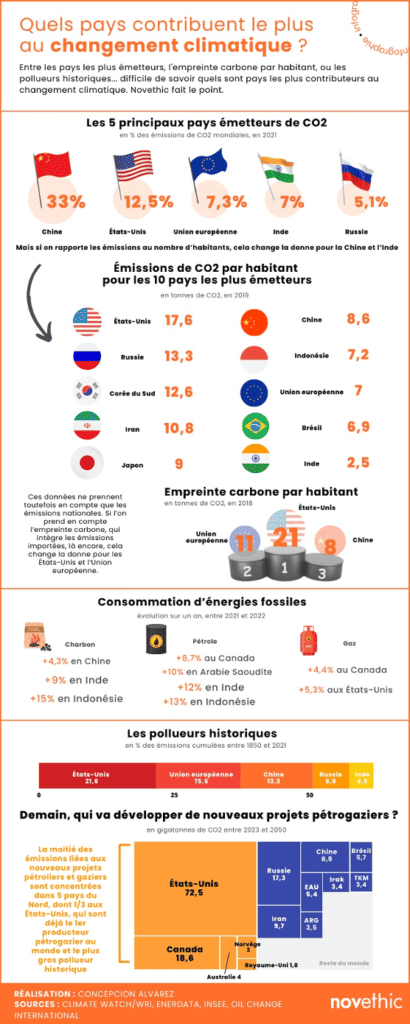
The most problematic for the future is the last point, taken from a recent study by the organization Oil Change International (OCI): more than a third of new oil and gas projects come from the United States, making it the "Planet-Wrecker-in-Chief ", to use OCI's evocative expression [for non-English speakers, who are not necessarily the same as non-Latinists, this phrase can be translated as "The planet's chief wrecker"]. A perfect transition to mention the lawsuits (mentioned by the New York Times) that the State of California has just filed against five of the world's largest oil companies, for climate devastation and for minimizing the risks of fossil fuels. The civil complaint was filed with the San Francisco Superior Court against Exxon Mobil, Shell, BP, ConocoPhillips, and Chevron. The American Petroleum Institute is also targeted, the New York Times adds. These California lawsuits are now "the most important" ever filed, after several similar actions across the United States. Seven other states and dozens of US cities have filed similar complaints against oil, gas, and coal producing companies in recent years, the daily specifies. A reason for hope on these subjects: the International Energy Agency (IEA) will soon publish its annual report in which it will announce that for the first time in its forecasts, consumption of oil, natural gas, and coal will begin to decline before 2030. This will give posthumous validity, Le Monde recalls, to former Saudi oil minister Ahmed Zaki Yamani, who in 2000 famously said: "The Stone Age did not end because the world ran out of stone, and the oil age will end long before the world runs out of oil." The phrase reversed the dominant thinking of the time, which focused on the limits of oil extraction rather than the hypothesis of a slowdown in global consumption. This does not prevent the Le Monde editorialist from concluding his article thus: "too little, too late".
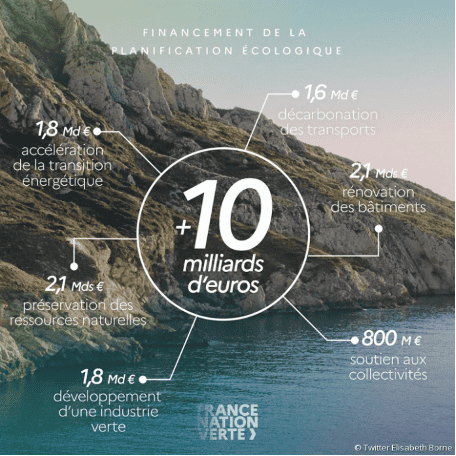
Meanwhile, in France, it's not only King Charles III and Antoine Dupont's jaw that are making the news: Élisabeth Borne presented at the beginning of the week the state budget dedicated to financing ecological planning in 2024. Here again, a good picture is worth 1000 words, and we find this one, marine-inspired, on the Prime Minister's X (ex-Twitter) account:
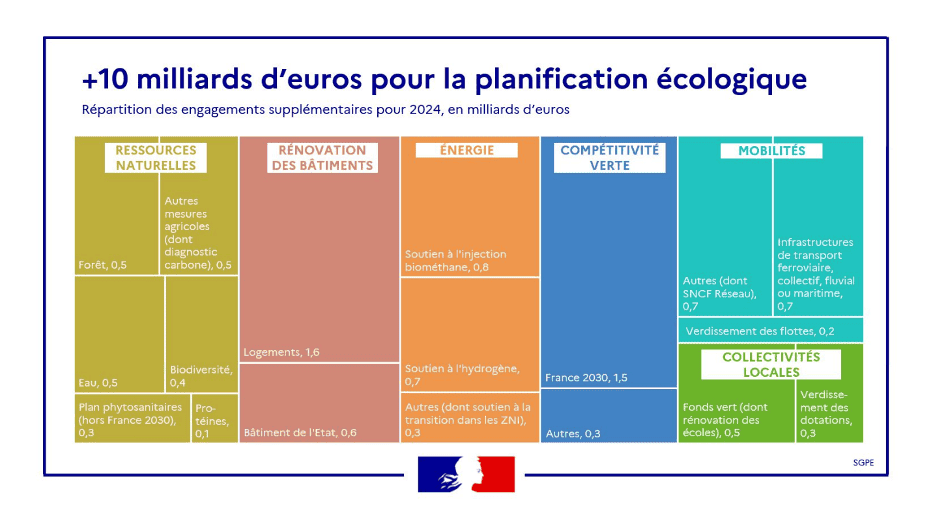
Less idyllic but more detailed in numbers, a more precise breakdown of the planned expenditures can be read in this table from the SGPE:
The Prime Minister's presentation only achieved a grudging success from political party leaders, to put it politely. Especially as the effect was somewhat spoiled by the missteps of the heavily publicized proposal to sell fuel at a loss in mass retail. The issue of gasoline is complicated: the government is well aware of this, since the yellow vests, and to be honest, no one has found a solution. As often in the transition, there is no "magic solution." Various ideas must be tested, adaptations, corrections, temporary solutions are needed, while waiting. But obviously, not this one! This curious proposal, contrary to all principles of a liberal economy, delighted Le Figaro and very quickly united everyone against it. The clear response from mass retail giants: "niet." An opportunity, also, for the CEO of TotalEnergies to show his sarcastic humor: "Do you often sell products at a loss?" With a little phrase spoken on TMC's microphone, "Patrick Pouyanné knocked down the government's latest idea to fight inflation," recounts the daily 20 Minutes.
To our weekly sections, with, first of all, the concept of the week, coming from the mouth of King Charles III: His Majesty proposed that France and the United Kingdom commit to a new " Entente Cordiale for the climate ", in reference to the text signed between the United Kingdom and France in 1904 to settle their historical differences. As a reminder, this "Entente Cordiale" ended rather badly in 1935, with a new Anglo-German naval treaty that was a bad surprise for France – and we won't talk about Brexit, nor the Rugby World Cup! Let us hope that the one advocated by King Charles III does not end with a disappointment of the same kind, as he wishes this partnership to be a more effective response to "the global climate and biodiversity emergency".
The resource in peril of the week is… olive oil, with this very Libération headline: "Olive oil: prices soar, speculators get fat" 😉. Climate change and the economic consequences of the war in Ukraine are causing the price of this central ingredient of Mediterranean cuisine to soar. An inflation fueled by speculation by Spanish and Italian giants, the daily asserts.

The assessment of the week concerns the European Green Deal. We can feel the European elections looming… An opportunity for Pascal Canfin, a Renew Europe MEP (of which Renaissance is a part) and chairman of the Environment, Public Health, and Food Safety Committee, to defend the strategy of France and the European Union. After the Green Deal and its 75 laws, Pascal Canfin confides to La Tribune that a Green Deal 2 is being prepared "to give maximum visibility to companies." The European Commission will present its new strategy in February, with the 2040 target. For this second stage, Canfin "advocates a financing shock, notably through the reform of the stability pact" (Editor's note: in other words, through deficit and debt). An opportunity also for the MEP to share this interesting illustrated and quantified assessment of what has been done and what remains to be done.
The vote of the week is, as often, European. It concerns the upcoming ban on too vague environmental claims. MEPs and member states decided overnight from Tuesday to Wednesday to ban these "generic" claims, often misleading, on consumer products. The text still needs the formal green light from MEPs and the Twenty-Seven before entering into force, with a two-year period for transposition into national laws. And this is only a first step before a second, more ambitious draft legislation against greenwashing! …
To perhaps stay on the same theme, the video of the week is an advertisement and is very well done, but we are entitled to wonder whether or not it constitutes greenwashing, precisely. Apple went big. What do you think? Greenwashing or transparency?

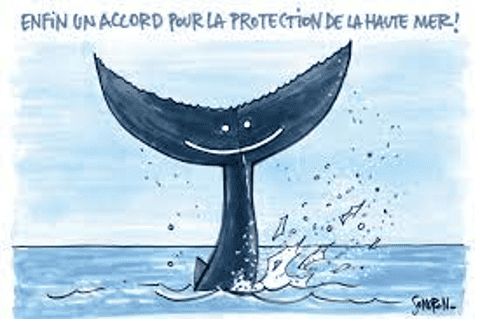
The ratification of the week will take more than a week to be finalized 😊. But the start is good! In a few days, more than 70 states have already taken the plunge, committing to ratify the high seas treaty. The text, opened for signature at the UN General Assembly, aims to protect 30% of seas and land by 2030. At the end of the first day of signing, 68 countries had signed, and not the least, as we find notably the United States, China, the European Union, and Australia. As a reminder, the next UN ocean conference will be held in Nice in June 2025.
The "we believe in it" of the week concerns textiles and can be read in a report by the daily Les Echos, whose title accurately reflects the content: "Textiles, towards less polluting manufacturing", which reviews the latest and future innovations hoped for in this area.
The riddle from last week was aimed at LinkedIn enthusiasts (there are many!), one of whose members had published this photo below, with an insightful comment. Who was it? The clue ("this person particularly masters their subject!") allowed many of you to guess: yes, it was indeed Valérie Masson-Delmotte herself commenting on her own photo, eloquently titled "morituri te salutant" [clarification for non-Latinists: this quote, "those who are about to die salute you," was the phrase spoken by gladiators to launch their jousts]
"This is the Forni Glacier, the second largest glacier in the Italian Alps, in the Cevedale massif (Stelvio National Park), one of the world's glaciers that has been closely studied since the end of the 19th century. In this region, glaciers have lost 40% of their surface area since the 1950s, and this retreat has accelerated over the last 20 years. The lack of fresh snow, the dark surface (low albedo) clearly visible in this photo are among the factors contributing to an increase in the ablation season and, through a negative mass balance, to this disintegration of glaciers."

The week's riddle is about a philosophical principle, to rise above it all on the eve of the weekend. Why would (RE)SET have liked to invent "Occam's Razor" reasoning? Clue: this photo is not one!