
Let's start this Breaking (RE)NEWS with the continuation of the subject mentioned last week: the draft European regulation on packaging and packaging waste, still alive! We recall the stakes: strengthening the "3 Rs" (Reduce, Reuse, Recycle) in a sector responsible for 40% of plastic waste and 50% of household waste volume. It came down to a small number of votes, but the European Parliament's Environment Committee voted this week at the last minute for a compromise, in the great community tradition. It will need to be confirmed in plenary in November. In substance, the compromise notably provides that a final distributor selling beverages must ensure that from 2030, at least 20% of these products are available in reusable packaging, as part of a reuse system (10% for alcohol – except wine). It exempts companies with fewer than 10 employees, and abandons the idea of introducing such a system for takeaway meal sales in hotels, restaurants, and cafes, which is a step back from the European Commission's initial proposal. But on other points, Parliament raises the ambition. The initial text provided for quantified targets for reducing packaging waste in member states; MEPs are introducing additional specific targets for plastic waste, as well as a ban on ultra-thin plastic bags. Also banned will be food packaging containing so-called "forever" chemicals (PFAS and bisphenol A). All this remains to be validated in plenary, therefore, and then to go before the European Council and harmonize everything, in early 2024. Let us hope that the final European regulation will harmonize national constraints, thus allowing brands, we repeat but the subject is important, to find universally valid solutions!
In this regard, it is never useless to recall why we need to reduce, reuse, and recycle? For one fundamental reason: resource scarcity! Remember (RE)SET's somewhat impertinent slogan: "And what about resources, dammit?!" This week is full of striking examples to awaken the minds of those, and they are many, who remain obsessed with the sole question of the energy transition, the object of all government attention, sometimes forgetting that resources are the mother of all transitions. To put it simply, resources pose two problems: their existing quantity, of course, especially if they are non-renewable, but also their actual availability. These themselves depend on geological factors but also technical, commercial, and geopolitical ones. Companies must therefore henceforth, to use the terms of Cécile Cabanis and Géraldine Le Meur, respectively Deputy CEO of Tikehau Capital and partner at FrenchFounders, " take into account, in value creation, the criteria of natural resource exploitation (…). This requires " the development of collective intelligence [because] only a common approach can lead to the adoption of a sustainable lifestyle for the planet. The collective, the deadly weapon of (RE)SET's consortia!
In the meantime, "the war over metals has already begun," Le Pointreminds us. We might even be tempted to add "twenty years ago," with successful offensives by China in Africa, and Russia too. Two countries that are not among those on which our European countries and companies can necessarily count in the short, medium, and long term. Moreover, in Europe, the import of critical metals from Russia is still in full swing these days. Customs data obtained by the online media Disclose and reported by L'Usine Nouvelle confirm that the import of Russian critical metals not under sanctions – such as titanium, aluminum, or nickel – is far from having ceased since the war in Ukraine. The aeronautics industry, in particular, rushed for titanium, anticipating future stock shortages. On the automotive side, the export restrictions on Chinese graphite, finalized last week, constitute an existential threat: China has announced it will limit its exports of battery-grade graphite, subject to a permit from December 2023. Its absolute dominance of this market could jeopardize the European automotive industry, L'Usine Nouvelletells us again. Which continues with iridium, also in the spotlight, threatened by the development of… green hydrogen, proof that the transition is complicated 😉. Too greedy for iridium, green hydrogen will have difficulty growing. Iridium, a by-product of platinum, is essential for the manufacture of PEM electrolyzers, which enable the production of green hydrogen. These electrolyzers could mobilize half of the world's known iridium resources , which is a problem. Platinum is the other critical metal for these electrolyzers. And we're not even talking about nickel, also essential for the transition.
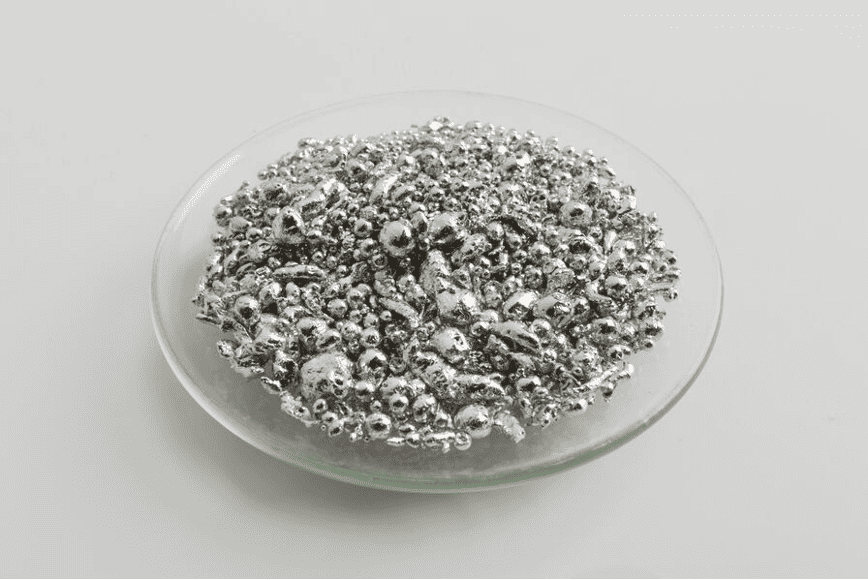
A marginal answer might paradoxically come – the transition is complicated, as we said! – from "recycling" in the nuclear sector: ruthenium, rhodium, palladium – the French Atomic Energy Commission (CEA) wants to recycle products from nuclear fission. A four-year research project has just begun, aiming to develop a process for recovering platinum group metals from fission products. But for the recovered critical metals to be valorized in civilian applications, the current regulations must evolve, the organization argues.
To start our weekly sections, let's continue with "the fledgling recycling" of the week. This is about boats in France: despite European Union measures and local authority efforts, the ship dismantling sector is struggling to emerge. The cause: its lack of competitiveness compared to low-cost countries, which are unconcerned about social and environmental aspects, explains Les Echos.
Let's continue with the "disruptive recycling" of the week. It concerns batteries, the nerve center of the transition in the automotive sector. Stellantis and Orano announced on Tuesday their intention to create a joint venture in their recycling, based on a new, so-called "disruptive" technology. This joint venture, L'Usine Nouvellespecifies, will focus on the pre-treatment of batteries to produce "black mass" loaded with critical metals (back to that), which will then be processed in the hydrometallurgical plant that Orano wishes to establish in Dunkirk (North). We'll talk about battery "repair" another time, another interesting topic.
Let's stay in the "disruptive" vein with the innovations of the week. Thus, a textile awarded at Pollutec, capable of capturing and destroying certain pollutants, could therefore serve in air purifiers. Another potentially significant innovation: a new glass washing devicethat opens the way for the reuse of certain cosmetic packaging. At (RE)SET, we are working a lot on reuse, particularly in cosmetics: a sum of technical challenges that indeed require this key step, washing and its quality approval. Complicated. And as Churchill said, "if you're going through hell, keep going"!
Less disruptive, the "non-magical" solution of the week is wastewater reuse, according to a report from the Ministries of Health, Agriculture, and Ecological Transition. The cause: its heterogeneity and therefore its cost: "For irrigation use, for example, the price of reused water is estimated between 0.8 and 1 euro/m3, compared to 0.05 to 0.20 euro/m3 for water from the natural environment." That is between four and 15 times more expensive! Investment in appropriate technologies and scaling up will be needed.
To continue on water, the bad example of the week comes from the municipality of Puget-Théniers, which for over ten years was calmly dumping its waste and garbage into the river. Its last two mayors are now trying to explain themselves in court …
About justice, the judicial investigation of the week has opened in the Netherlands and could be called "Dark Waters, season 2," as it concerns the same protagonist, the chemist DuPont (and here its subsidiary Chemours), following the class action lawsuit of 2,400 people, and for the same reasons: "PFAS," these forever chemicals, already at the heart of the case treated in "Dark Waters." Teflon, you remember?
Let's stay with justice in our Total section of the week which is, as often, fueled by Greenpeace. In its latest opus, Greenpeace indicates that the French oil company is currently involved in the development of no fewer than 33 climate bombs around the world, a nice score.
The enemy of the climate of the week, outside of DuPont and Total (we're joking), is SUVs: these vehicles, favored by drivers, produced 1 billion tons of carbon dioxide emissions by themselves in 2022! The IEA estimates in its latest report that SUVs are responsible for almost all of the continued increase in emissions in the automotive sector! Small problem: they now represent more than one in two new vehicle sales, and their electric versions, less bad than combustion ones, remain heavy (see image below) and therefore, using ADEME's calculations, ultimately not very convincing compared to traditional vehicles over their entire lifecycle… So they have earned, according to Le Monde, their stripe as "enemies of the climate".
The weighty report of the week is therefore that of the IEA, the summary of which can be read from two different and even apparently opposing angles, if we follow the French media: on one side, Le Monde tells us "demand for fossil fuels remains too high to meet UN targets," but on the other, Libération responds "thanks to low-carbon energy, 'limiting global warming remains possible,' says the International Energy Agency".
The other (!) report of the week is offered to you by Data Lab (Ministry of Ecological Transition), and it is not very thick. It summarizes in 92 pages illustrated with enlightening graphs the state of climate knowledge in 2022. 92 pages is a lot, the youngest among you might think 😉, but it is especially much less than the thousands of pages of IPCC reports.
The "terrifying news" of the week, according to researchers, is that whatever we do, a significant part of Antarctica will melt. The ice of the South Pole is a victim of rising water temperatures. The damage is already done, Le Parisien tells us. This very serious report can be found by following this link. In the same spirit, if one dares to write it, the UN identified this week the "six catastrophic risks threatening the planet" today, to use its own terms. They are summarized in this article from Le Monde and will not surprise any attentive reader of Breaking (RE)NEWS.
We can definitely feel that COP 28 is approaching – it's in a month – with also this "call" of the week, launched by 131 companies, including Bayer, Volvo, Decathlon, IKEA, Nestlé… They called in a joint statement on Monday for governments to tackle fossil fuels to meet the "ultimate" goal of +1.5°C warming. While pressure is mounting on states, the companies themselves are being pointed at for their lack of commitment…

Still regarding COP 28, the failed negotiation of the week between states is the challenge to the agreement in principle reached last year in Egypt on the creation of a fund to compensate for the "loss and damage" of vulnerable Southern nations facing climate change.
To continue with the global perspective, the portrait of the week is a green measurer, to use the very "Libération" headline of… Libération: Jim Skea, 70 years old since September, added the title of IPCC chairman this summer to a CV already filled by a long career in renewable energy and climate change research. He's not done being busy!

On the biodiversity side, the bad news of the week is that, despite all the promises and solemn commitments, deforestation continues to increase worldwide, despite improvements in Brazil, according to a report from a group of NGOs and researchers that you can download here.
The "small technocratic revolution" of the week, as Le Monde puts it, is the appearance of a "climate" sub-directorate within the all-powerful Treasury Department. A Copernican revolution for this Directorate, which has always equated "ecology" with "public spending". We told you that the challenge of the transition is financing and the leverage effect of public spending 😊.
The advice of the week that doesn't have much to do with it but we give it to you anyway as winter approaches: the National Agency for the Safety of Medicines (ANSM) is warning on Monday, October 23, about vasoconstrictors used to clear the nasal passages. "In case of a cold, avoid oral vasoconstrictor medications," advises the ANSM in a press release . It calls for not using Actifed Rhume, Humex, Rhinadvil, Nurofen Rhume, or Dolirhume tablets containing pseudoephedrine. The use of these medications is likely to cause "heart attacks and strokes," warns the ANSM. For the director, "there are non-drug alternatives," stating that for a stuffy nose, one should avoid exposure to "very serious side effects." She particularly recommends "moistening the inside of the nose with appropriate washing solutions: saline solution, thermal water or seawater sprays" or "drinking enough." A small reminder: a cold, if left untreated, disappears in 7 to 10 days…
The hair-raising and ill-timed app of the week concerns "ultra-fast fashion": Temu, which is breathing down the neck of Shein, an app from China, is actually a marketplace allowing purchases at very, very, very low prices, and it works. The new e-commerce player is topping all rankings in Europe and the United States. Do not look for any awareness of sustainability imperatives on this platform, there is none…
The pretty double negative of the week was uttered by Christophe Béchu, our Minister of Ecological Transition, regarding Storm Aline that ravaged Saint-Martin-Vésubie last week: "We cannot say that the worst is behind us," or how "not" to say that the worst is ahead of us 😉.
In that case, as things are going, we might as well rely on luck and preserve biodiversity by playing the lottery with the new scratch card game of the week, "Mission Nature." We're being ironic, but it's not all bad, since this ticket will allow the French Biodiversity Office (OFB) to collect nearly 6 million euros and finance the 20 projects selected for their link with biodiversity restoration, including a plan to safeguard Martinique turtles, the creation of ancient forests in the Grand Est region, or the restoration of the Mont-Saint-Michel wetlands.
Last week's riddle was a quote. Who said: " It is a political question whether we want – and to what level – to develop immediate satisfactions, the standard of living, that is, the expansion of consumption, and consequently sacrifice the future (at least in part), or, on the contrary, work in favor of future benefits, those that ultimately result from a present increase in investments, and sacrifice (at least in part) the present. " The clue was that neither the author of these lines nor Jancovici were born yet! Indeed, this quote is taken from a 1950 course by Pierre Mendès France, for his students at the recently created National School of Administration. The context was therefore the Marshall Plan and the reconstruction of France. The problem, stated 73 years ago, resonates perfectly with the challenges of the transition!

The riddle of the week is a simple date on the calendar: every year, October 21 is World… what Day? The clue: Darwin is not a stranger to it 😊.