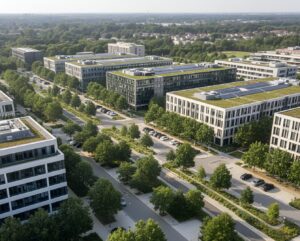
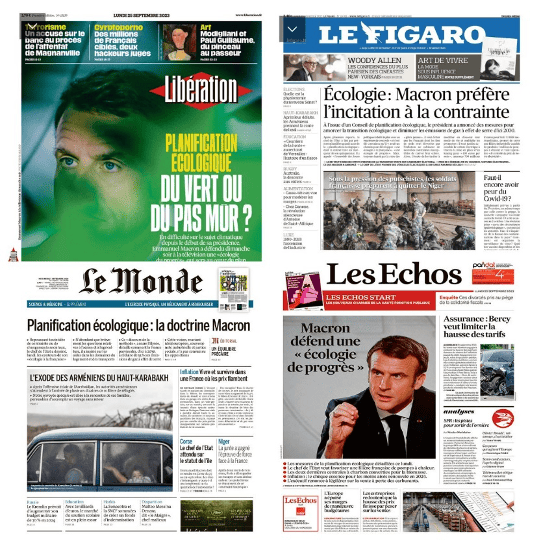
President Macron and the "French-style transition" made the headlines this week, with the "Vision" developed last Sunday and Monday. In itself, making the headlines on this subject is good news, showing that the major media and, hopefully, their readers and viewers, have understood that the subject is important. The exercise was difficult, but the result is there: France is one of the few countries now to have a "roadmap," sector by sector, with quantified targets. The vision underlying it is that of a "positive ecology," "à la française," and of "sovereignty."
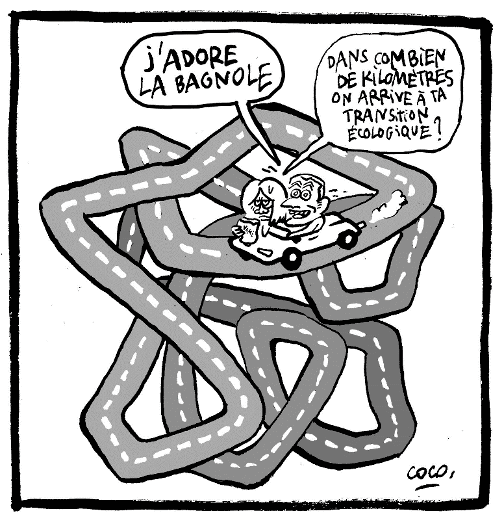
A few flaws made the message less clear than it could have been and caused a lot of ink to flow. Thus the President's quip about "the car," which he "loves" … We understand the intention – to mitigate the feeling of "punitive ecology" – but perhaps Emmanuel Macron could also have added "I love the bicycle in the city", Libération tells us, driving the point home with this humorous drawing:
On the net too, guaranteed success, with these quizzes that have flourished on social networks:
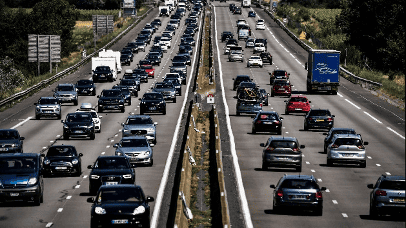
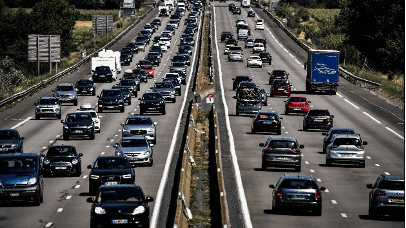
Little game: guess, of the right or left photo, which one illustrates a vacation departure after the advent of the electric "car"? 😊
More seriously, the presidential message, all about protection, can appear, depending on the perspective, cautious (yellow vest syndrome) or ambiguous. Thus the announcement about phasing out coal-fired power plants, which of course delights promoters of alternative energies but disappoints those who point out that this commitment was initially for 2022 and has been postponed to 2027, leading La Tribune to headline that Macron is recycling an unfulfilled promise. Same thing with heat pumps, which are "intelligent" but no, we will not finally ban gas boilers after all. Some observers regret therefore that we continue to pretend the transition will be painless, even though we know it won't be… What we think about it at (RE)SET can be found in an "opinion piece" published in La Croix. Quasi-perfect in spirit, the method – planning – and the overall costing (40 billion euros in 2024), the "French-style transition" invites us to keep three watchpoints in mind. First, even if we must not "discourage Billancourt," we cannot either pretend that the transition will be a path strewn with rose petals, at the risk of creating false expectations. Second, if we want it to work, we must above all encourage investment, and not only public: it is mainly private investment that will determine the success or failure of the transition. It must also be directed towards decarbonization, but not only! Resources (water, sand, minerals, …), biodiversity, are essential. Finally, we must remain vigilant because results must live up to projections, meaning that the quantified targets announced in recent days must be met. Unfortunately, the transition is an area where, from experience, this is rarely the case; the IPCC experts will not contradict us on that…
However, we can only applaud the excellent groundwork of the General Secretariat for Ecological Planning (SGPE), whose summary of work is taken up by Les Echos, with its 50 levers in all sectors. The whole receives the sustained applause of Pascal Canfin, President of the European Parliament's Environment Committee (and deputy secretary-general of Renaissance), who rejoices that for the first time, the State is truly present for the public financing of the ecological transition.
Perfect illustration of "the transition is complicated," the week also saw the collapse of some myths, which Novethic noted: recyclable plastic Lego, plastic bottle deposit, Lufthansa's green airplane. To which one could add, according to Le Monde, the composition of smartphones, which ultimately turn out to be, still more plastic … The common point between these developments: false good ideas for a nonetheless laudable cause. Thus Lego had to throw in the towel, or the brick, after a two-year experimentation phase. The world's largest toy manufacturer is giving up on making its bricks from recycled plastic. According to the group's CEO, Niels Christiansen, questioned by the Financial Times, "the use of recycled polyethylene terephthalate (PET) would have resulted in higher carbon emissions over the product's lifetime." "The level of manufacturing environmental disruption was such that we had to change everything in our factories" to increase the use of recycled PET, added Tim Brooks. "After all that, the carbon footprint would have been higher. It was disappointing." We don't know the figures or the chosen references, so… no comment.

For its part, the plastic bottle deposit system ran up against the financing balances of local authorities. To quote Christophe Béchu, "It must be said that the immediate and widespread implementation of a deposit for recycling does not meet the full support we need." Something else must be found to meet the targets set by the European Union and catch up with our neighboring countries who are succeeding. On the Lufthansa side and its green airplane project, it's obviously the fuel that is failing: Carsten Spohr, the CEO of Europe's largest airline, estimated that the company "would need about half of all German electricity to convert its current fleet to synthetic fuel." Lucid, Carsten Spohr knows he will not have access to that amount of electricity in Germany, so he is considering sourcing it "abroad, where wind or solar energy is available in practically unlimited quantities," without naming specific countries. Viel Glück [Editor's note: "Good luck"].
On to our weekly sections, to continue in the series "in fact, it's complicated," the "unthinkable" measure of the week, according to independent gas stations, is the sale of fuel at cost price, decided by the government. Another example of the inherent difficulties of the transition. The limits of "doing both simultaneously" 😉.
The conflict of the week opposes regulatory agencies and scientific institutions. To summarize and use Le Monde's headline, "the glyphosate file is a caricature illustration of the conflict between regulatory agencies and scientific institutions." Scientists claiming a belated, too belated, victory with those same agencies, concerning Bisphenol A…
To stay with the scientists, the call of the week comes from them, in an "opinion piece" in Le Monde: they strongly suggest "the implementation of a Manhattan Project for the ecological transition". A good idea, based on "the strength of the collective" dear to (RE)SET 😉.
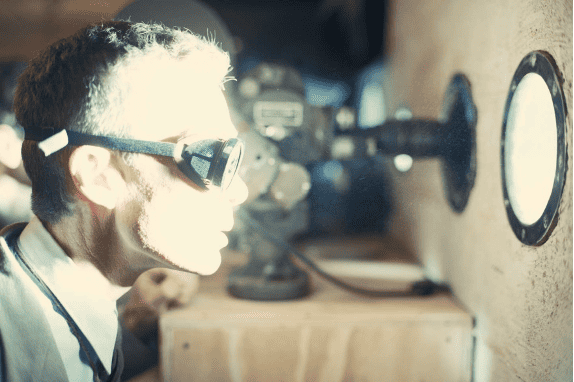
The doubt of the week concerns the future, at least in the short term, of the offshore wind power sector, victim of the scarcity and increasing cost of resources: the sharp rise in copper and steel prices makes their profitability uncertain, and several major projects are in the process of being, if not abandoned, at least postponed.
A little weather reminder of the week is always useful to remind you that, while we suffer less due to more comfortable absolute values, the temperature in France continues to break historical recordsevery day. Here is the forecast for Sunday: get the swimsuits out again!
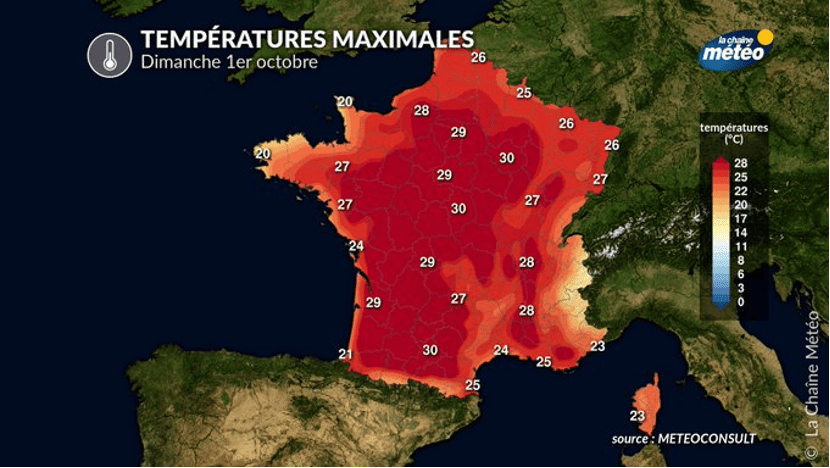
October temperatures which, for the less young, can only evoke "L'Été indien", that famous song from the 70s (warning: the chorus can linger in your head for a long time, it's at least the case for the author of these lines!)
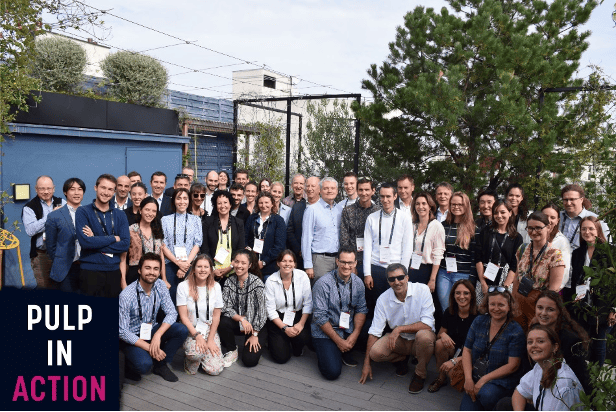
The bootcamp of the week is obviously that of (RE)SET, with its fourth opus (in 20 months) dedicated to "Pulp in action," bringing together 12 major brands in the cosmetics sector and 19 innovators from around the world: today, 20 pilot projects have been identified aiming to eliminate plastics from packaging in this pioneering sector, which is betting on substitution!
Thejudicial offensive of the week was brought by six young Portuguese, all the way to the European Court of Human Rights (ECHR), seeking nothing less than to create legally, or clarify, new human rights to a healthy environment. A very anticipated response from the ECHR in a few months.
The slogan of the week could have been "In France, we have no oil, but we have lithium," if we are to believe the President's statements and the assertions of the head of the Bureau of Geological and Mining Research (BRGM) in Les Echos : "The last inventory of national mineral resources is about fifty years old. 20% of the territory had been explored then, and only up to 300 meters deep, whereas today we know how to operate mines more than 1,000 meters below the surface. Similarly, at the time of the last studies, only 22 metals were being researched, whereas currently the list of metals of interest includes 55. Even if France will never be self-sufficient, its subsoil is far from being devoid of resources, contrary to common belief. First example: lithium. 'We will find it, that's for sure! France is undoubtedly one of the best-endowed countries in Europe,' assures Christophe Poinssot, Deputy CEO of the BRGM."
The riddle from last week questioned you on a philosophical principle and was illustrated by this photo which, in the manner of a Magritte painting, could have been titled: "This is not Occam's Razor"!

Wikipedia gives a simple definition that will allow you to easily understand why this famous "Razor" pleases us at (RE)SET 😉:
Also known as the principle of simplicity, principle of economy, or principle of parsimony (in Latin "lex parsimoniae"), "Occam's Razor" can be formulated as follows: Pluralitas non est ponenda sine necessitate [Editor's note: for non-Latin speakers, the translation is "multiplicity should not be posited without necessity"]. A more modern formulation is that "the simplest sufficient hypotheses should be preferred (it is necessary and sufficient)". It is one of the fundamental heuristic principles in science, without being strictly speaking a scientific result. In common language, Occam's Razor could be expressed by the phrases "the simplest explanation is usually the right one" or "Why look for complicated when simpler suffices?" However, "simplicity" as used here does not mean that the most simplistic, obvious, or conventional hypothesis is necessarily the right one. The razor does not claim to designate which hypothesis is true; it only indicates which should be considered first.
The week's riddle … is more down-to-earth and allows us to recall that at (RE)SET, we love to get our hands dirty under the engine hood. So what is it? A clue: note that beautiful green color!