Half-empty COP, or half-full COP? The media feed on this question. Still, we need to know which COP we are talking about…? At (RE)SET, we sometimes have a bit of a contrary spirit and we like to surprise. Since the media fill their columns with COP 28, let's fill ours with COP 15 😉. "COP 15," as its name indicates, is also a "Conference of the Parties" but unlike its "big" sister, it is not interested in energy, but in biodiversity. The time is justified to talk about it because exactly one year ago, 190 countries agreed, in Montreal, to sign an essential agreement, which provides for the protection of 30% of land and oceans by 2030 and twenty-two other objectives aimed at reducing biodiversity loss. And last Monday, Élisabeth Borne presented the final version of the third "national biodiversity strategy" (SNB), the reduction of which constitutes, according to her, "an existential threat." This SNB is intended to be the French version of the so-called Kunming-Montreal agreement adopted at COP 15. Long awaited for two years, the SNB will be closely scrutinized in its implementation because its two previous versions failed to achieve their objectives.
Elisabeth Borne's words emphasize the importance of the subject: " The collapse of biodiversity is so strong, so fast, so widespread that a sixth mass extinction threatens. (…) In a word, the collapse of biodiversity is an existential threat to our societies. We must stop it quickly and strongly reverse the trend ", she said while presenting 40 measures that " seek radical results without brutality " in their provisions. The measures, broken down into axes, sub-axes, and actions, are detailed in fact sheets, which you will find in this fascinating 333-page document. The objective is, as announced in Montreal, the effective protection of 30% of land and sea, the restoration of 30% of degraded ecosystems, and a halving of pesticide use. The failure of the previous two SNBs to meet the set targets is often attributed by observers to two major pitfalls: our agricultural model, based on a Common Agricultural Policy (CAP) that has not yet fully completed its "transition," and its counterpart: an immoderate use of pesticides, an addiction from which, as we have seen in Brussels in recent weeks, Europe is not ready to wean itself… For this third SNB, these two pitfalls are still present, and WWF France did not fail to point this out, regretting the absence of a revision of the CAP, which " still represents 63% of subsidies harmful to biodiversity in France, or 6.5 billion euros per year ". Response from Sarah El Haïry, Secretary of State for Biodiversity: " The objective is to gradually eliminate these harmful subsidies ", adding that a " mission " will be launched " with the ministries of economy and agriculture " to " reorient them to support the ecological transition ". A certain "déjà vu" feeling 😉. In the meantime, if you want to know everything about this SNB 3, we have a solution: sign up for the next (RE)SET webinar on the subject, which will be held on Friday at 2:30 p.m., free and open access, follow this link!

From COP 15 to COP 28, it's only a step we gladly take with Alain-Richard Donwahi, the Ivorian President of two of the three COPs imagined at the Rio Summit (1992). In an "opinion piece" published by Le Monde, he judges "urgent to adopt a coordinated approach between climate change, biodiversity loss, and desertification ". We read that the discussions for the preservation of the planet, shared among the three COPs (climate, desertification, and biodiversity), are too fragmented, while being closely linked. With a " perverse effect ": " attention, efforts, and resources are mainly focused on the climate COP to the detriment of the other COPs, which nevertheless deal with equally fundamental issues. " He says it better than we do, even though at (RE)SET we never fail to remind: " By separating the subjects, by fragmenting discussions and thinking, we too often forget that climate change, desertification, and biodiversity loss are closely linked. They form a vicious circle that accelerates each phenomenon and amplifies its effects. To fight effectively, it is essential to adopt a holistic approach: understand the interactions between each of these phenomena and go beyond the urgency and crises created by their manifestations to address their causes. »
This skillful transition brings us back to COP 28, the famous one, with this observation: once again, this COP proves the validity of its existence perhaps less in its content – "promises, always promises" – than in its surroundings. Thus, it can boast of having caused a Copernican revolution in the writing of the 8 p.m. TF1 news 😊 A detail, you might think, but actually no: it's important. Because not everyone reads (yet) Breaking (RE)NEWS! To reach the general public, the 8 p.m. TF1 news remains "a must" and it has often been accused of outrageously neglecting, a bit like Le Figaro, "transition" matters. That's no longer true! In a superb 3D clip created with remarkable pedagogy and lasting "long" (for a news program) 5 minutes, TF1 has grasped the magnitude of the subject, and we congratulate them! If you were still looking for how to explain the greenhouse effect to your children or your grandparents, watch this video. Well, if the TF1 editorial staff reads this Breaking (RE)NEWS, they will understand that the next step will be to show the same inventiveness to talk about COP 15 or, even better, the real global subject that encompasses all others: RESOURCES!

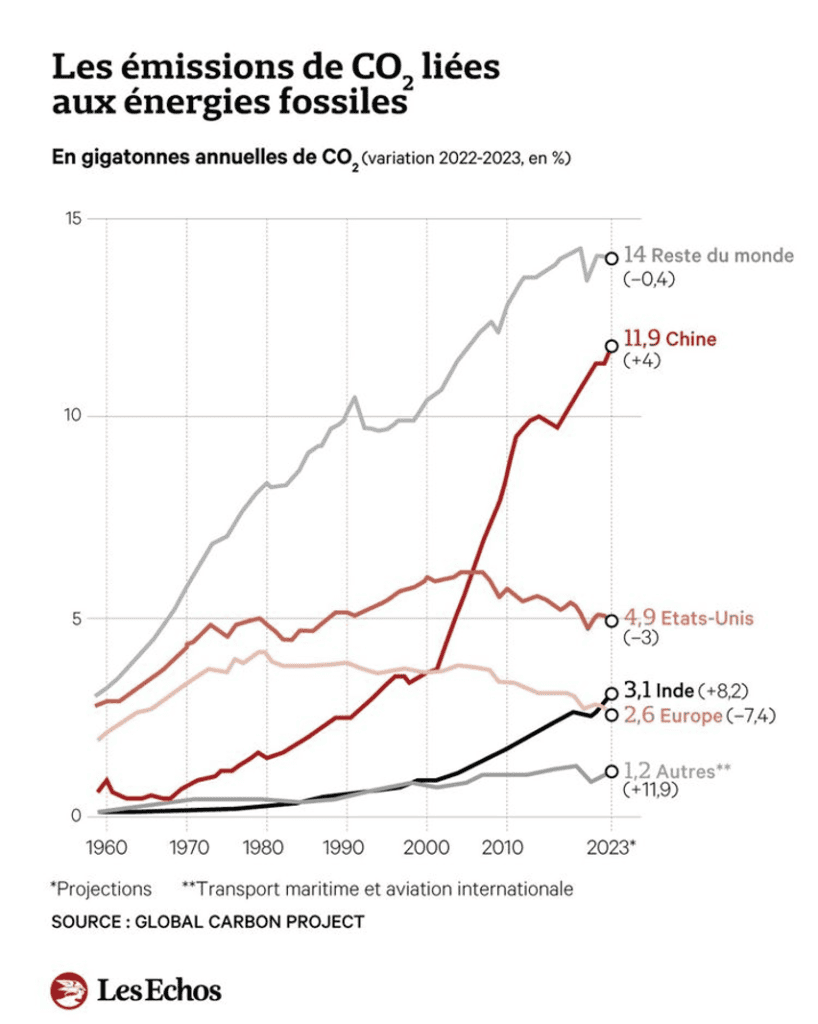
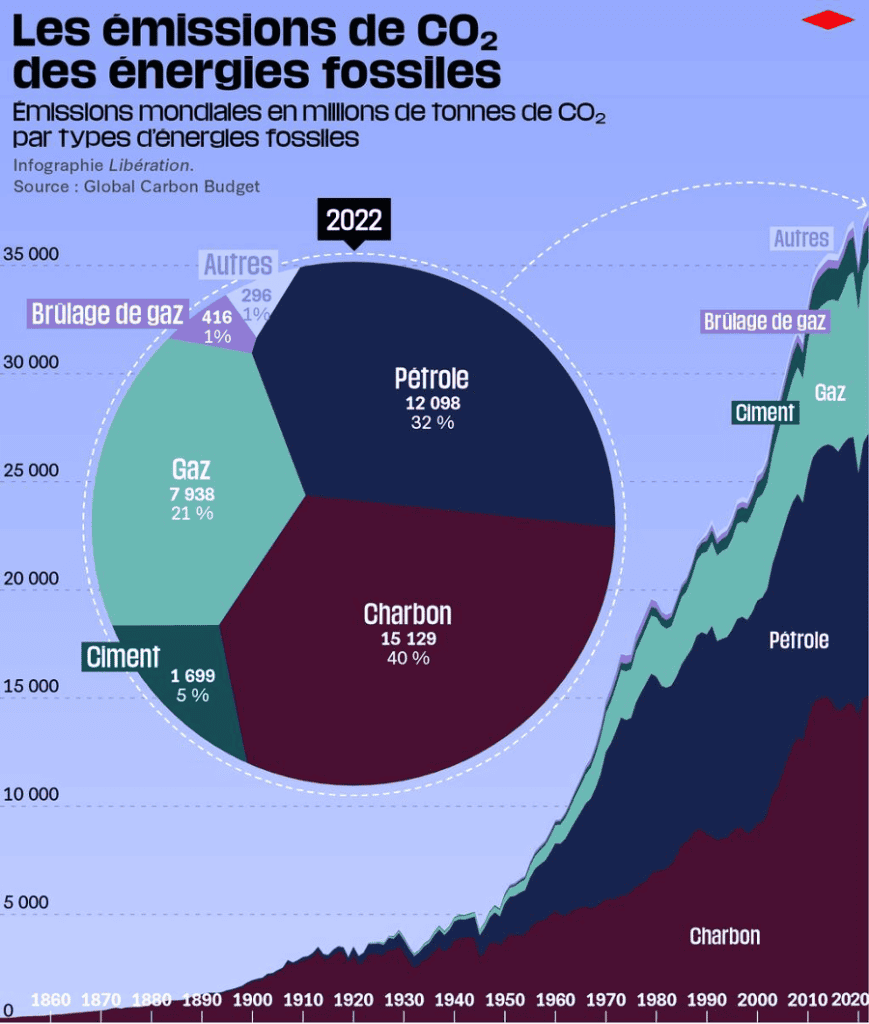
"COP" still, some good news nonetheless: added at the last minute to the plenary session agenda, the realization of the loss and damage fund was adopted right away by the states. This fund is intended to help the most vulnerable countries face the irreversible damage of climate change. Southern countries had been demanding it for thirty years. It should be operational "within the year," even if no quantified objective was given. Otherwise, COP 28 officially ends on December 12, and we still don't know if an agreement will be found to call for the phase-out of fossil fuels, beyond just coal. A moment to recall, with these graphs, that far from stabilizing, and therefore even further from decreasing, emissions related to fossil fuels continue to rise at a healthy rate… Beware of optical illusions: the flamboyant red curve in Les Echos' graph represents China, but if we relate emissions to the number of inhabitants, Australia or the United States remain far ahead.
And in the meantime, the European Copernicus observatory has just confirmed that the year 2023 is already assured, based on November figures, of being the hottest ever measured in history.
To continue gently towards our weekly sections, the quote of the week is quite a doozy, as they used to say a long time ago. Just consider: "There is no science, nor any scenario, that says that the phasing out of fossil fuels will allow us to reach 1.5 degrees." And we give it to you in a thousand (another formula that smells a bit of mothballs), the brilliant scientist author of this sentence is… the President of COP 28, Sultan Al Jaber. A COP 28 President should not say that 😉. His interlocutor, Mary Robinson, former President of Ireland, was stunned.
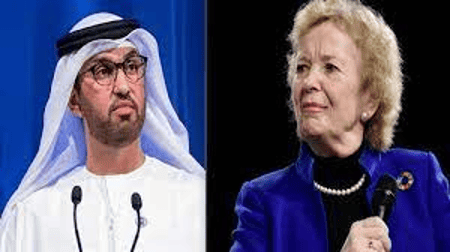
This leads us directly to the number of the week : 2,456 "fossil" lobbyists participating in this COP 28, which some call an " oil spill ". This figure was made public by a coalition of NGOs with the evocative name "Kick Big Polluters Out." It's an understatement to say that the shadow of fossil fuel lobbies hangs over these talks, which is not illogical at a time when the question of their phase-out is becoming increasingly pressing. TotalEnergies and all its competitors came in a pack to defend what they perceive as their best interest.
The vehicle of the week that pleases no one except drivers and car manufacturers 😊 is again the SUV. According to Greenpeace, the surge in SUV sales cancels out the climate gains made possible by electric vehicles. And Greenpeace will not consider the use of electric SUVs, as these models have a much higher carbon footprint than other electric cars, notably because they require more steel during production, which ADEME has already pointed out in its studies. Food for thought if you are a Parisian and you plan to vote on February 4 in the referendum organized by the City of Paris "for" or "against" the tripling of parking prices for SUVs!
The conviction of the week is a bit repetitive but we never tire of it: the Council of State thus condemned the State for its inability to bring air pollution levels in Paris and Lyon into compliance with legal limits, imposing two penalties of 5 million euros for the two semesters from July 2022 to July 2023, halving the penalty amount per semester compared to previous convictions, explains the highest administrative court. These amounts will go to various organizations and institutions. In October 2022, the Council of State had already condemned the State to pay a record penalty of 20 million euros.
Theiceberg of the week goes by the name A23a, and it's big, very big: 4,000 square kilometers, 400 meters high, and a good billion tonnes. Well known to scientists – it once hosted a Soviet research station – it broke away from the western continent in 1986 before remaining stuck at the bottom of the Weddell Sea for over thirty years. According to recent satellite images, it is now drifting beyond the northern tip of the Antarctic Peninsula, at the mercy of winds and violent currents. The trajectory of this giant ice cube, 38 times the size of Paris, is not linked to climate change but rather to a succession of natural events, glaciologist Lydie Lescarmontier, director of Antarctic action at the International Cryosphere Climate Initiative, explains to Libération . The South Pole specialist, present at COP28 in Dubai to warn about the critical fate of polar regions, nevertheless observes an increase in the number of spectacular icebergs due to human-caused global warming. If I were you, I'd avoid long-distance cruises on luxury liners in the coming years 😉.

TheESG innovation of the week, or rather next year's if all goes well, was voted on by the European Parliament and is moving in the right direction. The Committee on Economic and Monetary Affairs approved a text that brings significant changes to the rules proposed by Brussels to regulate environmental, social, and governance (ESG) rating activities. To simplify, instead of an overall ESG score, the average of the three letters, three scores would be established, one per letter. The idea is of course to prevent a company from making a significant effort on one or two of the three while completely neglecting the last, and still obtaining a decent average score. Concretely, today, it's the "E" part, as in environment, that is most lacking in companies. An opportunity to recall the classic example of the gentleman, or lady, whose feet are put in the freezer and head in the oven, estimating that the average temperature is acceptable…
The other European vote of the week will have to be validated in plenary session, but it is on track: the European Union is preparing to ban the destruction of the vast majority of new, unsold clothing. This regulation already exists in France but will therefore be extended. Only the smallest businesses will be exempt.
The interview of the week pleases us at (RE)SET, as we find many of our strong convictions there. Interviewed by Le Monde, Anais Voy-Gillis, associate researcher at the Institute of Business Administration in Poitiers, doctorate in geography and specialist in industrial issues, states that "(…) the belief is still too strong that we will get through this with a few marginal adjustments and by decarbonizing industry. But decarbonization does not solve everything. Once we have decarbonized, many questions remain, such as access to resources and raw materials." She also recalls that a "100% neutral human or industrial activity does not exist and will not exist. Talking about green industry or green growth makes little sense. What matters is how we go about minimizing our environmental impact, especially for so-called 'heavy' industries" ? Common sense and pragmatism are the lifeblood of the transition 😉.
The useful product (and its by-product) of the week is the sisal. Researchers at Stanford University have developed an absorbent material from sisal fibers intended to be used to make sanitary pads. Their goal? To fight menstrual poverty in arid and semi-arid regions, in particular by sharing their work with local manufacturers. It is estimated that 500 million women worldwide cannot access quality menstrual hygiene products. Sisal is a plant fiber widely used in flooring. Unlike cotton, it is inexpensive and does not require much water to grow. And, unlike wood, sisal is abundantly available in many countries. Native to Central America, the plant is also grown in Africa, particularly in the eastern part of the continent, and in other regions of the world with arid or semi-arid climates.

The little creature of the week that might not go extinct after all is the kiwi (the bird, not the fruit). Evidenced by the birth, for the first time in nearly a century, of two of its kind in the wild, near the capital of New Zealand 😊.

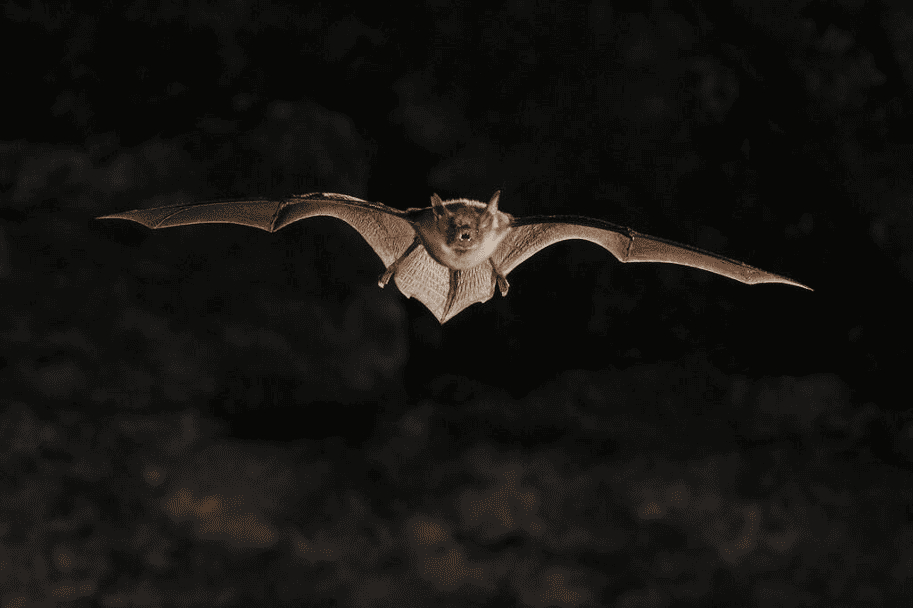
The not-always-little creature of the week that we should appreciate more at its true value is the bat! A high-tech gem, possibly cuddly according to experts, it primarily provides a natural response to the proliferation of mosquitoes and other beetles that can harm our sleep and our agriculture, respectively. On the other hand, they need attention: stressed, they are perfect carriers for many viruses. So be kind to bats, there, it's said!
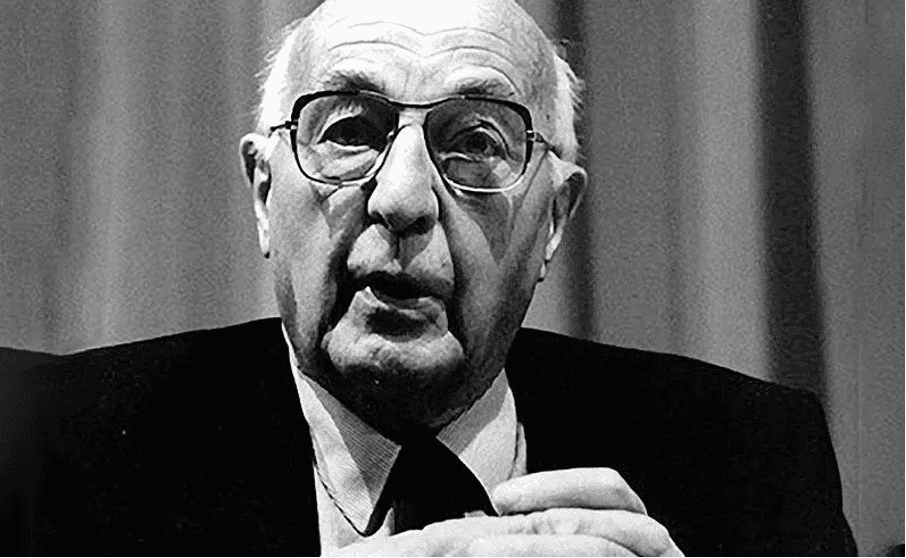
The riddle from last week was to identify this personality in the photo, who would have benefited from being better known. The clue: this man invented a concept that we like at (RE)SET ! Who was it? You will have recognized him – or not – this bespectacled gentleman is none other than Nicholas Georgescu-Roegen, of Romanian origin, a mathematician and economist who developed what was called the theory of " bioeconomics " in 1971. To oversimplify, this economist was particularly interested in the question of entropy: "not only is nothing free in relation to the environment, but everything always costs more than what one can get from it." A way of anticipating the Meadows report and the work of the Club of Rome. Reconciling economic activity with environmental constraints was at the heart of Nicholas Georgescu-Roegen's work and remains more relevant than ever! Unfortunately becoming a figure of the degrowth movement, he was actually more interested in modifying the accounting of growth and its quality.
The week's riddle again takes us up a level; it will then be difficult to go higher (that's the clue 😉). Who said: "(…) fill the earth and subdue it (…) be masters of the fish of the sea, the birds of the sky, and all the animals that move on the earth"? Another one who forgot COP 15 and hasn't read SNB 3…?