
The school holidays are over, the Agricultural Show has closed its doors after many turmoils, the European Parliament is at odds over environmental issues, Bercy is cutting these budgets: welcome to a few weeks before the European elections.
To paraphrase Les Echos' analysis, "dark clouds are gathering over ecology in France. This week, it's MaPrimeRénov' (renovation grants) and the Nodu (pesticide measurement indicator) that have suffered from government backtracking." But to be honest, this "bad wind" is not blowing only over our heads. In Brussels, the victim of the week is the CSDDD, also known as CS3D, or Corporate Sustainability Due Diligence Directive, to those in the know. Crossing the Atlantic, we see that in the United States – also in a pre-election period – the transition is not celebrating either. Three of the world's largest financial asset managers, JP Morgan, State Street, and BlackRock, have announced their departure from the Climate Action 100+ organization, which advocates for companies to take climate objectives into account. At the same time, more and more industrial players, from chemicals to automobiles, are openly contesting the environmental standards they are subject to. And for the past month, farmers across Europe have been taking their tractors out. Decidedly, "the ecological transition is off to a bad start," to quote Le Mondethis time, which continues: "The bad wind coming from the United States is sweeping over Europe."
Regular readers of Breaking (RE)NEWS will not be surprised by all these developments, which have been a subtext of the "transition" news for months. Today, in France and Europe, governments are reducing their "green" spending, far from the ecological ambitions still displayed a short time ago. Thus, the "doubling of transition spending," called for by many reports, in France (notably with the Pisani-Ferry report) as well as among our neighbors. While L'Obs, among others, notes "the executive's seven renunciations on ecology" in recent weeks, from EcoPhyto to MaPrimeRénov', including social leasing for electric cars or the Green Fund for Climate, reports are coming one after another denouncing the growing gap between stated objectives and actual investments. Faced with debt, rising interest rates, and slowing growth, France is not the only country on the continent to be slashing its "green" spending. In Germany, the Karlsruhe Constitutional Court banned, in November 2023, the transfer of 60 billion euros to a fund for climate and economic transformation. In a few months, Sweden abolished subsidies for the purchase of electric vehicles and then revised downwards the share of biofuel in diesel and gasoline.
In this context, a report by the Institute for Climate Economics (I4CE), published this week and reported by Le Monde, recalls the level of investment needed for the European Union (EU) to meet its commitment to reduce greenhouse gas emissions by 55% in 2030 compared to 1990 levels. According to its calculations, public and private climate-related financing increased by 9% between 2021 and 2022, reaching 407 billion euros (2.6% of the EU's GDP). But to hope to stay on the path to carbon neutrality by 2050, the Twenty-Seven should devote at least 813 billion euros annually (5.1% of GDP) to it. That is, double, as Les Echoscorrectly calculated. We are not on that path.
In Brussels, the "clap of thunder" came from an unprecedented about-face by the Council of the European Union. After four years of arduous negotiations, a complicated but victorious trilogue between Parliament, the Commission, and the Council, the adoption of the "European duty of vigilance" was only supposed to be "a formality," to use the words of L'Usine Nouvelle. It was not to be. The EU's Committee of Permanent Representatives (COREPER) could not muster a majority to vote on CS3D, due to a lack of a qualified majority. This is a major setback for European social and environmental regulations and for the Green Deal, against a backdrop of lobbying by European economic actors. For several weeks, the text was under attack from all sides: a coalition of interests, bringing together European conservatives and far-right parties and certain economic lobbies, was pressuring to block the validation of the text, with the ear of their respective governments. The rapporteur for the draft directive is "outraged" that Paris and Berlin are " trampling " on the work of Parliament. The difficulty lies in the timing. It is no longer possible, it seems, to try to have the text revoted, given the imminence of the elections. And after the elections, as Breaking (RE)NEWS readers know, the new Parliament and the new Commission are likely to be less inclined to continue down the path of deepening the Green Deal, of which CS3D is one of the most important elements…

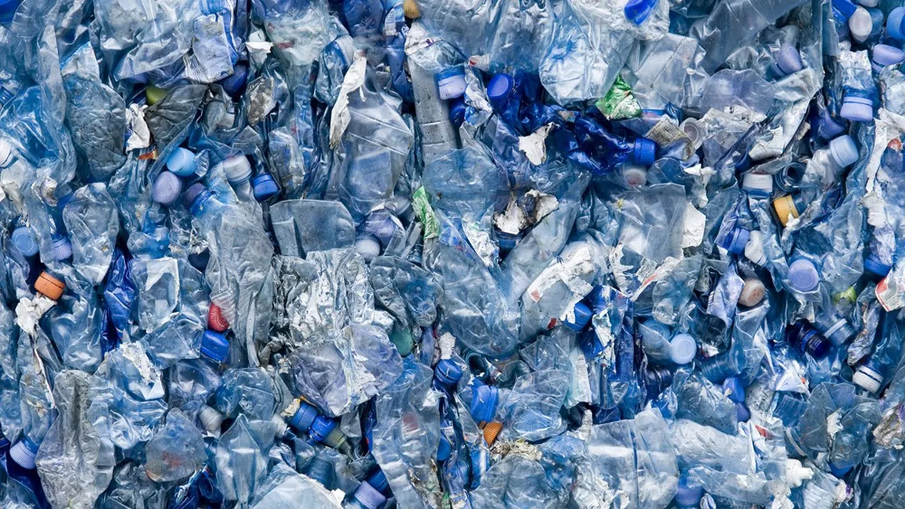
To start our weekly sections on a more positive note, the advancement of the week shows that "not all is lost." To paraphrase Les Echosheadline, "Europe puts an end to the export of its plastic waste." In these uncertain times, the adoption of an agreement to better control waste transfers outside the European Union must be welcomed. More specifically, exports to non-OECD countries will no longer be authorized unless they have the necessary facilities to "manage them in an environmentally sound manner," according to audits entrusted to "independent bodies." A specific register containing information relating to these audits will be centralized by the Commission. Regarding exports of plastic waste, they will simply be banned to non-OECD countries. The targeted countries will have the opportunity, after five years, to request to import this type of waste again and will have to prove that they do not resort to landfilling or incineration of collected waste. A clause is provided for by the end of 2038 to analyze the relevance and consequences of this ban. Additionally, the transport of waste intended to be disposed of in another European country will only be authorized in exceptional circumstances.
In the same positive vein and still in Brussels, the confirmation of the week concerns the Nature Restoration Regulation. "A historic victory," for France Nature Environnement, which recalls that this text went through intense negotiation phases and only narrowly survived a massive campaign orchestrated by the right and far-right of the European Parliament. Nevertheless, with over 80% of natural habitats in poor condition and 70% of soils in poor health, the EU is now providing itself with the necessary means to ensure the sustainability of the lifestyles of its inhabitants and its economy. Member states commit to implementing restoration measures on 20% of European land and sea by 2030, and on 100% of degraded areas by 2050. This general objective will be broken down by ecosystem type (marine, forest, agricultural, urban, …) and adapted to national environmental realities. Member states now have two years to develop their national restoration plans, which will be reviewed by the Commission by 2027 at the latest. The World Economic Forum estimated in 2020 that more than 50% of global GDP (i.e., 44,000 billion dollars) depends on nature and its services. Nature supports many activities essential to our existence and our economies: food production, extraction of renewable materials (such as wood or textile fibers), water purification, climate regulation, or protection against natural disasters (e.g., landslides and floods). The inclusion of a legal obligation of restoration in European texts is a strong signal.
The opinion piece of the week, published in Le Monde , is rather provocative with this counter-intuitive assertion: "Technical progress and the substitution of one metal for another should quickly deflate the myth of rare earth scarcity," estimates Didier Julienne, a metal market expert. A praiseworthy faith in technology and the genius of engineers, and we would like him to be right, but keeping our fingers crossed that this prediction comes true is probably a minimum. Especially since the same newspaper also gives voice to other researchers who express a radically opposite certainty: "The European Commission forecasts a dizzying increase in demand for critical raw materials." The intuition of growing scarcity of critical resources is widely shared by (RE)SET.
Theinvestigation of the week, published by Les Echos, rather focuses on the issue of rare metal scarcity due to the increasing use of "high tech" and suggests a ultimately logical solution: favoring "low tech"! Which gives this paradoxical title: "High tech: what if the future were low tech?" Simplifying production processes and promoting the design of more frugal products without superfluous technology and with fewer resources: this approach, long confidential, is now entering engineering schools. And in companies, according to Les Echos, which takes as an example the electric car of the Bordeaux-based start-up Gazelle Tech, a featherweight vehicle (900 kg) whose body is entirely made of composite materials, with a small battery (20 Wh) providing a range of 180 km:

The new acronym of the week is black humor. You liked MOPGA ("Make Our Planet Great Again") from President Macron in 2017 – which you can rewatch here on YouTube– you will like MOPDAA less, the ironic version of the former, which stands for "Make Our Planet Dead After All," invented by a researcher quoted by Le Monde.
Somewhat in the same (bad) spirit, the quip of the week is to be credited to François Veillerette, the spokesperson for the association Générations Futures: "It's no longer EcoPhyto, it's EcoPipeau!" (EcoRip-off), TF1reports. A fine analysis of the change in indicator for measuring pesticide use in fields. France is going to drop Nodu (the pesticide use indicator) in favor of HRI-1, the harmonized risk indicator developed by the European Union. And if scientists are to be believed, if Nodu was far from perfect, based on quantities and not on the degree of danger, HRI-1 has other flaws. Notably, by construction and simple arithmetic, the adoption of HRI-1 will allow France, without any change in its practices, to easily achieve the "50% reduction" in its pesticides, an objective that has been constantly postponed for 20 years.
The good news of the week is the quantification, by the General Secretariat for Ecological Planning (SGPE), of the impact of the economic and environmental transition on employment by 2030: the transition would cause 250,000 job losses and 400,000 job creations. That is, on net, Les Echosreminds, a positive balance of 150,000 additional jobs created by 2030. Of course, these jobs are not the same and therefore do not require the same training or experience…
The complaint of the week is that of the association FoodWatch against Nestlé and Sources Alma, which Libérationcovers. The consumer defense association has filed a complaint against the two groups for the disinfection treatments they used on their waters such as Vittel or Perrier. These practices are common for tap water, a priori without health risk, but are prohibited for so-called "natural mineral waters"… as their name should indicate.
The number of the week is given to us by the IEA, International Energy Agency. In 2023, emissions from the energy sector, i.e., those linked to the combustion of fossil fuels (coal, oil, and gas) and industrial processes, reached a new record high: 37.4 billion tonnes. It is particularly the consequences of climate change, caused by the combustion of fossil fuels, that explain this increase: extreme and prolonged droughts hit several countries, including the United States and China, causing a drop in hydroelectric production. To compensate for this drop, these countries had to resort to more fossil fuels to produce electricity, which generated an additional 170 million tonnes of CO2. According to the IEA, without this "unusually low" hydroelectric production, global CO2 emissions linked to electricity – not energy – production would have decreased in 2023. Temperatures in 2023, which was the hottest year ever recorded, also limited the need for heating energy.
The pleasing graphs of the week have only a distant connection with our subjects, but we cannot resist the pleasure of sharing them with you because they say a lot about the French way of life as well as, perhaps, about the quality of our agricultural and livestock products:
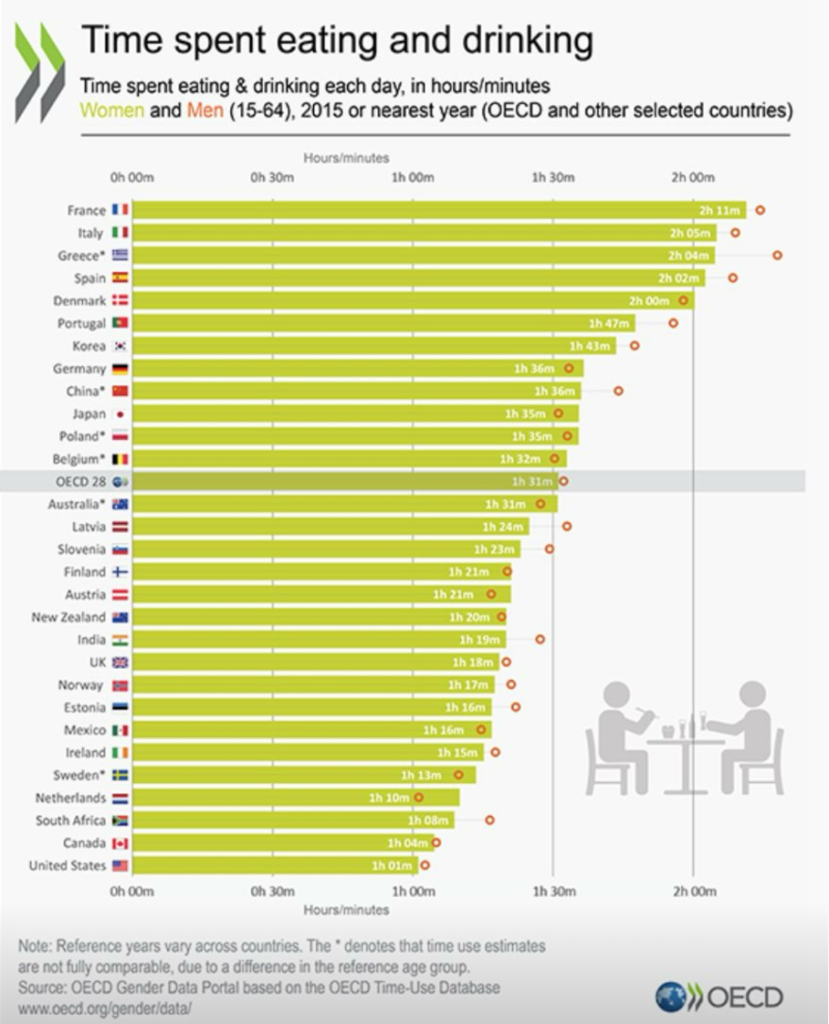
Yes, the French love to eat and drink and they devote time to it! The opposite of our poor North American friends (Canada and the United States).
And yet…
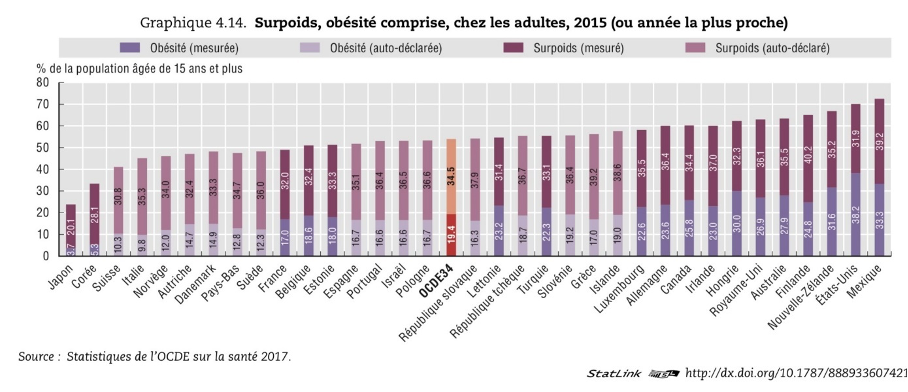
France has less than 50% of its population overweight – which is already far too many, of course – compared to over 70% of Americans! Obesity now affects one billion people on the planet, according to a study published in The Lancet and reported today by Le Monde.
So long live France and its farmers, we come back to it. That said, the Japanese diet is even healthier (less than 25% obese) and, based on rice and fish, it is significantly less GHG-emitting than ours. This leads the French Society of Nutrition and the Climate Action Network, in a recent study, to recommend that the French eat less and better quality meat… As a reminder, food accounts for 22% of France's carbon footprint, and "60% of these emissions come from the production, at the agricultural level, of the food we consume," the document recalls.
The COP of the week that is little talked about was mentioned in our previous Breaking (RE)NEWS. The 14th Conference of the Parties (COP14) of the Convention on the Conservation of Migratory Species of Wild Animals concluded with a series of commitments by states to try to preserve these species, half of which are in decline. Including the Balkan lynx:

But also the Pallas's cat:

Or again, perhaps slightly less endearing, the bull shark:

Still on biodiversity, the animal of the week is the dinosaur, which is still among us, as revealed by the weekly Le Point. Which specifies that it "goes tweet tweet"! Because we are, of course, talking about the descendants of dinosaurs. Because new scientific studies are now consensus: today, the vast majority of paleontologists agree that birds are indeed dinosaurs. They simply evolved and crossed through the ages to our era. Birds therefore come from a family that lived in the Cretaceous period, which extends approximately from -145 to -66 million years. It was during this geological period that most dinosaurs disappeared, but birds survived the meteorite impact. Let's leave the conclusion to the journalist from Le Point: we must "reconsider the contempt you have for pigeons. Be careful, its cousin might be a T-Rex!"

The riddle from last week was a number: $2.2 trillion spent worldwide in 2023 alone. But which sector could have prompted such spending…? The clue was that this number is explosive… Indeed, it's global military spending in 2023, up 9% year-on-year, as can be read in Les Echos. NATO accounts for half of this amount. Very low-carbon spending, by the way! This week's riddle takes us up in height, distance, and age… What is it? A clue: it is absolutely not an image taken from the second part of the film Dune, which has just been released and, by the way, we recommend.

[As a reminder, (RE)SET, founded in 2019, is the first independent consulting firm dedicated to economic and environmental transition and built for action. "(RE)SET: resources to win environmental and economic battles!" Inevitably partial, sometimes biased, always committed, this media review with its often spirited, even impertinent tone, in no way commits (RE)SET in its consulting activities, but it paints a picture we find interesting of the state of the transition as it appears in the press and research. A snapshot of the debate, of the forces at play, the oppositions, the convergences, which we hope is useful for your decisions and for building your transition strategies.]