The vast majority of French people, including you faithful readers of Breaking (RE)News, as well as the author of these lines, will find farmers when going back a few generations in their family trees. This is undoubtedly also why we love our farmers. We love them so much that our leaders are tempted to make big mistakes from a scientific point of view. And they make concessions on almost anything. But are these true signs of love? Abandoning Ecophyto – which never really worked – to continue using too many pesticides? Excluding over-transpositions of European regulations, when there are very few in this sector? Continuing to subsidize ever more a model of agricultural production that we know is ultimately doomed?
As the tractors return to their fields, environmental experts are "stunned," to use the term from Les Echos, a daily where one finds few "eco-leftist" journalists. " The dyke has burst ", continues Les Echos : "After holding the line on the essentials, the government finally gave ground on ecology to give pledges to angry farmers (…) The future will tell how long this pause will last – which will incidentally reveal France's true ambitions for the ecological transition. "
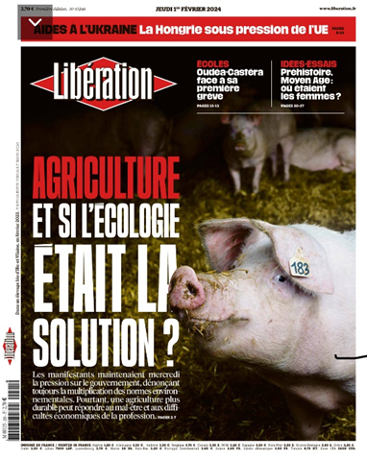
Moving from Les Echos to Libération, this gives these two front pages separated by 24 hours:
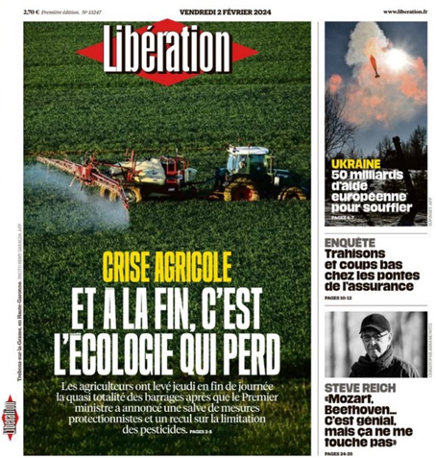
The government thus decided to satisfy almost all of the FNSEA's demands, to make a long story short. Notably, Gabriel Attal promised that " all aid " from the Common Agricultural Policy " will be paid into farmers' bank accounts by March 15 " that a "emergency fund would be set up before the end of the week to support our winegrowers, particularly in Occitanie ", and that a " major product traceability control plan " will be implemented to "ensure fair competition." The head of government also announced simplification measures aimed at " unblocking " the administrative constraints weighing on farmers. No more " over-transpositions " of European directives, the prime minister swore. Finally, while the Élysée insists that the " present of farmers " must not compromise " the future of generations ", Marc Fesneau announces a " pause " in the Ecophyto plan, aimed at gradually reducing pesticide use. This suspension of the Ecophyto plan set off fireworks from environmental defenders: a " disastrous signal ". If we dared, we would almost downplay the importance of this bad decision, because this latest version of the Ecophyto Plan, the third, followed two previous ones with the same objective: reducing pesticide use by half in France. That never happened: it has been increasing for 20 years, confirming the dismal failure of successive Ecophyto plans. This one will therefore have failed faster.
Another bad signal that one might cynically think won't change much: the over-transposition of European standards, now excluded. Because in reality, Pierre-Marie Aubert, a specialist at the Institute for Sustainable Development and International Relations (Iddri), explains in an interview with La Croix : there are practically none in France…
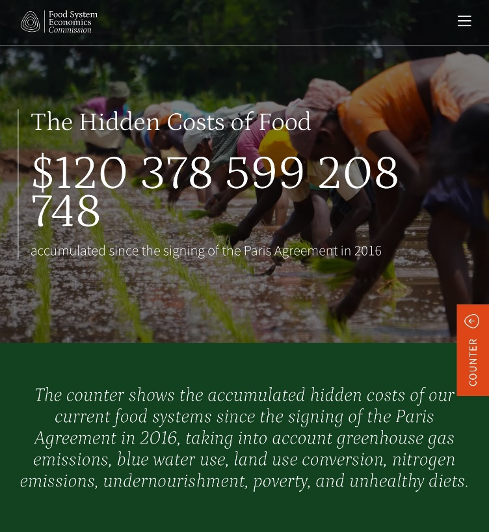
It seems that neither the FNSEA nor the government have had the time, during this period of crisis, to read an article conveniently published in the Financial Times and relayed by Courrier International , which focuses on the new report by the Food System Economics Commission. We highly recommend this report, which you can read by following this link. . This report tells us that transforming the global food system towards a more sustainable model, better for health, climate, and biodiversity, would increase agricultural prices "by about a third by 2050 ", but this increase would be offset by gains of up to $10 trillion per year. The Food System Economics Commission, an independent group of some 60 experts in economics and sustainable development, worked for four years to establish that the current " environmental cost of food systems amounts to 3 trillion per year, and additional health costs to at least 11 trillion per year ". Adopting a healthier diet (more fruits and vegetables, less meat) would thus save 5,000 to 10,000 billion per year, "even taking into account the additional costs associated with transforming production and consumption," according to the report. Its website's support tool calculates in real time the "hidden costs" of food, accumulated since the Paris Agreement was concluded. At the time these lines were written, the figure was: $120,378,599,208,748. That's a lot of euros 😉.
In an opinion piece in Le Monde, biologist Marc-André Selosse, a soil life specialist, goes in the same direction, recalling that "the measures demanded by the farming profession, even granted by the government, lock us into dependence on fossil fuels or pesticides and delay the implementation of alternatives. But the ecosystem and health reality is stubborn: the gap between it and agricultural practices is growing, and promises, in the long term, an even harder landing. »
So why? Why have we endorsed these days the continuation of an agricultural development model that we know is not ultimately sustainable? Eric Le Boucher, an editorialist for Les Echos, has his own idea on the matter: "By sticking, on all subjects, to the imposture of the two populisms of the far right and far left, media-political debates in France systematically fall into demagoguery and the illusion of oversimplification, all continuously sprinkled with 'controversies,' 'declines,' and fears. Today, it's agriculture's turn." "In summary, here is the tone of the national outcry: down with free trade, down with Europe, and down with this ecology we can no longer stand! The misfortune of this charlatanism is that French agriculture, like France in general, quite the contrary, needs free trade, needs Europe, and must, despite the difficulties, change its model to move to agroecology." "The new revolution of agroecology (…) can help build a new model for France and teach it again how to properly exploit its immense natural wealth. The primary condition is, for all French people, and first of all farmers, to break free from oversimplification and not to listen to demagogues."
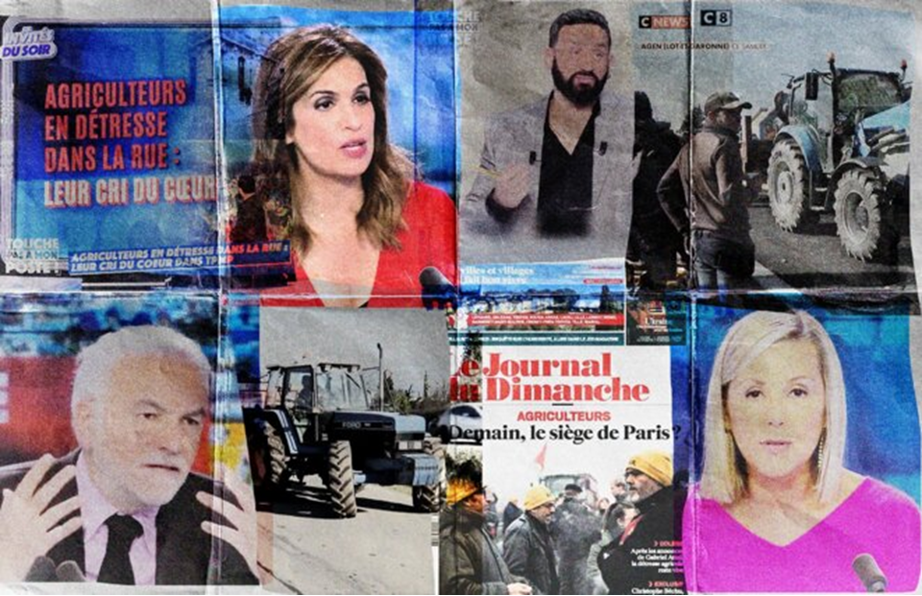
But how can we not listen to demagogues when they are everywhere, wonders Médiapart which noted that the far right (to put it politely), with the "Bolloré media" (JDD, CNews, C8, …), pulled out all the stops, all in sync with the farmers' anxiety… The prize going to CNews, which turned its logo upside down while guests' venomous accusations against "the little gray men in Brussels" scrolled by…
For its part, Le Figaro was not to be outdone, trying its hand at humor and delightedly attacking the Eurocrats: "Bernard [the Eurocrat] knows that the 'Farm to Fork' program, since it imposes degrowth, will harm the purchasing power of Europeans, will lead to the suicide of some farmers, and will threaten importing African countries with famine (anyway, overpopulated countries). But it will allow for a small reduction in the amount of greenhouse gases emitted by European agriculture; yet, since this is responsible for 0.7% of global emissions, it's worth it. »
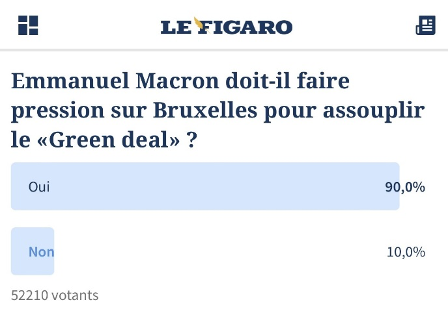
All this works perfectly, at least for Le Figaro readers, for whom an instant poll held yesterday gave this unambiguous result:
In the meantime, on its own very small scale, here is a suggestion from Breaking (RE)NEWS to try to overcome the demagoguery and current political climate by being productive and concrete: why, since the issue of pesticides has been raised for decades, not try to bring together stakeholders and launch a consortium to identify new techniques acceptable to all? The consortium, as Géraldine Poivert reminds in her latest article, is the joker, the master asset of the transition. It would be a shame not to use it enough…
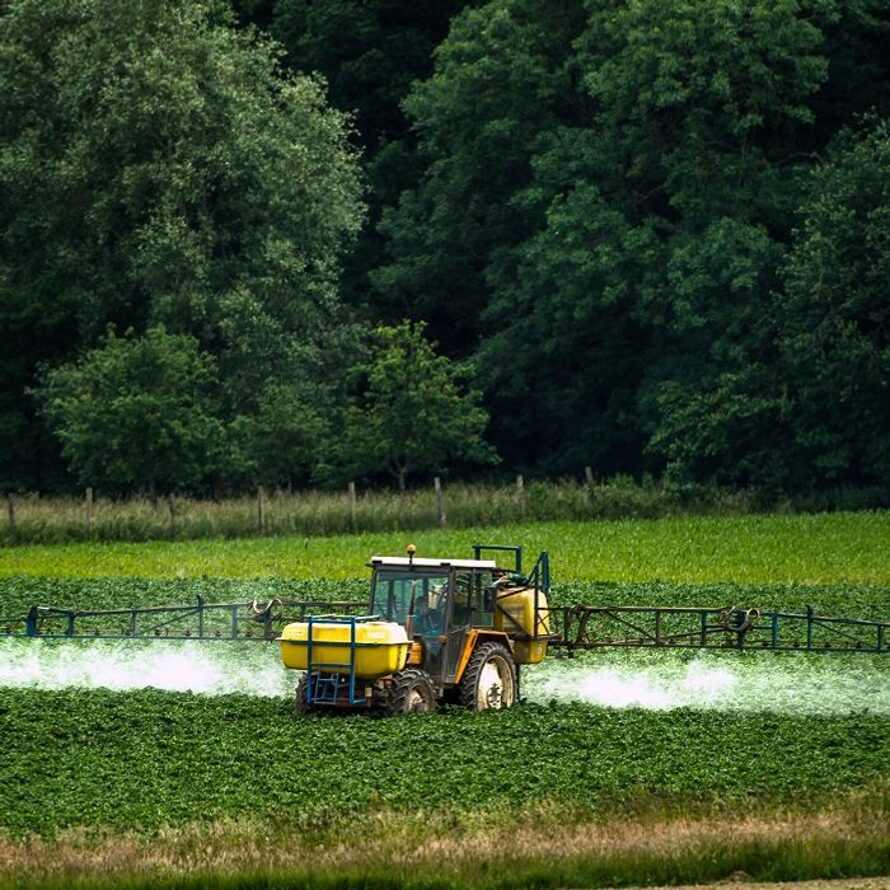
Since we are talking about agriculture and pesticides – note the skillful transition to our weekly sections – the opinion piece of the week is from 40 health insurance executives, who raise an alarm cry that seems not to have been perfectly heard by the Attal government. "Pesticides: let's learn lessons from the asbestos tragedy for the future," they proclaimed… two days before the Ecophyto plan was put on pause! According to this collective, " the parallelism between the facts that led yesterday to the asbestos tragedy and today to that of pesticides pushes us to mobilize and alert the public and decision-makers. It is time to act: the responsibility of pesticides in the 70% decline in the quantity of human sperm and in the disappearance of 80% of flying insect populations is now established. Thus, we know that there is not human health on one side and biodiversity health on the other. Our destinies are linked ". Moreover, they add, " it is also demonstrated by the 2019 EU Court of Justice ruling that the pesticides sold today do not comply with the law. As they are marketed, they are never properly tested on health. Manufacturers wrongly evaluate only isolated molecules, but never mixed, as should be the case. " Once again, we cannot say "we didn't know"…
The number of the week unfortunately keeps us on the subject: 63%. In an explosive report, the National Institute for Demographic Studies (INED) reveals that 63% of the world's inhabitants live in regions where fertility no longer reaches the replacement level, compared to 45% twenty years ago, reflecting a dramatic decline in fertility worldwide. The cause: many factors, but notably one, the "sperm crisis" often mentioned in Breaking (RE)NEWS. Fewer in number, less vigorous, they are less effective, and this movement has been amplifying continuously for over 50 years. Among the identified causes: … pesticides. Demographic rearmament in France and the pause of the Ecophyto plan are not necessarily compatible in the long run 😉.
The scandal of the week that should have been worse is that of so-called "mineral" bottled waters. For years, waters sold as "spring water" or "natural mineral water" underwent prohibited purification techniques. According to a joint investigation by Le Monde and Radio France, at least a third of French brands are affected, including those of Nestlé, which has admitted these practices, having by its own admission "somewhat lost sight of the regulations." As well put. Informed since 2021, the government decided, rather than cracking down, to quietly relax the regulations, until today… For its part, L’Usine Nouvelle specifies that the Swiss group Nestlé Waters, probably aware of the upcoming revelations from Le Monde and Radio France, took the lead and admitted its wrongs; justifying the use of activated carbon filters and ultraviolet treatment by the need to " overcome the impact of climate change and the rise in water stress which partly affected the mineral content of its waters ". Contacted by L'Usine Nouvelle, the number one bottled water company in France confirms that it must " adapt its activity, its practices, and its sites to changes in the environment around its sources, which can sometimes make it difficult to maintain the stability of the essential characteristics of a natural mineral water, as required by the regulatory framework ". It acknowledges having taken protective measures that " were not in line with the regulatory framework or its interpretation in France " without specifying for how long, as it does not know " the exact history ". Nestlé Waters had informed the government of its illegal practices as early as 2021. It even convinced it to modify the regulatory framework that prohibits industrialists from microfiltration below 0.8 microns, as evidenced by the minutes of an interministerial meeting organized in February 2023 consulted by Le Monde and Radio France. A way for it to continue treating its mineral waters – while abandoning, however, ultraviolet treatments and activated carbon filters – without them losing their natural mineral water appellation. Otherwise, there is tap water, cheaper… Too bad for the die-hard plastic bottle users; we know there are still a few, even at (RE)SET !
The anti-sustainable development monster of the week is a ship. Not just any ship: the world's largest! 365 meters long, 40 restaurants, seven swimming pools… "Icon of the Seas," the world's largest vessel, has set sail. But rest assured: it is powered by an engine running on liquefied natural gas, a fossil fuel that the industry presents as a cleaner alternative to heavy fuel oil. Cleaner, perhaps, but still fossil-based, and a large emitter of methane, a powerful greenhouse gas, Le Mondereminds us. Its shipowner, obviously very sensitive to environmental issues, has nevertheless provided for organic waste sorting for its 5,610 passengers and 2,350 crew members…

The "meanwhile" of the week keeps us on the waves. Ocean temperatures continue to break historical records, month after month for over a year.
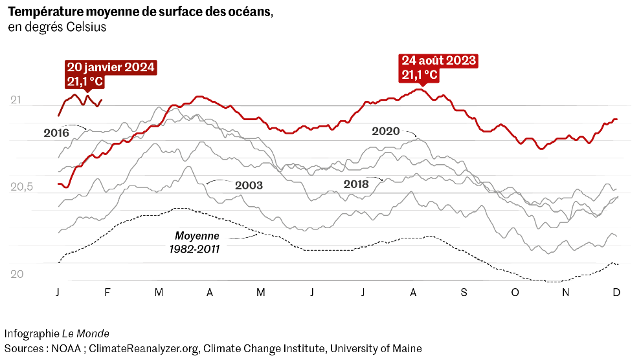
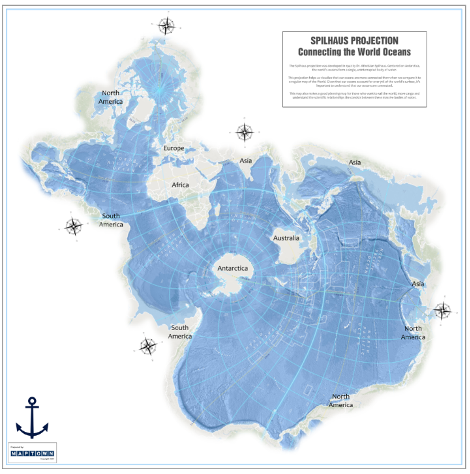
The graph is clear enough not to need much more added, except this reminder from Julie Deshayes, climatologist at the Laboratory of Oceanography and Climate: " We have experienced an exceptional year, due to the direct effects of climate change and natural variability with the El Niño phenomenon (…) It is actually extraordinary compared to the past and normal compared to the future awaiting us due to greenhouse gas emissions. And it is now that we must do everything to limit emissions, if we want a chance that future years remain at this level. " We take this opportunity to remind that if this average hides notable differences from one ocean to another, from a fish's perspective, there is only one sea, as geographer Maxime Blondeau reminds us on his blog 😊. Proof in the image:
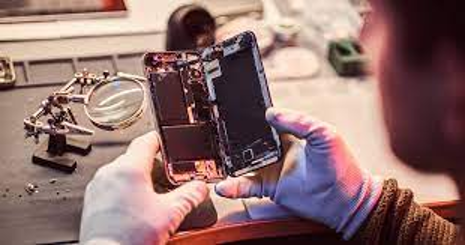
The sustainability index stuck in a rut of the week is that for smartphones in France, which will probably disappear before even being born. The Ministry of Ecology planned to introduce in 2024 a new index, accessible to consumers, evaluating the durability of televisions, smartphones, and washing machines. Scored out of ten, it would go further than the current repairability index by adding new elements, such as resistance to drops and water immersion for smartphones. But the ministry's plans were thwarted by the publication, on October 27, of a detailed unfavorable opinion from the European Commission, forcing the executive to put the project on hold. The reason: a competition issue between the French bill and a European text that will soon apply. In its opinion, the Commission recalls that a European sustainability index is already planned for mid-2025 for smartphones. "The French index would likely only have been applied for a few months," assesses the Commission, questioned by Le Monde. Its ephemeral existence would have "created additional costs for economic operators and added confusion among consumers," it believes, since these two indices differ in several respects. It is impossible for France to enrich the European model with its own additional criteria, the Commission further explains: " Such an approach would lead to a multiplicity of indices depending on the member state ", it argues, assuring that there are " clear benefits to applying harmonized rules (…) to improve product sustainability ". In its detailed opinion, the EU recalls that a procedure could be opened against France if its legislation is not harmonized with Europe's, leading to possible financial sanctions. Anyway, we would be tempted to add, the time is no longer, in Paris, for "over-transposition" of European rules… This is not the first time that future French regulations have come into conflict with future European regulations and must therefore, ultimately, be modified. This would not be serious if it didn't give marketers headaches!
The vote of the week will take place the day after tomorrow (!) in Paris, and it concerns SUVs, the bête noire of environmental activists and the Mayor of Paris. In perfect timing, the head of the International Energy Agency speaks out in Les Echos and specifically calls for legislation against these vehicles, which now represent 50% of new car sales in Europe. 40 million were sold worldwide in 2023, and they emit on average 20% more CO2 than saloons, mainly due to their weight and non-aerodynamic design, which worsens their fuel consumption. They represent the world's fifth largest source of CO2, with a billion tonnes of greenhouse gases released into the atmosphere each year, more than Japan's total emissions, the IEA stresses. And you, what will you vote on Sunday?!
The reason for hope of the week – of which there are few, some weeks like that 😉 – can perhaps be found in the mobilization of a new business network. Novethic, among others, presents it. "Business for a Better Tomorrow" brings together 15 European business networks (including Mouvement Impact France, the Communauté des Entreprises à Mission) and thus wishes to contribute to the emergence of a more sustainable and just economy in Europe. By showing its support for the measures already enshrined in the Green Deal, the coalition shows that it is differentiating itself from a part of the European business elite, such as MEDEF, which is currently pressuring to limit the ambitions of the Green Deal and Europe's sustainable transformation policy. Business for a Better Tomorrow, on the contrary, advocates for strengthening regulation mechanisms related to the ecological transition: strengthening the carbon tax, green VAT, standards to combat greenwashing, strengthening the taxonomy, phasing out fossil fuels… These 15 business networks already represent nearly 100,000 companies, including Maif, Ecosia, Enercoop, Citeo, and Camif. Before the European elections, this is a sign that some European companies wish to mobilize and carry a coherent message to support a paradigm change. Phew, finally a sign of this kind 😊.
By searching carefully, we found another reason for hope of the weekin the Prime Minister's general policy speech, detailed the next day by Christophe Béchu. The minister, quoted by L'Usine Nouvelle, gave details on the contours of the plastics initiative: " We will work with the 50 industrialists most dependent on plastic materials in a process of reducing use, by developing eco-design and the substitution of virgin plastics. This will involve packaging manufacturers but also the construction sector, automotive… " For Christophe Béchu, " the idea is to reduce dependence on virgin plastics either by substituting plastics with other materials or by incorporating recycled plastics in significant proportions ". Agri-food industrialists like Nestlé or Danone should be concerned, as well as automotive subcontractors or the PVC sector in construction. " Coordination work with professional federations will be carried out to identify the 50 sites concerned ", specifies the entourage of the Minister of Ecological Transition. At (RE)SET, which knows a little about these issues, we are delighted 😉.
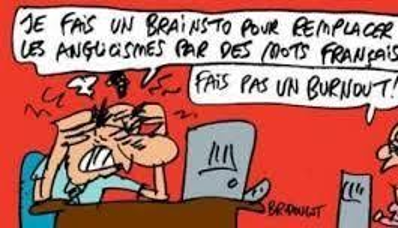
The riddle from last week was for lovers of the French language: what does the word "parangonnage" mean, appearing in a growing number of official documents? The clue was that the answer lies in the desire to fight against Anglicisms. We hope you didn't "burnout" by multiplying "brainstorming" to "address" this riddle! Parangonnage is the proper French word to avoid saying "benchmarking." We hope that the benchmarking of newsletters place "Breaking (RE)VIEW" among the "leaders"! This week's riddle is a recent quote; you need to find the author. Who wrote a few days ago: " The poles are overheating. The ocean is angry in this era of widespread boiling, sick from plastic, stuffed with CO2 and heat accumulated in the atmosphere by the greenhouse effect, gnawed like its corals by acidification. The great eruptive wave is only waiting for a sign to break. And we continue, like capricious children, to hop happily on the thin layer of ice that will soon give way under the weight of our culpable carelessness! " A clue: he knows how to write, but you had already noticed that 😉.
[As a reminder, (RE)SET, founded in 2019, is the first independent consulting firm dedicated to economic and environmental transition and built for action. "(RE)SET: resources to win environmental and economic battles!" Inevitably partial, sometimes biased, always committed, this media review with its often spirited, even impertinent tone, in no way commits (RE)SET in its consulting activities, but it paints a picture we find interesting of the state of the transition as it appears in the press and research. A snapshot of the debate, of the forces at play, the oppositions, the convergences, which we hope is useful for your decisions and for building your transition strategies.]