
This time, there's no way around it: the 28th UN Climate Change Conference of the Parties (COP 28) opens on Thursday. It will be held until December 12 in Dubai and, as often, will be worth at least as much for the reports it generates as for the tangible results that will come out of it. International organizations, states, scientists, NGOs, each gives its analysis, and the results, while not surprising, are interesting because they are increasingly precise about the fact that the numbers don't add up, that commitments are not kept, and that in terms of energy and climate, at the global level, promises only bind those who listen to them. So, COP 28, "moment of truth," as the International Energy Agency puts it? Or of lies, as The Economist insinuates?
COP28 will be a "moment of truth" for the oil and gas industry, the IEA asserts. In its "special report," available here, it particularly emphasizes that the sector is, for now, not a " serious partner " in the fight against global warming. It urges fossil fuel producers to decarbonize their own industry, which, according to the IEA, can be done easily and without excessive cost. It especially wants to make them understand that " realizing that new investments in oil and gas fields pose a climate risk, of course, but also an economic risk, because even with current policies, overall oil consumption will peak and then decline. " It is therefore in their own best interest to diversify as quickly as possible into alternative energy sources, which they are doing only too slowly. Meanwhile, global oil consumption continues to rise, and is even expected to reach its highest historical level this year, as La Croix recalls in its dossier " Can we get by without oil ", which tends to answer "no." It is in this context that the United Nations Environment Programme (UNEP) publishes its "Emissions Gap Report." According to this study, emissions increased by 1.2% between 2021 and 2022, reaching a new peak of 57.4 gigatonnes of carbon dioxide equivalent (GtCO2). There you have it; it was supposed to drop drastically under the logic of the Paris Agreement, but it continues to rise stubbornly. In 2030, we will produce twice as much fossil fuels as needed to meet the target set by the Paris Agreement, UNEP specifies. This puts Earth on a path to warming of 2.9°C or more by the end of the century. The full UNEP report can be viewed here. All this leads The Economist to say that "progress on climate change has not been fast enough," which the British weekly perfectly illustrates with this drawing:

And really "harder" because, as a reminder, since January, the average temperature on Earth is the warmest ever measured for the first ten months of the year: 1.43°C above the 1850-1900 level. Every month since June has broken monthly records. October 2023 is 1.7°C warmer than the average October in the 1850-1900 period.
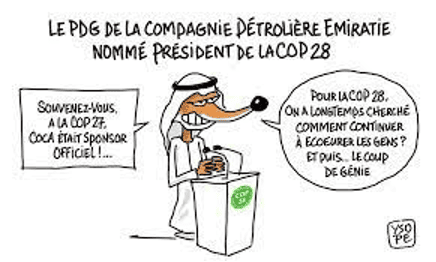
By a quirk of timing, while COP 28 opens in Dubai, the members of the OPEC oil cartel, joined by Russia, will meet in Vienna on Thursday to agree on a strategy in the face of falling prices. A "great split" , to use Le Monde's headline. It must be said that this COP 28 has strong hydrocarbon odors. Its president, Sultan Al Jaber, tries to give hope to climate advocates, but he also chairs the host country's oil company. Worse: in June, the British daily The Guardian revealed that the COP presidency used the servers of the main Emirati oil company, Adnoc, to send and receive emails. The company was thus able to view messages intended for the presidency in return… And in early November, the English-language wire of Agence France-Presse demonstrated, after reviewing internal documents, that the powerful consulting firm McKinsey helped Mr. Al Jaber's team prepare for the summit by proposing energy transition scenarios, such as a 50% reduction in oil's share by 2050. A trajectory in total contradiction with scientists' alarms! For COP 27, more than 7,000 representatives of the "fossil" sectors were accredited and present; it is unlikely that they will be fewer this time.
Still on COP 28, but this time from the perspective of equity, the Oxfam report revealed in its conclusions that the richest 1% of the planet, or 77 million people, are responsible for 16% of global emissions due to their individual consumption. This is the same proportion as the poorest 66% of the population, or 5.11 billion people. Hence the title of the report: "Climate Equality: A Planet for the 99%." Without wanting to personalize, or so little, experts calculated that Bernard Arnault's greenhouse gas emissions are 1,270 times higher than those of an average French person 😊.
To continue gently towards our weekly sections, and staying in energy, the good news of the week comes to us from China. The largest energy consumer and world's leading emitter of greenhouse gases, China is often on the podium when it comes to pollution and its role in global warming. Here is a slightly more shiny medal: that of the record growth of its green energy capacity. As a result, China's CO2 emissions are expected to decrease in 2024, according to a study published on the British climate-specialized website Carbon Brief.
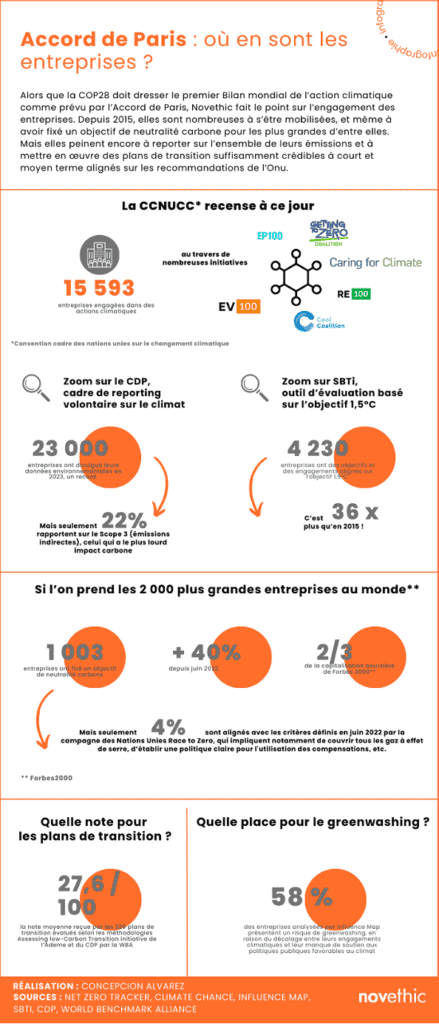
Still in the same spirit, the infographic of the week comes from Novethic, which compiled data from the United Nations Framework Convention on Climate Change and other sources to arrive at these key figures, including this one: an average score of 5/20 on the transition plans of large companies analyzed. (RE)SET still has work to do 😉.
The "lack of fair play of the week" could well be in France: according to Le Monde's information, the government does not intend to pay out several hundred million euros for failing to meet its 2020 European renewable energy target. Energy Transition Minister Agnès Pannier-Runacher informed European Energy Commissioner Kadri Simson in a letter dated October 20. In 2009, France committed under a European directive to reach the threshold of 23% renewable energy (wind, solar, hydro…) in its gross final energy consumption by 2020 – compared to 10.3% in 2005. With only 19.1%, this binding target was missed. The country had the option of artificially reaching it by buying "statistical volumes" of renewable energy from states that had exceeded their own target. A year ago, Agnès Pannier-Runacher publicly stated that the State would have to pay around 500 million euros for this delay and had begun negotiations with Sweden and Italy. Since then, the minister has revised her strategy.
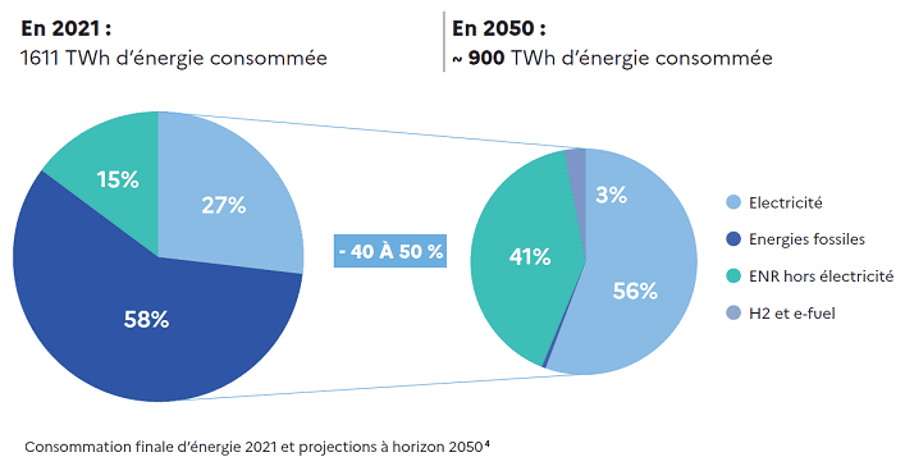
Which might be related to th "strategy of the week", unveiled this week by the same minister: it is the new "energy strategy" of France, which should lead next year to an ambitious framework law, a year behind schedule. The goal is to halve the share of fossil fuels in the national "energy mix" by 2035, then reduce it to zero by 2050. A commendable and ambitious objective, which will have to be translated into reality. "The transformation to be undertaken is of a magnitude comparable to that of the first Industrial Revolution ", summarizes Agnès Pannier-Runacher. An amplitude perhaps better understood with this infographic:
The "end of the world and end of the month" debate of the week is to be found in the annual report on the state of France from the Economic, Social and Environmental Council (CESE), which details why environmental activists and the "yellow vests" share the same slogan but give it radically different meanings. It is overviewed by Libération here and available in its entirety there.
The well-known little creature of the week whose numbers are decreasing too quickly is the sperm! In 50 years, their count in men of childbearing age has decreased by 50% and the trend continues. The exact cause is unknown, but scientists now have some ideas and essentially implicate two families of insecticides: organophosphates and methyl carbamates.

The transition is easy with the rejected European law of the week. A "black day for the environment," as Ouest-Franceheadlines: the pesticide regulation was rejected in the European Parliament. It contained measures aimed at reducing the use and risk of pesticides by 2030. The text was rejected because it was so emptied of its substance by the EPP (Conservative Party), according to observers, that other deputies refused to endorse content deemed too weak. The result: no measures, therefore, even as each day brings its share of scientific demonstrations of the toxicity of many pesticides.
On the other hand, the European law adopted (or soon to be) of the week is moving in the right direction, and Pascal Canfin is rightly delighted on LinkedIn: "The European Parliament and the Council have reached an agreement on new rules concerning waste transfers. These new rules will help combat pollution generated by the export of European waste to third countries that do not always have the means to manage it." In the wake, other important near-laws were adopted after long negotiations. The " Net Zero Industry Act " is intended as a response to the American Inflation Reduction Act. The Parliament plans to support the development of 17 technologies deemed necessary to reduce greenhouse gas emissions to zero by 2050. Since its presentation by the European Commission, the text had been substantially revised. First, on the number of technologies, since about ten technologies were initially involved. Second, on their development primacy, as the text originally provided for two lists, one of which had priority over the other because it grouped together so-called "strategic" technologies. In the meantime, parliamentarians merged the lists. As a result, nuclear power, initially relegated to the secondary list, finally gets its due, both for existing reactors and for future technologies such as small modular reactors. Finally, this time regarding packaging, the European Parliament ultimately chose to regulate its use. While packaging waste continues to increase within the European Union, the future regulation is intended to reverse the trend and reduce it by 10% by 2035.
The summit of the week that fizzled, is the one we told you about last week, held in Nairobi. Dedicated to continuing negotiations on the development of a future international treaty against plastic pollution, it mainly served to continue identifying disagreements … To put it more positively, as Libération puts it, "the negotiations did not advance much ".
The opinion piece of the week also concerns the European level. A collective of twenty-three academics and personalities committed to human rights and climate action, including Julia Faure, Alain Grandjean, Valérie Masson-Delmotte, Claude Henry, and Eva Sadoun, calls on France, in an op-ed in Le Monde, to make financial actors responsible for the services they provide. They say it better than we do: "Making financial actors responsible [within the framework of the duty of vigilance] for the services they provide? Everyone is for it: the European Parliament, the European Commission, the United Nations, European NGOs, the European Central Bank, investors… Everyone? No. One intractable French government persists. Would France dare to give finance a blank check? (…) A position all the more incomprehensible since France was a pioneer on the subject, adopting a law on the duty of vigilance as early as 2017. France wishes to completely exclude financial services from the scope of the duty of vigilance, even to the point of vetoing various compromise proposals. […] A position that is compatible neither with President Macron's stated political will to make France and Europe major players in the ecological transition, nor with France's claimed leadership on the duty of vigilance."
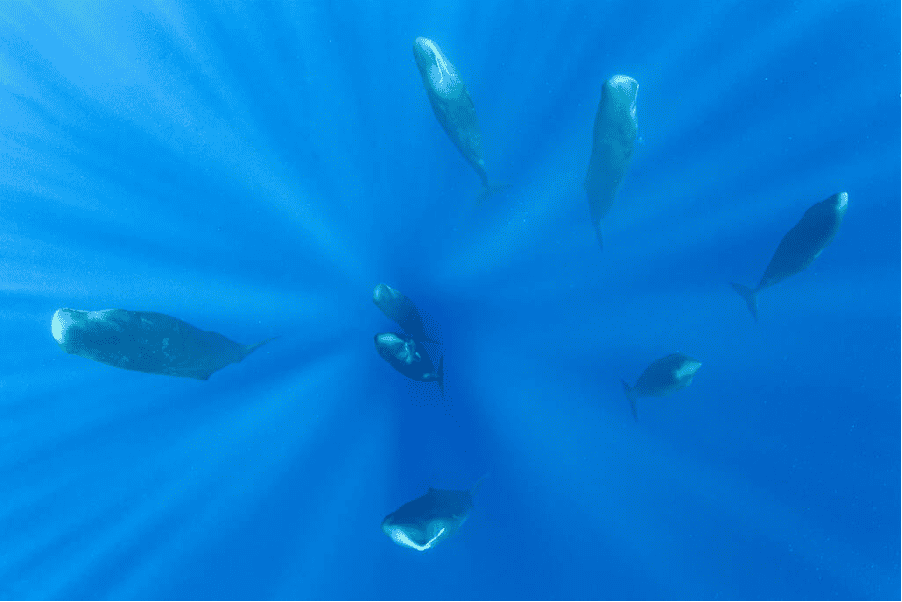
The biodiversity news of the week concerns the sperm whale, which benefits for the first time from a nature reserve dedicated to its frolicking, around the island of Dominica: the small Caribbean island nation has announced the creation of a 800 square kilometer marine protected reserve for the sperm whale, a now endangered species. Commercial fishing and large vessel traffic will be prohibited there.
The fiber of the week is… banana! Plant fiber is in fashion! Not even Bananatex would say otherwise. The banana fiber fabric of this Swiss company, after being used to make bags or furniture, is now used to shape biodegradable t-shirts, simultaneously strong, light, and flexible. Clarification: there is no deforestation involved. The banana tree is cut at a height of 40 cm and left to grow back. Nature is beautiful…
Somewhat in the same spirit, the surfboard of the week comes from green algae. They are abundant, alas, so they might as well be used for something! It takes two kilos of algae to produce a surfboard. It is a surfer originally from Douarnenez who worked on the design of a board made from green algae, which proliferate on Breton beaches and release toxic gases when they decompose. This provides a Breton alternative to surfboards mostly made of polystyrene or polyurethane, and gives a clear conscience to riders!

The unexpected co-product valorization of the week is offered to us by the rooster and the hen. Last week, we praised chicken feathers here; this time it's about eggshells : the young company Circul'Egg (nice name!) has developed a patented process for valorizing these shells. On November 10, it inaugurated its 1,600 m² industrial site in Janzé, near Rennes (Ille-et-Vilaine). Its capacity is intended for processing 15 to 20 tonnes of shells per day.
We don't know if Circul'Egg could make a profit from it, but the contamination of the week precisely concerns eggs and… it doesn't date from this week. It simply continues! Following a study just made public, the Île-de-France Regional Health Agency (ARS) maintains its recommendation not to consume eggs from domestic henhouses in the Paris metropolitan area after the detection of "significant levels" of dioxins, furans, PCBs, and PFAS, four families of persistent organic pollutants (POPs) dangerous to health. In total, more than 90% of the analyzed eggs do not meet threshold values!
The ultimate trend of the week is composting… after death! Once an activist, always an activist: six US states have given the green light to the practice of human composting, which allows a deceased person's body to be turned into compost. In France, associations are campaigning for its legalization… Dare we recall that in the famous science fiction book (and film) "Soylent Green" from the 1960s, they advocated for something "better"? But we wouldn't want to "spoil" it, so read it 😉.
The debate of the week concerns advertising: is it the enemy of the climate? In its podcast, Le Monde asked the question last week, and raised the possibility of banning advertising for large SUVs or private jet flights. But since then, there has been the campaign everyone is talking about, that of ADEME with its "devendeurs" (un-sellers). An advertising that is not the enemy of the climate 😉.

On that note, the waste of the week, is today! You can't have missed it: Black Friday and its crazy consumers, the big day of compulsive buying, is today! Usually, NGOs deplore it and advocate replacing it with a "Green Day." But, a sign of the times, it is now the Minister of Ecological Transition, Christophe Béchu, who takes up his finest pen in an op-ed in Le Monde to explain that "we must reinstall in France a culture of sufficiency , repair, and reuse." And the minister advocates for a "Green Friday" of sufficiency, while defending the emergence of a French repair sector. Christophe Béchu also reminds us that according to the latest "Sufficiency and Lifestyles" barometer from the Agency for Ecological Transition (Ademe), just published, 83% of French people believe we consume too much. Black Friday's days are numbered. Or not 😉.
The "transition stumbling over reality" of the week is imagined by Le Figaro, whose columnist ironically contrasts the glorious results of oil and coal companies with the more difficult results of alternative energy producers. With such enthusiasm that one might wonder if it's not rather Le Figaro that is stumbling over the reality of the green transition 😊.
The riddle from last week was a galaxy, or rather, a galaxy cluster. The question was simple: how many galaxies does this so-called "Perseus" cluster, only 240 million light-years from Earth, contain? The photo shows about thirty in the foreground. But those with very good eyesight will have noticed that in the second, third, and other planes, there are over 100,000 galaxies within this single cluster. Our Milky Way, where our little sun, located in the distant suburbs, struggles to stand out, is decidedly a small thing, and our Earth even less so!

The week's riddle is a personality who would have benefited from being better known. The clue: this man invented a concept that we like at (RE)SET! Who is it?