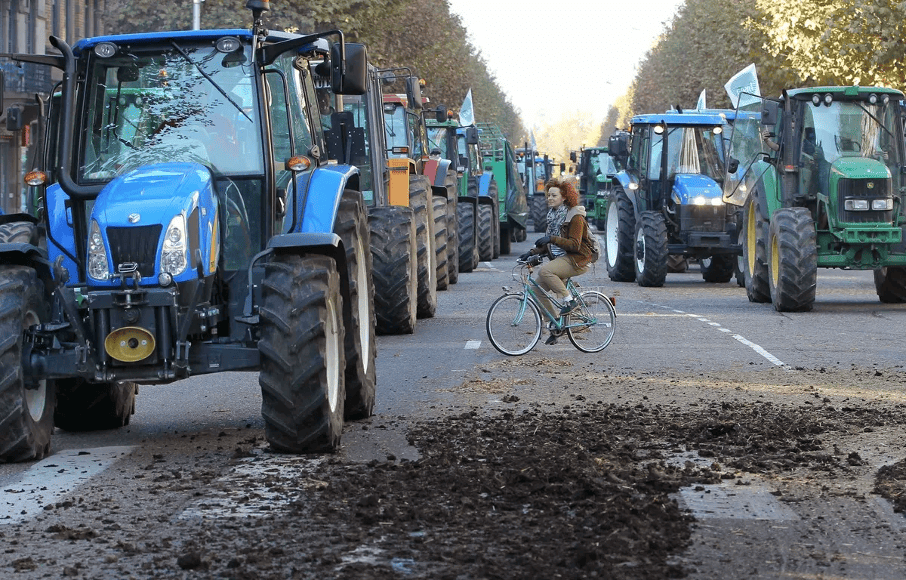
While as these lines are being written, a blockade threatens Paris, surrounded by tractors and other machinery, it would be strange not to dwell a little on the contradictory pressures paralyzing the agricultural sector in France. For decades now, we have been trying unsuccessfully to make the economic and environmental transition rhyme with agriculture. The farming world, suffering from the effects of global warming and environmental imbalances, is at the same time partly responsible. Farmers are asked to produce more responsibly and sustainably, which means fewer polluting plant protection products, but also more cheaply, which is not compatible. We dream of buying "local" and favoring short supply chains, but we rush to buy imported products, whose prices are often lower. We explain that we need to eat less meat, but livestock farmers are already the poorest farmers. We denounce the stranglehold of mass retail on farmers (6 companies concentrate 80 to 90% of French food purchases), and the role of the agri-food sector, but we praise prepared products.
To paraphrase the farmers' slogan, maybe someone is standing on someone's head? But who is standing on whose head, wonders Philosophie Magazine (you will note that Breaking (RE)NEWS is broadening its sources!), which notes: " The farmers' protest movement started in the Tarn with a slogan: "We're standing on our heads" (…) I really like this slogan; it should be global. And continues: " I like the slogan but not the FNSEA. It's led by a Rousseau who is not Jean-Jacques but Arnaud, a grain farmer and president of Avril Gestion, the 4th largest French agri-food group: it's a bit like electing Carlos Ghosn as head of the CGT union at Renault. »
Placed on bad foundations, dialogue is proving impossible between, on the one hand, advocates of sustainable agriculture and, on the other, those of intensive agriculture, powerfully represented by the FNSEA. In truth, all serious experts know that the only solution is to increase the value of agricultural products and the share of their trade that goes to farmers, especially if they are small and engaged in sustainable production. This implies inflation in the food sector, which few governments want, given its social consequences… This also requires a reform of the mechanisms of international trade in agricultural and food products, with mirror clauses preventing the import of products that do not have the same environmental constraints, which many states do not want.
In the meantime, everyone is pointing the finger, with more or less political ulterior motives. Between those who denounce the Common Agricultural Policy (CAP) and those who prefer to criticize the (European) Green Deal. According to the Minister of Economy, Bruno Le Maire, the current events are "a signal for the EU," Le Figaroreports, denouncing " too much paperwork, too many constraints ". Conversely, environmentalists denounce the CAP, guilty of inaction, and praise the Green Deal as a force for change.
The timing could not have been more perfect for the publication of the report by the High Council for Climate, which points out the obstacles to the decarbonization of agriculture. A victim of climate change, French agriculture is not reducing its impact on it enough, the High Council's report, published yesterday, asserts. The cause: " brakes and obstacles " that slow down the decarbonization of our food system. This report, published in its entirety here, should be read. It does not really align with current policy. The turmoil of recent days has at least one positive consequence: giving us all time to read this report!
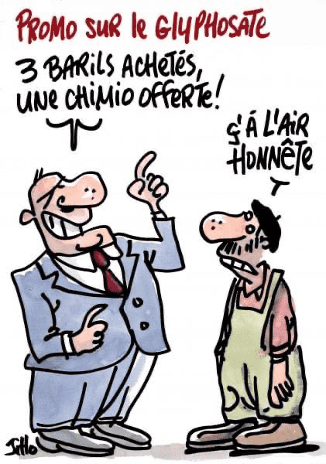
Since we are talking about agriculture – note the skillful transition to our weekly sections – the war of the week is the glyphosate war, which has been going on for 10 years since the first apparently contradictory studies on the effects of this major herbicide on health and the environment. The latest twist, revealed by Le Monde : more than 80 NGOs are preparing to take legal action against the European Commission's re-authorization of glyphosate in the EU, last November 16. Two separate proceedings were launched yesterday to challenge the Commission's decision and should lead, in the coming months, to a referral to the Court of Justice of the European Union (CJEU). The plaintiffs dispute the legality of the authorization granted to the controversial herbicide. They consider that the health and environmental risk assessment conducted by the regulatory authorities deviates from EU law. The day before the filing of these two appeals, the online newspaper Politico dropped a third stone in the Commission's garden, revealing a confidential memo on the subject, produced in 2022 by the legal service of the Strasbourg Parliament. This analyzes a 2019 judgment (known as the "Blaise judgment") of the Court of Justice of the European Union, according to which commercial formulations of plant protection products must undergo studies assessing the risks of long-term exposure before being placed on the market. However, currently, in the case of glyphosate (but also the majority of pesticides), such studies have not been conducted. The only tests of this type (to assess the carcinogenic risk in animals, for example) are on the active molecules – in this case glyphosate alone, without the mixtures of co-formulants intended to increase its effectiveness. According to the note published by Politico, the Commission does not appear to have respected the European regulations on the subject as interpreted by the CJEU.
The question of the week concerns food waste. It is wisely asked by The Conversation , and ADEME answers: what will the new source separation be used for? As a reminder, on January 1, 2024, the obligation for all local authorities to offer their residents a solution for the source separation and recovery of their biowaste came into force: in other words, all their food waste and green waste. In France, biowaste represented, in 2017, 83kg per inhabitant per year, corresponding to 1/3 of our household waste. The current challenge for local authorities focuses mainly on food waste, produced by the entire population; green waste being in the majority of cases treated on site or through existing solutions. While it requires consumers and local authorities to adapt, this new step in waste sorting is essential from an energy and environmental point of view, since it will on the one hand avoid unnecessary incineration and landfill, and on the other hand generate environmental benefits for energy production and agriculture: these biowastes will indeed have two main destinations, organic amendments and biomethane.
The other report of the week was written by the European Court of Auditors and attacks the internal combustion engine, which seems to be raising its head, particularly in Germany, reports Le Monde. " The green revolution will not take place in Europe as long as the internal combustion engine reigns supreme ", warns the Court, which has identified three obstacles: real CO2 emissions from cars are still underestimated, those from combustion cars (gasoline and diesel) have not fallen, and sales of electric vehicles are not taking off fast enough. The Court notes that improvements in engine technology have been " neutralized " by the increase in vehicle weight (+10%) and engine power (+25%). A study published on January 22 by the organization Transport & Environment reveals that new cars are widening by an average of one centimeter every two years: the average width increased from 177.8 cm in 2018 to 180.3 cm in the first half of 2023. The same goes for plug-in hybrid vehicles, which combine combustion and electric engines and are considered by lawmakers as low-emission vehicles. Their real-world CO2 emissions are "much higher than expected," the report indicates. Several studies published in 2022, notably by the International Council on Clean Transportation (the body that revealed dieselgate), have shown emissions three to five times higher than those measured in the laboratory. In short, without a real change of trajectory, the report's authors estimate, the EU has " no chance " of achieving its ambitious carbon dioxide emission reduction targets.

The "Prévert list" of the week dates back a month (!) and concerns the transition innovations implemented since January 1st as recalled by the Ministry of Ecological Transition on its website. From the reinforced repair bonus to the free return of used tires without purchase obligation, including the obligation to take back construction waste from individuals and craftsmen, the generalization of source separation of biowaste, the ban on destroying unsold food items, not to mention the end of stock clearance for fruit and vegetable packaging, the obligation to shade parking lots, the ban on Crit'Air 4 vehicles in certain large cities, to name just a few examples, this is only the implementation of texts already voted, sometimes long ago, and most often the subject of years of awareness-raising, stakeholder consultation, and other negotiations. This brings us back to the President's statement at his press conference last week: in 2024, not to expect new "historic" decisions but rather to implement what has already been decided. It's less sexy but more useful, essentially says Géraldine Poivert on LinkedIn : « The implementation of the transition is not 'the logistics will follow'; it's very complicated. It's not effervescent; work is needed to make it possible. It's the blind spot of the ecological transition, with your nose under the hood, far from fine speeches. At (RE)SET, that's what we like to do. We need to get to it! »
The mission letter of the week is the one signed by Élisabeth Borne before her departure. It concerns the governance of eco-organizations. Just before leaving Matignon, Élisabeth Borne entrusted three State departments with a mission to evaluate the operation of accredited companies such as Citeo and Léko. See you in three months, knowing that the new accreditation runs for one year in 2024 instead of the usual six. L'Usine Nouvelle discusses it, specifying that the possible creation of a supervisory authority is in sight. Three issues serve as a reading grid: economic performance, environmental performance, and competition. Another interesting article in L'Usine Nouvelle is the one devoted to France Stratégie's analysis of household packaging. The main lines drawn do not surprise experts: the reduction of single-use plastics cannot be done without the development of innovative cellulose-based solutions; the priority given to decarbonization limits the generalization of glass due to weight constraints and opens up new perspectives for lightweight plastics; the rise of reuse – " a paradigm shift to be seriously considered " – and bulk – " a dynamic lever, but with potential concentrated on certain segments " – with or without deposit, is linked to consumer acceptance; the implementation of a deposit system for recycling leads to a modification of established flows.
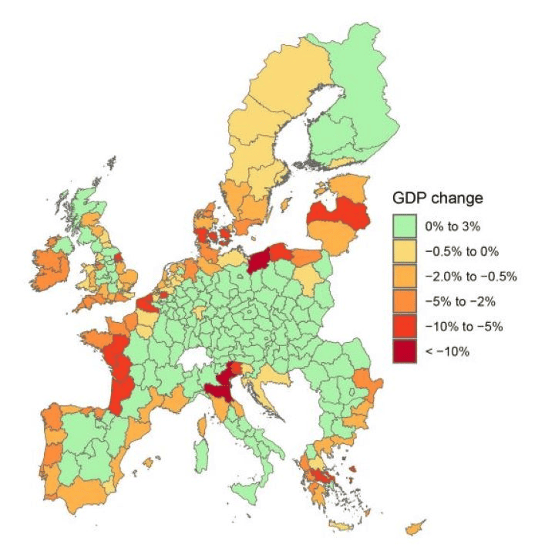
The number of the week is given to us by a study published this week in Scientific Reports : 827 billion euros. This is the anticipated cost for sea level rise alone in the EU by 2100, "all else being equal," as economists say. And France would not be spared, as shown by this illustration of the impacts on regional GDP: from Nantes to Biarritz, for example, the bill is steep: up to -10%!
The plan of the week will be officially presented in six months and could, it is hoped, disprove the dire forecasts above. The Minister of Ecological Transition, Christophe Béchu, launched a "great conversation" in Paris on Tuesday on the theme of adaptation. The "real" national climate change adaptation plan (PNACC-3) is expected this summer. About fifty measures should compose it, Libérationdescribes. The goal: to trigger a series of profound transformations to counter the various effects of climate change. The minister's "compass": preparing France to adapt to a warming of 4°C by 2100 in mainland France (today, the temperature has already reached +1.7°C). This corresponds, on a global scale, to a thermometer rise of 3°C by the end of the century – double the Paris Agreement, a trajectory towards which the planet is heading. The plan, which will be the subject of a "government seminar" at the end of February to "arbitrate the broad outlines," will thus be based on this trajectory of a France at +4 degrees. A scenario courageously put on the table for a year by the minister to " get out of denial " and " sound the general mobilization " of adaptation policies, complementary and just as essential as the mitigation strategies dedicated to reducing greenhouse gas emissions.
The product of the week could find a (small) place in adaptation scenarios: "washlet toilets," also called "Japanese toilets," which is not fair since they were invented in Switzerland, could be destined for a bright future, according to Libération which provides a fairly amusing but serious "on the ground" report. It shows that, after a rather perilous installation and learning phase, the idea is good: the cleaning water jet for number two uses 0.6 liters of water per activation, compared to 287 liters for the manufacture of a roll of toilet paper, which we learn "spreads" more than it "cleans." Moreover, it's refreshing, which will be welcome in case of a heatwave 😉.
The doomsday clock of the week is the one marking the end of the world. Good news: the hand did not move forward this year. Bad news: it remains at 90 seconds to midnight, its historical record from last year, thus equaled. Dr. Strangelove would appreciate. The Bulletin of the atomic scientists, guardian of this clock that has been ticking since 1947 and the threat of global atomic destruction, describes the reasons justifying this level. These include, among others: climate crisis, exceeded planetary boundaries, terrorism, war, artificial intelligence, corruption, … In 1947, the clock indicated seven minutes to midnight, in 1991, 17 minutes to midnight. And so today, one minute and 30 seconds to midnight. A small reminder: at midnight, it's the end of the world! Conclusion of the Bulletin of the Atomic Scientists: " it’s time for action ". Funny, that's also (RE)SET's slogan for 2024 😉

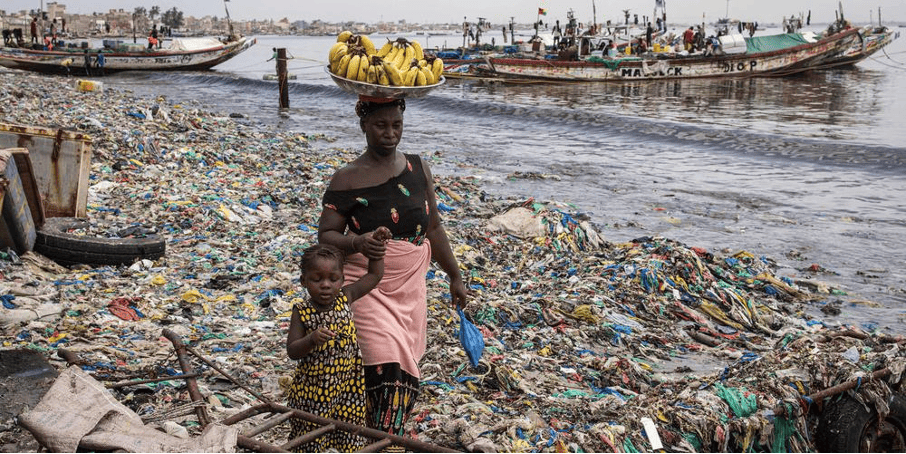
The open-air garbage dump of the week takes us to Dakar, Senegal, in Hann Bay, once considered one of the most beautiful coves in Africa. The former idyllic stretch of fine sand has become over the years the dumping ground for toxic waste from industries and households, as evidenced by an AFP report picked up almost everywhere. The majority of Senegalese manufacturing industry is located along the bay and directly evacuates its effluents there. Ocean pollution there has reached worrying levels. The state has been promising for more than twenty years to tackle the cleanup. A depollution project launched in 2018 with the financial support of the French Development Agency, Invest International, the China Development Bank (CDB), and the European Union is struggling. Finally, the National Sanitation Office (ONAS) has just announced the resumption of work suspended for months.
The pollution scandal of the week concerns the company Alteo and its toxic waste quietly discharged for years by its Gardanne plant (world leader in alumina production) into the Mediterranean, bringing "red mud" into the Calanques. The courts accuse the industrialist of having discharged into the sea, in the heart of the Calanques National Park, an effluent laden with potentially toxic substances that have resulted in harmful health effects and/or damage to fauna and flora. Alteo has just been indicted, Le Mondereports… more than five years after the opening of a judicial investigation for "endangering the lives of others" by the Marseille prosecutor's office in July 2018.
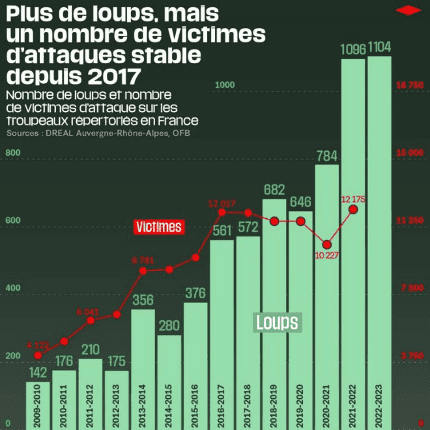
The big threatened beast of the week is again the wolf, with the upcoming publication of a new "Wolf Plan," 2024-2029, which should allow, in short, to kill more of them. It must be said that the packs, eradicated in France in 1937 and having returned on their own from Italy in 1992, are re-acclimatizing well to our regions. This does not make the flocks of sheep and goats happy, whose flesh delights canis lupus, his real name. However, Libérationasks, is shooting at them the right solution? Two graphs suggest that it is not obvious. First, if the number of wolves has increased tenfold in ten years, the number of their livestock victims has "only" multiplied by four and has been stable for 7 years:
Second, is the wolf the main obstacle to the multiplication of sheep (to make a long story short)? Not necessarily, since flocks maintain themselves better in the Alps, where wolves are abundant, than elsewhere, where there are none…
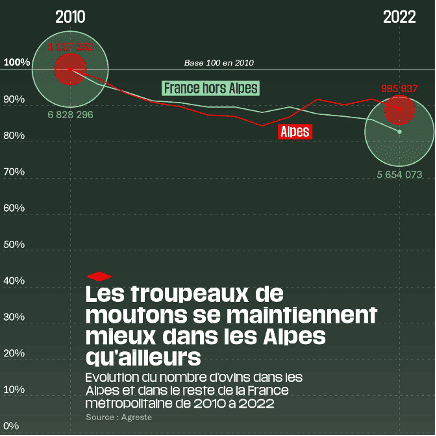
Wolf advocates conclude that it is not inevitable: the wolf will not jeopardize sheep and goat farming in France. " (Re)learning to live with canis lupus is possible ". One essential question remains that your children will surely ask: can the big bad wolf eat us? Don't panic! Discreet, wary, perhaps enriched by experience, it avoids Homo sapiens and moves away if they meet. Attacks are extremely rare. The tiger mosquito is much more dangerous for humans! Which shows that size is not the right criterion 😊.
The editorial of the week resembles a relapse, that of Le Figaro, which we noted in a recent Breaking (RE)NEWS seemed to have finally given up its climate-skeptical stance and was beginning to take a little interest in environmental transition issues. But no: on January 19, the conservative national daily relapsed in an editorial entitled " Ecological Aberrations " where, under the pen of the Deputy Editor-in-Chief, one finds all the clichés of the genre: " Green ideology has struck again, detached from any field reality (…) The ZAN, an avatar of the worrying ZFE that bans access to city centers, is not the least of the aberrations of our ecological ambitions. Farmers know something about it (…) they can't cope anymore. And they are rebelling. Homeowners are not left out, victims of nit-picking regulations on thermal renovation that actively contribute to the paralysis of the real estate market. In energy, the same green dogmatism nearly ruined the nuclear industry, this industrial miracle that gave us the most abundant and cheapest electricity in the world (…) Ecology à la française is certainly a long learning path ", concludes Le Figaro. One would be tempted to add that the issues and modalities of the transition also constitute a long learning path… for Le Figaro journalists!
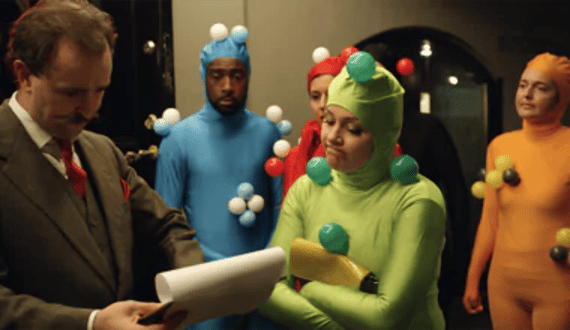
The riddle from last week was aimed at everyone and took us to a hilarious and informative video. The question asked: who is this green character who may not be on the guest list? Answer: it's "Cara… Carbon… Tetrachloride" and it's part of the " Sin List ", identified by the NGO ChemSec as one of those molecules you don't want to see entering "The Product" 😊.
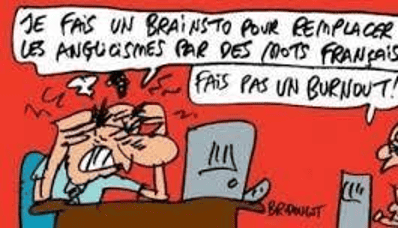
The week's riddle is for lovers of the French language. What does this word, appearing more and more in official documents, including recently the Prime Minister's mission letter on EPRs, mean: "parangonnage"? The clue: it's about fighting Anglicisms 😉.