
The planet has a prominent climate whistleblower whose virulence is at least comparable to that of António Guterres, the UN Secretary-General. When the latter warned COP 27 that "we are on the highway to climate hell," Pope Francis, who knows a thing or two about hell, launched COP 28 a little early this week by stating that "the world is crumbling". The pontiff called for a "binding" energy transition in a text published on Wednesday, October 4. The Argentine Jesuit deplores "insufficient" responses while the world approaches a "tipping point." The Pope insists on the damage caused by "man's unbridled intervention in nature." He criticizes the "irresponsible lifestyle of the Western model," particularly pointing the finger at the United States and China for their greenhouse gas emissions. Jorge Bergoglio also warns against the "contemptuous and unreasonable opinions" of climate skeptics.

Climate skeptics indeed, a quirk of the moment, are raising their heads everywhere in the world, particularly in France, where the " army of doubt ", to use the evening daily's expression, is attacking climatologists with ever-increasing violence, on the front line of this battle which we hope is rear-guard. Harassed on social networks, reviled on all occasions by enemies as radical as they are well organized, scientists sometimes struggle to make their voices heard. Which perhaps justifies this little press drawing 😉.

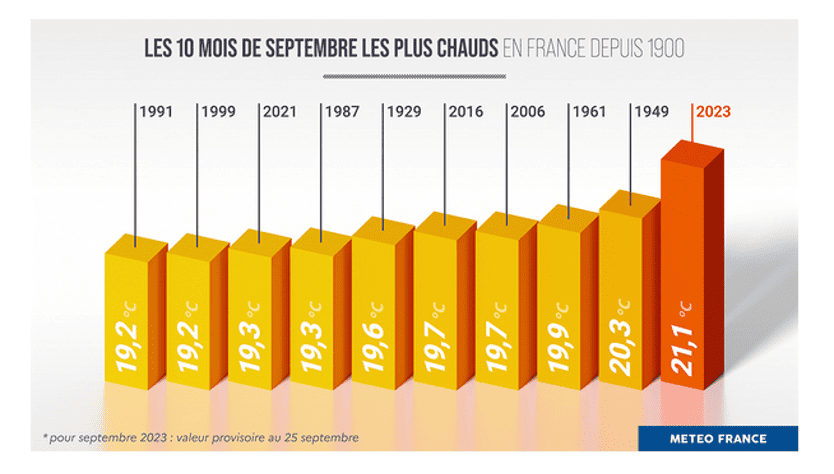
And yet the evidence is overwhelming this September 2023 more than ever! Because in September, as in August, July, and June, the global average temperature broke its record since measurements began. Globally, the margin is even " extraordinary ", according to the adjective used this week by the Copernicus Institute. A margin that applies both to air temperature and sea temperature, with the known consequences for biodiversity. In France too, autumn is "warm," but you have probably already noticed that for yourself.
While "the world is crumbling," therefore, Europe is organizing with the launch this week of a truly interesting and ambitious mechanism: the CBAM. Yes, Europe likes obscure acronyms. The Carbon Border Adjustment Mechanism, otherwise known as the "carbon border tax," is sufficiently complex and potentially structuring to require a "dry run" test period, lasting until January 2026, with a ramp-up until 2034. L'Usine Nouvelle calls this period a " crash test ", as it is a mechanism perceived as a potential "catastrophic scenario" by a good part of French industry: "If we don't apply it intelligently, we will be in danger. It will turn into a tool for massive deindustrialization," warns the president of France Industrie. This catastrophic scenario " is worrying companies ", add Les Echos, as they are "frightened" by two main risks.
First, a bureaucratic risk, red tape, which they detest, because technically we don't yet know how to report imports of the six concerned products (steel, aluminum, cement, fertilizer, hydrogen, and electricity, but also processed products like bolts and screws – all these sectors together represent more than 50% of the European continent's industrial emissions). Concretely, declaring their imports and the carbon emissions related to these products is not so simple for industrialists and could become a real "administrative headache," they say, during the trial phase.
A competitiveness risk, above all, as long as 1/ not all products are covered and 2/ not all countries have such mechanisms. Even if the very purpose of the CBAM is to force, sorry, encourage, countries around the world – at least those who intend to export to France – to adopt carbon tax systems, it is clear that this could take several decades. The intermediate phase, which has just opened, will be fraught with perils. Nevertheless, the game is worth the candle! For it is useless to reduce your greenhouse gas emissions at home if you then import them from elsewhere, those emissions, like the Chernobyl cloud, knowing no boundaries 😉.
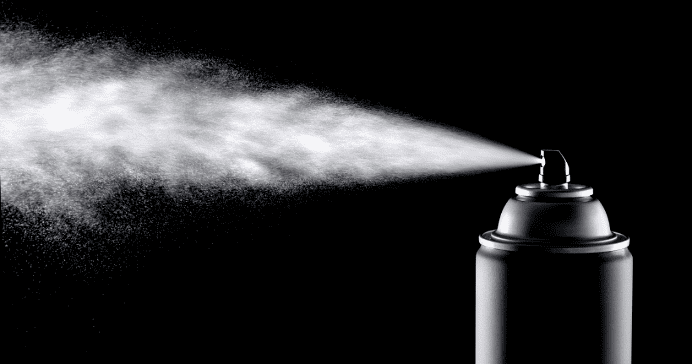
To begin our weekly sections, let's stay in Europe. It is at this level that, more and more, the essential is happening… The European agreement of the week concerns fluorinated gases: by 2050, they must disappear from our refrigerators, air conditioners, and other heat pumps. Still indispensable today for the operation of refrigeration systems, fluorinated gases, and more specifically hydrofluorocarbons – known as HFCs – are powerful greenhouse gases with a warming potential 1,000 to 10,000 times higher than CO2. Their predecessors, the sadly known CFCs, are responsible for the hole in the Antarctic ozone layer, even more destructive in the short term. But HFCs are only "less bad"; they remain notorious pollutants, Libération recalls, while Les Echos specify: "HFCs will be banned in refrigerators from 2026, in certain small heat pumps and certain air conditioning systems from 2027, and then in all air conditioners and heat pumps between 2032 and 2035. They will be prohibited in technical aerosols after 2030, and in foams after 2032." It will also be forbidden to export the affected products outside Europe.
The judicial development of the week concerns TotalEnergies, now being prosecuted in criminal court: "In 2022, TotalEnergies generated more greenhouse gases than France, or nearly 1% of global emissions," according to data communicated by the company. Presented as "one of the main contributors to climate disruption," in 2018 it was the world's fifth largest emitting private company, according to the Climate Accountability Institute. TotalEnergies is therefore now the target of a criminal complaint for "failure to fight a disaster and involuntary manslaughter," reports Le Monde.
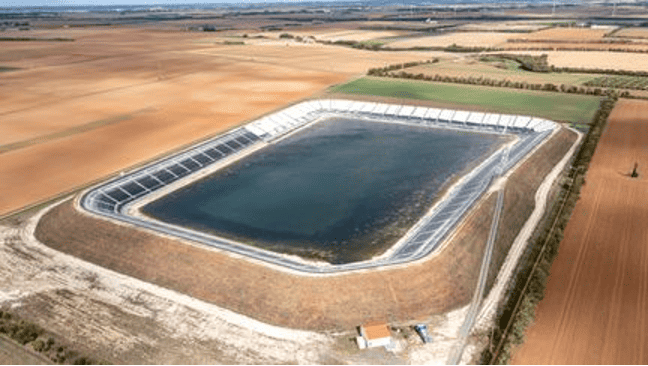
The other (!) judicial development of the week concerns mega-basins, with an administrative judge having just canceled the projects for fifteen water reservoirs in New Aquitaine. The reason cited? "Inadequacy to climate change," but also lack of transparency and the incomplete nature of the ecological impact studies. It is Novethic that speaks about it best.
The trash can of the week is unprecedented: it is space, where you should also not throw your waste just anywhere, otherwise you risk having to pay heavy fines for debris abandonment : the US Federal Communications Commission (FCC) on Monday, October 2, imposed a $150,000 fine on Dish Network for abandoning a satellite wreck in an orbit deemed dangerous. Never before had a space sector company been penalized for such actions.
The hole in the racket of the week concerns ecological planning in the housing sector, according to a Le Monde investigation. It is not the laudable objectives that are questioned, but the capacity to finance them, as " the banks are not there ", even though the majority of spending will have to come from the private sector.
The video of the week shows us a magnificent sphere. No, it's not planet Earth, but the new Los Angeles concert hall. As captivating as it is catastrophic from a sustainable development perspective, this energy black hole, as Le Parisien calls it, is notably composed of one million (!) LED lamps. With its 95,000 MWh consumed per year, the Las Vegas sphere devours the equivalent of the electricity consumed by 20,000 French households in a city the size of Valenciennes. "The Sphere" cost more than 2 billion euros and can accommodate 18,000 people. [Editor's note: it's striking to note that it's the band U2 that is inaugurating the Sphere – we know the strong commitments of its famous singer, Bono, who is very present in the promotion of impact investing…]
The miracle solution of the week for the energy transition will not be… for a long time. Indeed, hydrogen has many virtues, but not that of being easy or inexpensive to transform into truly "clean" energy, according to this Le Monde investigation. Hydrogen is nonetheless interesting, but on a horizon of three or four decades, we are told.
The European summit of the week took place yesterday in Granada. In the greatest discretion, due to the cancellation of the press coverage that was to be associated with it. The debates do not seem to have advanced as much as hoped. Too bad, especially if we follow the author of this opinion piece published in Le Monde, who called on the summit participants (27 heads of state or government) to seize the opportunity to reaffirm their commitment to the Green Deal, as it is being increasingly contested in some states, to the point of delaying the scheduling of certain texts, on pesticides and biodiversity, in particular.
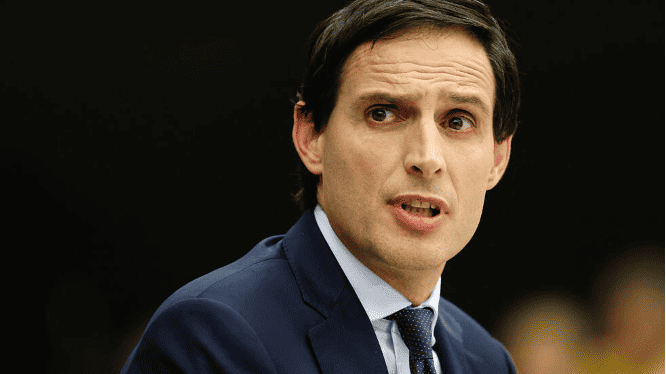
Still on Europe, with the appointments of the week, which were not simple. Les Echos recount how the two future pilots of the Green Deal failed their final oral exam before the European Parliament. Auditioned on Monday and Tuesday, Maroš Šefčovič, proposed to pilot the Green Deal, and Wopke Hoekstra, who is to become the EU's "Mr. Climate," failed to muster a two-thirds majority in their favor. But they passed the written makeup exam, Novethic specifies. It must be said that "Mr. Climate" has two "complicated" lines on his CV, having worked for Shell but also for McKinsey 😉.
The progress report of the week was presented by Christophe Béchu: the water plan is… halfway 😉. The implementation of its measures is progressing slowly, judge Les Echos, while Libération prefers to give voice to experts who denounce " a catalog of non-structuring mini-measures".

The fiasco of the week comes from the United States and concerns the recycling of plastic waste, with a major Bloomberg investigation that did not go unnoticed. The process is becoming fashionable, for NGOs and some media: discreetly including GPS-type electronic chips and embedding them in clothing or, here, plastic waste, to see what really happens to these "chipped" objects. In this case, at least 40% of the plastic waste duly stamped by Coca-Cola, Nestlé, Amazon, and more than 500 brands ended their sad lives in… landfills, therefore far, very far, from the proclaimed recycling ambitions. This leads Novethic to say that the plastic recycling of these companies failed in the United States..
The riddle from last week allowed us to recall that, at (RE)SET, we love to get our hands dirty under the engine hood. But which engine was it? The dominant green color in the photo was a clue.
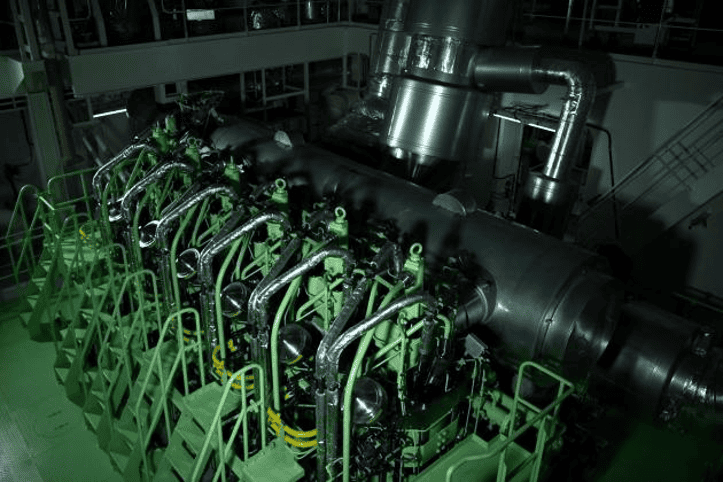
It's the engine of the world's first container ship running on bioethanol, the "Laura-Maersk," Danish, recently christened in the presence of its godmother, the President of the European Commission, Ursula von der Leyen, campaigning to defend her European Green Deal.This week's riddle is a measurement: "4805.59 meters". It also made news headlines. What is it about? Clue: we're talking more about height here than length!