It's a spectacular start to the school year for the economic and environmental transition in general and (RE)SET in particular! Let's start with the most important: (RE)SET, therefore 😉. Sharpened pencils, overloaded schedules, this is our fourth back-to-school season, with a bang! Before, (RE)SET's growth was "Fast." Now, it's Fast and Furious + Angry Hulk + Lethal Weapon + Mission Impossible in a loud and thundering green blockbuster! Action movies, because (RE)SET is all about: ACTING to win the battles of the transition, for the benefit of all, and first and foremost for our cherished clients and partners. The (clean) rocket mode is engaged! In five years, the Palais Royal esplanade will be too small to accommodate us 😁.
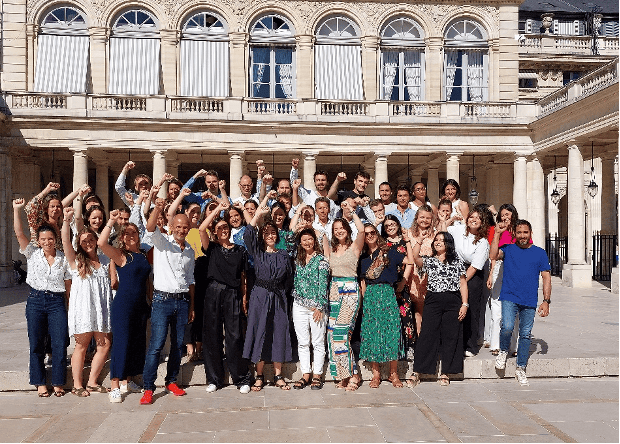
As you noticed in the photo, even (RE)SET's superheroes struggle to bear the intensity of the sun. It must be said that "Climate collapse has begun." UN Secretary-General António Guterres has a knack for finding weighty words, those that have an impact, if not on the climate, at least on the media and public opinion, which is useful for putting pressure on governments. The shocking phrase made an impression:
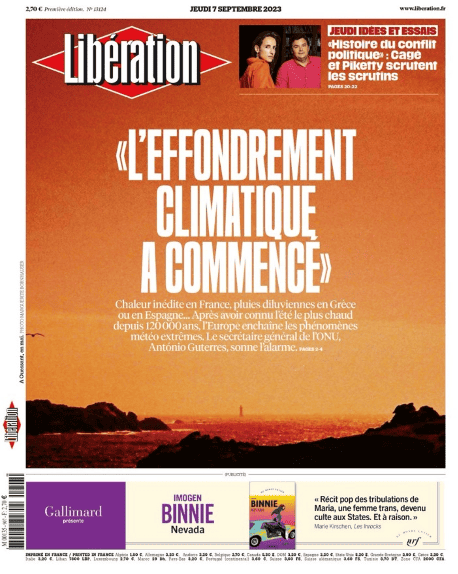
The UN chief was commenting in his own way on the chilling announcement from the European climate observatory Copernicus: June, July, and August were "the three warmest months in about 120,000 years, that is, since the beginning of human history." At least things are clear. Should we therefore speak of climate collapse? No, answers Emilie Crémin, associate researcher at the University of Glasgow, who continues: "if the term 'collapse' is initially used by biologists working on biodiversity collapse, the expression does not apply well to climate, because it does not collapse, it changes." Indeed, António Guterres's phrases are not borrowed from the vocabulary of scientists, which sometimes surprises, but rather from that of politicians. And from a media perspective, we can only be pleased: a statement from the UN chief probably has as much impact on public opinion as an IPCC report…
To return to France and finish with the weather (until next week, probably), here too, "never has a back-to-school season been so hot", even TF1 noticed. Consequently, Paris is experiencing an ozone pollution peak, as everything is connected… But Île-de-France is not alone in suffering from this late heatwave; records are following records, everywhere.
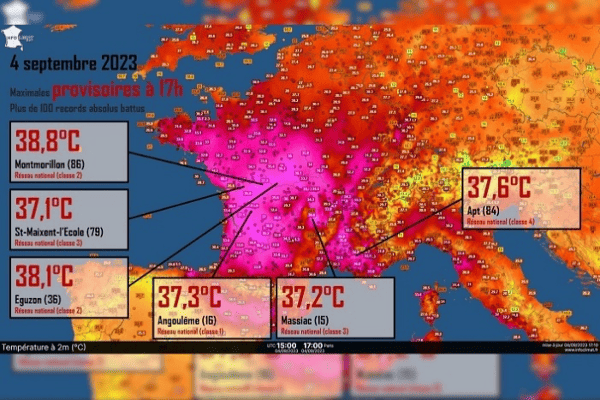
An atmosphere that perhaps reinforces the media's impatience; several have noted that we are still waiting for the great presentation of national ecological planning. Les Echos mention a political blind spot of the back-to-school season while Libération stigmatizes the wavering that regularly postpones the long-awaited Ecological Planning Council meeting. It must be said that there will be budgetary consequences, and the Finance Bill is looming. The newspapers suggest that the General Secretariat for Ecological Planning has worked well but that the result is "difficult to communicate, that we need to find the right words." Perhaps we should ask António Guterres for help 😉. Meanwhile, we recommend that some government members, and not the least, avoid taking flights for 36-minute journeys, it's awkward, in the context.
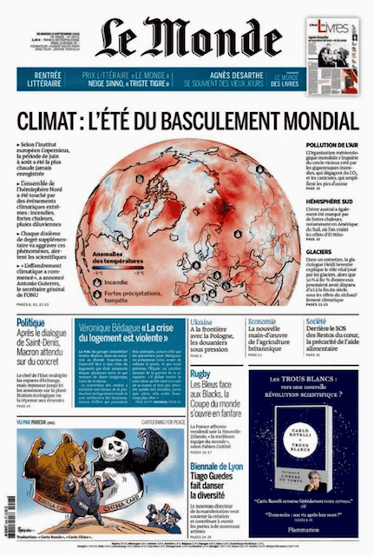
Another atmosphere further south, in Kenya, where the first "African Climate Summit" was held, with real issues addressed. In this country, a drought of unprecedented intensity in forty years has decimated livestock, wildlife, and plunged nearly 4 million people out of a population of 50 million into hunger. Le Monde aptly quotes one participant who recalls that "no one disputes that Africa, which is in no way responsible for global warming, is the continent that suffers the most from it" . Kenya is moreover a model country on this continent, with 90% of its electricity coming from renewable energy. A success all the more notable because according to the latest IEA report, published Wednesday, Africa (20% of the world's population) attracts only 3% of global energy investment. Even though more than 40% of this continent's population still awaits access to electricity. Figures to remember sometimes to understand where the real problems and priorities are… The summit gave birth to the request to create a global tax on carbon emissions, "including a tax on the trade of fossil fuels, air and sea transport." This, to which could be added "a tax on financial transactions," would "provide dedicated, affordable, and accessible financing to invest in large-scale climate projects, without drawing on [domestic] resources and without suffering undue influence from geopolitical and national interests." Enough to fuel the discussions of the next COP 28, this coming November, which we recall will be held in Dubai, a country particularly unfavorable to this type of tax. Also enough to fuel, no doubt, the debates of the next "Olympic Sustainable Development Summit" in Paris next summer.
Let's move on to our weekly sections, starting with the outburst of the week, delivered to Les Echos and France Info by glaciologist Jean Jouzel. A generally calm scientist, to the point of having been invited by MEDEF to its summer university, he found himself debating with the CEO of TotalEnergies. As he tells Les Echos: "Faced with the inertia of decision-makers, in the end I'm fed up", he repeated on France Info to make sure he was understood, taking a swipe at Patrick Pouyanné, who explained to him "why he was going to continue as before".
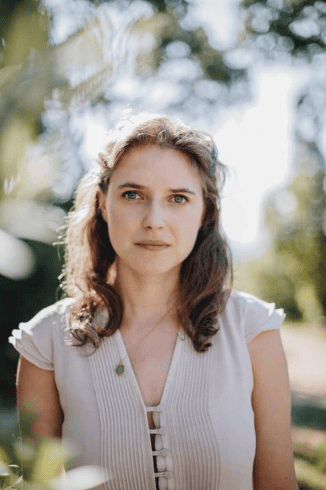
The portrait of the week is dedicated to "the next generation," to use Le Monde Campus's expression, which explains that Paloma Moritz embodies it well, at the head of the environment section of "Blast." She describes herself as "committed but not activist", which suits us well at (RE)SET.
The big bang of the week is in sight in the world of trash cans, but it is late, Les Echos explain, detailing the difficulties – and costs for the various actors – of the upcoming introduction of food waste sorting.
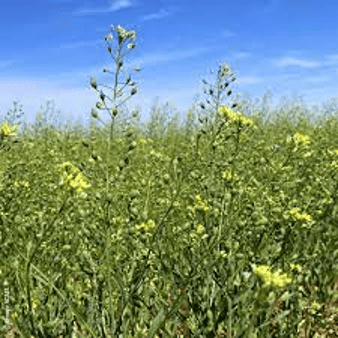
Les Echos still extol the virtues of the miracle plant of the week, in the wildest dreams of the aviation sector. Camelina, its sweet name, has the virtue of being able to be "relatively easily" transformed into biofuel. The first hectares (3.5, to be precise) have just been planted in France. A comfortable area for a children's park, but according to Les Echos' calculations, 550,000 hectares would be needed to even approach the sector's modest targets (2% biofuel for aviation by 2025…). The dream seems distant.
Since we are in the aviation sector, let's stay there with the lobbying of the week : that of the aviation sector against new taxes. The government would like to introduce new levies to finance the rail plan and the energy transition, which aviation actors refuse. Airport managers and airlines, targeted because of their responsibilities in global warming, are vehemently opposed to any increase in their taxation. "This is a source of concern and misunderstanding for the sector," laments Thomas Juin, president of the Union of French Airports (UAF), who would find "fairer and more coherent for train travelers to contribute to the rail financing plan rather than air passengers, who will already have to finance the energy transition" of the sector. At a time when the idea is rather to reduce train fares to bring them closer to those of planes, the UAF's suggestion will have difficulty convincing…
Especially since the discovery of the week (and of previous weeks) keeps us in aviation, with scientists beginning to understand and measure the intensity of pollution linked to condensation trails. For several years, scientists from around the world have been taking a close interest in the non-CO2 effects of air transport. That is, aviation pollution other than that related to carbon dioxide emissions. "Two-thirds of the global warming caused by aviation have their source in these non-CO2 effects," according to some experts quoted by Le Monde. "Within these effects, it is condensation trails that have the most important and most visible impact" on the environment, notes Matteo Mirolo, sustainable aviation specialist at the NGO Transport & Environment. Contrail are formed at the exit of engines by the condensation of water around the soot released into the atmosphere after kerosene combustion.
The thorny issue of the week is, once again, plastic and how to integrate it, or not, into the global transition. Le Monde published several articles, including this one, titled "humanity still without solution" – particularly defeatist and fatalistic. In this area where (RE)SET has some legitimacy to speak, having notably helped to establish in France the first consortium on the major issue of plastic in packaging (nearly 40% of plastic demand in Europe, as Le Monde recalls), reality does not lend itself well to excessive simplification. Indeed, substitute products already exist, at least in some areas. In others, much more demanding, alternatives, bio-based or not, are developing rapidly. In truth, the technology is there, the engineers are too; what is most often lacking is the will to act 😉. You don't catch up in a few years on decades of fruitful R&D in plastics processing, tens of billions spent developing and refining the qualities of this flexible, resistant, impermeable, docile (except for recycling 😉), transparent material… It takes time and, above all, money. R&D of course, but also heavy investments, modifications of factory lines, the establishment of collection and sorting networks… This therefore requires strong investments over time. The future international treaty aimed at ending plastic pollution will give, we hope at least, a boost to these investments, especially if it is accompanied by dissuasive and enforced sanctions. Le Monde's article has a horizon of 2060. In 37 years. By then, let's bet, given current progress, that a good part of the problems related to plastics – at least "new plastics," then we will have to continue dealing with the existing stock for a long time… – should be resolved, if we make the effort.
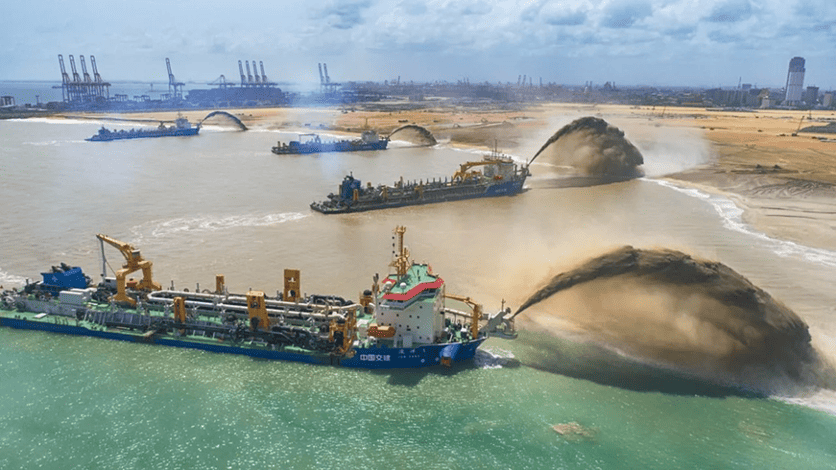
Which brings us to the resource of the week, which tends to slip through our fingers. Sand, therefore. The United Nations denounces its global overexploitation, Les Echos report, to the point, according to Le Monde, that this formerly abundant key resource is becoming scarce: each year, six billion tonnes of sand are extracted from the marine environment. In Belgium, it's simple: there is no more exploitable sand!
Dedicated to another essential resource, which is dear to us at (RE)SET, water is the subject of the weighty report of the week, published by WWF. Without excessive surprise, we read that three-quarters of groundwater tables in Europe are below their normal level and that nothing suggests this will improve, except by taking drastic measures to limit its consumption. Regarding water transition, Bruno Bonnell, Secretary General for Investment, wrote a column this week in L’Opinion highlighting the central role of public authorities and announcing the launch of a call for projects: "Pumping a liter of water from the ground costs 60 times less than using a liter of recycled water. Why invest? The State must therefore limit the financial risk of private initiatives, while stimulating an economic sector to create new businesses. That is the whole ambition of 'Innov Eau,' a call for projects with 100 million euros dedicated to players innovating for the water transition."
If that doesn't work, we can always pray, perhaps, since water is at the center of the Catholic Day for the Protection of Creation, La Croix reminds us !
On the animal biodiversity side, this week's predator is the wolf, against which the President of the European Commission clearly has a bone to pick, Libération tells us. Indeed, the reintroduction of the wolf has worked a little beyond expectations, in some regions, to the point that it has become a danger to other animals, including sheep, shepherds argue. The controversy is not new but is heating up quickly, as packs multiply. Europe is seriously considering reversing some of the protections enjoyed by wolves. The President of the European Commission herself had a bad experience with a wolf: in September 2022, one entered an enclosure on the von der Leyen family property in northern Germany and killed her old pony, Dolly. Bad choice!
Regarding predators (we're joking!), banks were the object of the climate stress test of the week, under the leadership of the European Central Bank (ECB). If they don't prepare better and if the Paris Agreement targets are not met (a certainty for everyone), the financial sector could lose up to 21 billion euros per year. Here as elsewhere, it is the lack of responsiveness that is the cause. The ECB puts it very well, with this quote that will not surprise any attentive reader of Breaking (RE)NEWS: " procrastinating may be easier and cheaper today, but it implies paying a higher price tomorrow". The stress tests nevertheless conclude that in all scenarios, even the most optimistic, the economy will suffer from climate impact, companies will lose profitability, and banks will suffer more losses. There, it's said. There was no answer to last week's riddle, because there wasn't one (!), but this time you will have to show sagacity to answer this question: what is this pretty flower doing in Breaking (RE)NEWS? As a clue, only one number: 423 billion dollars per year.